
Scientists tracking migration to learn more about virus, birds
CHRIS PETERSON | Hagadone News Network | UPDATED 17 years, 4 months AGO
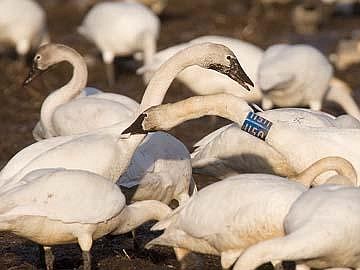
Tundra swans squabble during their migration through the Flathead Valley recently. You can track their progress en route to Alaska online. A banded swan is pictured. (Chris Peterson photo)
Chris Peterson is the editor of the Hungry Horse News. He covers Columbia Falls, the Canyon, Glacier National Park and the Bob Marshall Wilderness. All told, about 4 million acres of the best parts of the planet. He can be reached at [email protected] or 406-892-2151. | April 16, 2009 11:00 PM
A couple of weeks ago, fields south of Columbia Falls were filled with tundra swans, making their slow trek north.
The swans are largely gone now, but you can still track their progress as they head toward Alaska.
See, at least a few of them are implanted with radio transmitters and others are wearing neck collars. The tracking is part of a U.S. Geological Survey effort to track tundra swan movements across the United States.
Swans can carry avian influenza virus. While the virus isn't common in North America, it has had a significant impact on bird populations in Europe and Asia, noted USGS scientist Craig Ely.
There is some concern that swans in North America could get infected. Some populations migrate to Asia as do pintail ducks, and their breeding grounds can overlap with Asian birds. Pintails are often seen with swans, as are wigeons, another duck species. (Hundreds of pintails were migrating with the swans in the Flathead.)
So far, however, swans in North America have not been infected with the virus and even if they do get infected, there's not much that can be done to stop it, Ely noted.
What scientists can do, however, is warn domestic fowl owners and the general public in the event an outbreak occurs. One strain of the virus, known as H5N1 killed thousands of domestic and wild birds in Asia in 1997 and can infect and kill humans.
Beyond avian flu, the tracking program also hopes to look at swan genetic populations and differences.
Swans fly in distinct migrations — some go to the east coat, some the west coast and others don't migrate much at all.
The swans that were here in the valley started their migration from central California and are slowly working their way north where they'll breed in western Alaska.
The northern Alaska tundra swan population is distinct from the western population. It migrates to the east coast. Why different populations migrate to different regions is still a mystery, Ely notes, but migrations are based on thousands of generations of learned behaviors.
The Pacific population of tundra swans in total is about 90,000 birds. Tundra swans can also be confused with trumpeter swans, which are larger and less common. The Pacific flyway of trumpeter swans is about 11,000 birds.
To track the swans, go to the direct link at: http://alaska.usgs.gov/science/biology/avian_influenza/TUSW/index.html.
ARTICLES BY CHRIS PETERSON
Grizzly sow with cub had dead whitetail cached nearby when attack occurred
Montana Fish Wildlife and Parks released more details on a bear attack in the Cedar Flats area on Aug. 31, noting it was a grizzly sow with a cub and there was a cached whitetail deer carcass about 100 yards off the trail near the incident.
Study: When a bear fights a dog, women more likely than men to step in
People walking their dogs in bear country shouldn’t rely on Fido to be an early warning system or come to their aid in an attack, a new study suggests.
Enjoy huckleberries? Thank a bumblebee
If you’ve ever savored a huckleberry, you can probably thank a bumblebee for it. Turns out hucks are one of the favorite plants to pollinate, as they provide an early spring food for bees, according to recent research by the U.S. Geological Survey.