
BP faces another setback
Adam Geller | Hagadone News Network | UPDATED 15 years, 9 months AGO
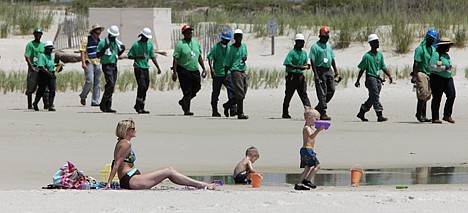
<p>Mary Smith of Theodore, Ala., watches over her grandchildren as a large crew of clean up workers walk along the beach in Dauphin Island, Ala., Wednesday, June 2, 2010. Oil from the Deepwater Horizon disaster has started washing ashore on the Alabama coast. (AP Photo/Dave Martin)</p>
PENSACOLA, Fla. - The BP oil slick drifted perilously close to the Florida Panhandle's famous sugar-white beaches Wednesday as a risky gambit to contain the leak by shearing off the well pipe ran into trouble a mile under the sea when the diamond-tipped saw became stuck.
BP engineers will turn to giant shears to slice off the leaking pipe, said Lt. Commander Tony Russell, an aide to Coast Guard Adm. Thad Allen, the government's point man for the crisis. The saw had sliced through about half of the pipe when it snagged, and it took BP 12 hours to free it. The company said it hoisted the saw back to the surface after finally yanking it out of the pipe.
The plan is to fit a cap on the blown-out well at the bottom of the Gulf of Mexico to capture most of the spewing oil; the twisted, broken pipe must be sliced first to allow a snug fit. The company had said preparations were being made to resume cutting, but didn't give a timetable. The shears have already been used to slice off another part of the riser, but crews hoped to use the diamond saw to get a finer cut so they could use a dome that would fit the pipe more snugly.
"I don't think the issue is whether or not we can make the second cut. It's about how fine we can make it, how smooth we can make it," Allen had said earlier.
As the edge of the slick drifted within seven miles of Pensacola's beaches, emergency workers rushed to link the last in a miles-long chain of booms designed to fend off the oil. They were slowed by thunderstorms and wind before the weather cleared in the afternoon.
Forecasters said the oil would probably wash up by Friday, threatening a delicate network of islands, bays and white-sand beaches that are a haven for wildlife and a major tourist destination dubbed the Redneck Riviera.
"We are doing what we can do, but we cannot change what has happened," said John Dosh, emergency director for Escambia County, which includes Pensacola.
Allen said more staff, boats and helicopters were sent to the eastern Gulf Coast as the slick spread, including a cutter in Mobile Bay, Ala., and one off Pensacola. The boats will help skim oil and add more boom to collect it. Four helicopters would help skimmers spot threatening oil.
Since the biggest oil spill in U.S. history began to unfold April 20 with an explosion that killed 11 workers aboard an offshore drilling rig, crude has fouled some 125 miles of Louisiana coastline and washed up in Alabama and Mississippi as well. Over the past six weeks, the well has leaked anywhere from 21 million to 45 million gallons by the government's estimate.
The latest attempt to control the leak is considered risky because slicing away a section of the 20-inch-wide riser could remove kinks in the pipe and temporarily increase the flow of oil by as much as 20 percent.
If the strategy fails - like every other attempt to control the leak 5,000 feet underwater - the best hope is probably a relief well, which is at least two months from completion.
ARTICLES BY ADAM GELLER

Olympics delayed as US nears a deal on $2 trillion in relief
NEW YORK (AP) — The Tokyo Olympics were put off to next year as coronavirus deaths and infections surged in Europe and the U.S. on Tuesday, with New York warning it is about to get hit by a “bullet train." Stocks soared as Washington lawmakers closed in on a nearly $2 trillion deal to help businesses and ordinary Americans pull through the crisis.

As pandemic spreads, China's ex-epicenter down to 1 new case
MADRID (AP) — The battle to contain the coronavirus reached new urgency, as more governments locked down borders and ordered new closures and restrictions and pleas went out to funnel masks and ventilators to places struggling with soaring numbers of sick patients.

Italy expands lockdown, Israel tightens entry to halt virus
SOAVE, Italy (AP) — The battle to halt the coronavirus brought sweeping new restrictions Monday, with Italy expanding a travel ban to the entire country, Israel ordering all visitors quarantined just weeks before Passover and Easter, and Spain closing all schools in and around its capital.