
At home in America
BILL BULEY | Hagadone News Network | UPDATED 15 years, 9 months AGO
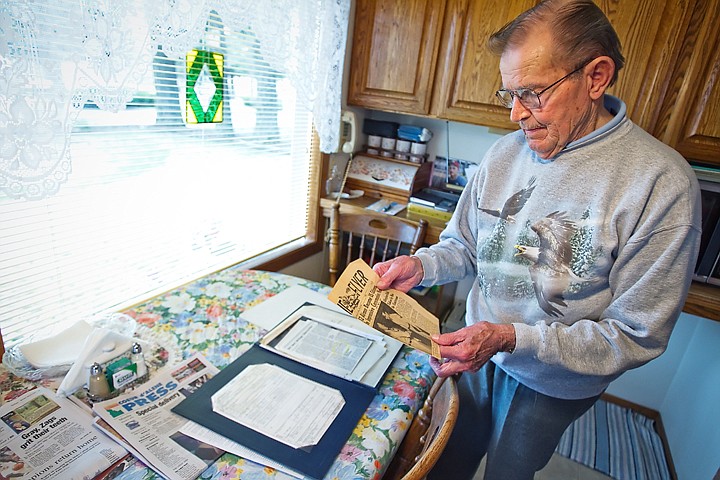
<p>Johann Schalk, of Dalton Gardens, looks over a 1954 newspaper article written about the day he became an American citizen at his home on Monday.</p>
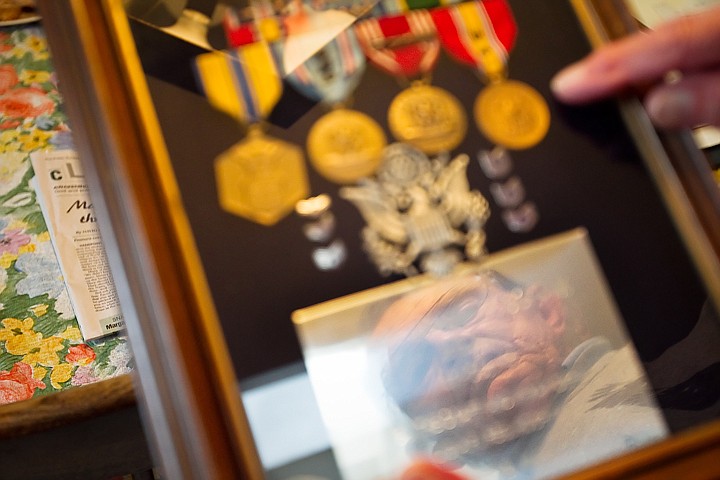
<p>Johann Schalk, who came to American from Germany after World War II, is reflected in a case displaying medals that he earned while in the United States Air Force.</p>
Bill Buley covers the city of Coeur d'Alene for the Coeur d’Alene Press. He has worked here since January 2020, after spending seven years on Kauai as editor-in-chief of The Garden Island newspaper. He enjoys running. | March 12, 2010 8:00 PM
DALTON GARDENS - On June 25, 1954, Johann Schalk became an American citizen.
To prove it, he produces a newspaper article with a headline, "12 airmen become U.S. citizens."
"That was a good day," the Dalton Gardens man says with a German accent.
Today, the 82-year-old lives in his Orchard Avenue home with his companion and canine, Buddy. The retired X-ray technician likes his quiet lifestyle in a well-kept, cozy home. He misses his wife, Gwendolyn, who passed away in 2005 after 48 years of marriage.
He displays a picture of their military wedding taken in 1957. There is a young, handsome man wearing a bow tie and a perfectly fitting suit, and a beautiful brunette smiling as she holds flowers. They are clearly happy together.
"We didn't quite make 50," the father of three says sadly. "My wife was my big shoulder to lean on."
His demeanor brightens a few minutes later when he holds a glass case of military ribbons and medals he earned during his 20 years with the U.S. Air Force.
There's one for good conduct, an Air Force Accommodation medal, one for national defense. It is an impressive collection that Schalk takes pride in.
"That's what I received in my military career," he said.
Career achievements aside, it's the story of how Johann Schalk came to America, of the Germany he left behind, that when asked, he'll tell.
Growing up
Schalk was born April 11, 1927, in Langen, Germany.
As he grew up, he discovered that jobs and money were difficult to come by, the country stuck in a depression since its defeat in World War I.
"As a kid over there in Germany, I knew nothing but bad times," he said
There were 12 people in his family - six boys, six girls. Come Christmas each year, they received a gift package from the government.
"Any family with four kids or more got Christmas presents," he said,
That's one of the ways Hitler built up the country, developed loyalty and gained a following - that and the threat of imprisonment, beatings or death if you didn't fall in line.
"Of course, the Nazis came in and took the whole thing over," Schalk said. "The people were misled."
When Schalk was 12, he was sent to a camp to determine which branch of military he might be best suited for later on. For one exercise, he found himself crawling through a muddy field - which fortunately led to him catching pneumonia and he was sent home.
Life was better as the Wehrmacht rolled to victories early in World War II. But when the war stretched on and Hitler's war machine faltered, the suffering of Germany's citizens increased.
Schalk pulls out a scrapbook with a 1939 picture of the town of Bremerhaven, not far from Langen and where he worked during the war. The street is filled with people and cars. Homes, buildings and churches stand strong.
Then he shows one of May 1945. Much is destroyed. Buildings turned to rubble. Cars crushed. Streets shattered.
"This is what's left over. 612 people got killed in that raid."
That raid. It almost got Schalk, too.
Employees at the plant where he worked in Bremerhaven sometimes had to take night watch duty. One of Schalk's supervisors marched up to him a half hour before quitting time and said, "You've got night watch."
"No I don't have any food, I have nothing with me," Schalk answered. "I just had a shift."
"You have it anyhow," his boss said.
"No, I don't," Schalk said, and then left for home.
Good thing.
That night, Bremerhaven was leveled by British bombers and burned three days and nights.
"Britain bombed at night, Americans in the day," Schalk said.
Schalk said incendiary bombs set the place on fire the night of the raid.
A second wave came over and dropped jelly bombs. A third dropped canisters that exploded about 200 yards above the city, raining down gasoline and phosphorous.
"They had firestorms up there you wouldn't believe," he said. "That was something to see."
"Flames went everywhere, nothing was left," he continued. "It was a like a cremation."
The next day, teens like Schalk grabbed shoeboxes and went out to pick up shrapnel and remains of anti-aircraft fire.
"All of us had souvenirs," he said.
Had the war lasted another month, Schalk said he would have been forced into military service for Germany.
"They would have come to get me," he said.
One of his brothers who was in the military came home when he was 17 after being wounded, then sent back out to fight more.
Schalk's family never saw him again.
After the war
When World War II ended, conditions were desperate in Germany. Schalk had graduated from a trade school in Germany with plans to be a machinist.
"There was no work. There was hardly any food," he said.
An American military radio station and a barracks were established about two miles apart near Schalk's home. As American soldiers walked from the station to the barracks, Schalk came to know some of them because they would pass by his home.
Eventually, he got an offer to work in the kitchen at the barracks, which meant three meals a day for the hungry young German. Soon, he was assigned to the dispensary.
"That's when my medical career started," Schalk said. "The first thing I know I'm driving an ambulance."
He worked for six and a half years at the American outpost, even saving two American soldiers involved in a crash on July 4 by rushing them to a German hospital.
"When I dropped them off I asked the doctor, 'Please take care of them.' He gave one look and said, 'We will try.'"
He learned the English language, before deciding this: He wanted to live in America. His passport is stamped Aug. 1, 1951.
He was 24 years old when he arrived in New York aboard the Gripsholm, the sister ship of the Stockholm, in March 1952 after a 10-day trip from Germany.
"We had two inches of snow and ice all over the boat," he said.
He recalls coming into the harbor and seeing the Statute of Liberty.
"I seen the lady standing there, I read a lot about her. I said 'Oh, that's going to be my new country.'"
He was glad to leave behind a life in Germany where he had endured war, hunger and poverty.
"The only thing I missed was my family," Schalk said. "I came over to a pretty different life."
He never ran into any problems being a German native living in America.
"There was a lot of people in New York. Most came from Germany and Italy," he said.
He spent six months working in a hospital in New York before the Korean War broke out and the U.S. draft came calling - and he wasn't even a U.S. citizen yet. Still, when they saw he had medical and X-ray experience, he was stamped class 1A and sent to an Air Force base in Syracuse, N.Y.
He would spend 20 years in the military doing medical research and X-ray work. His duties would take him to Craig Air Force Base in Alabama, the Philippines, Westover Air Force Base in Springfield, Mass., Newfoundland and finally, Fairchild Air Force Base.
Schalk retired in 1972 - but not for long.
"They didn't want to let me go, so they asked me, 'Do you want to stay as a civilian?'" he said.
He did four more years of civil service work before moving to Coeur d'Alene, where he would work another 13 years for Radiology Association of North Idaho.
Today, really retired, he's a craftsman, a man of many talents. In his garage, he makes fly ties and fishing rods. He shows off canes and baskets courtesy of his handiwork.
He continues his mastery of English by circling words in newspapers and books when he doesn't know their meaning, then looks them up in the dictionary.
"I'm always learning," he said.
His German accent still comes through when he talks about his experiences, his wife, his children and five grandchildren.
He would change nothing. The good, he says, far outweighs the bad.
"If I had to do it all over again, I would."
Johann Schalk speaks of simple lessons he learned in life. He often refers to respect, love, honesty.
In all his 82 years, in the war and death and despair he saw, he is sure of this:
"We must get along together."
ARTICLES BY BILL BULEY

Companions Animal Center has adopted out nearly 2,000 dogs, cats in 2025
Companions Animal Center has adopted out nearly 2,000 dogs, cats in 2025
As if to prove it, signs on two kennel doors proclaim “I have been adopted! I’m currently waiting to be picked up by my new parents.” One is a timid black mastiff. But the shelter remains crowded. Monday, it has about 50 large dogs filling kennels, including in the new wing oped this year, and there is still a four-month waiting list with names of about 80 dogs that people are looking to surrender pets.
Post Falls man named director of ministry with global reach
Post Falls man named director of ministry with global reach
Grassi, a longtime hunter and fisherman, started what was originally called “Let’s Go Fishing Ministry, Inc.” with a focus on outdoors, men and God. It was later changed to “Men’s Ministry Catalyst." The emphasis was on helping men understand their role as defined in the Bible.
Nonprofit foundation helps family become homeowners for first time
Nonprofit foundation helps family become homeowners for first time
The Young Family’s Foundation launched about a year ago with a mission "to empower young, hardworking families to achieve the dream of home ownership. Even if a family saved $25,000, they would still be $19,000 short of the down payment needed to buy a $550,000 home, which is the median price in Kootenai County. It’s estimated that only about 20% of area households can afford to buy a home.