
Arab nations back indirect peace talks with Israel
Hadeel Al-Shalchi | Hagadone News Network | UPDATED 15 years, 11 months AGO
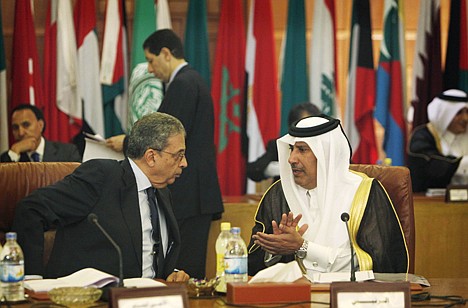
<p>Arab League Secretary General Amr Moussa, left talks with Qatari Prime Minister Sheikh Hamad bin Jassem al-Thani during an Arab League foreign ministers meeting at the Arab League headquarters in Cairo, Egypt Saturday, May 1, 2010. The Palestinians are seeking the Arab League's backing Saturday to resume peace talks with Israel through a U.S. mediator. (AP Photo/Nasser Nasser)</p>
CAIRO - Arab nations on Saturday endorsed indirect peace talks between the Palestinians and Israelis, a move that likely paves the way for the start of long-stalled U.S.-brokered negotiations.
The United States has proposed the talks to end the impasse between Israelis and Palestinians over the conditions for resuming negotiations, which broke down more than a year ago amid Israel's military offensive in the Gaza Strip.
The green light from Arab foreign ministers comes after a first attempt to get indirect talks going collapsed in March when Israel announced a new Jewish housing project in east Jerusalem. The Israeli decision enraged Palestinians, who claim east Jerusalem as a future capital, and drew fierce criticism from the United States. It also led to the worst rift in years between the U.S. and Israel, Washington's closest Mideast ally.
Palestinian President Mahmoud Abbas has signaled that he is willing to resume negotiations, but has been waiting for approval from Arab countries, which would provide Abbas the political cover he needs to return to talks.
Arab League chief, Amr Moussa, stressed Saturday that the league would be keeping a close eye on the talks, and said there will be no transition from indirect to direct negotiations. Arabs want a total freeze in settlement building before returning to direct talks.
This is the second time Arab states have backed indirect negotiations with Israel; the first time was in early March. The Arab foreign ministers expressed reservations Saturday about backing the talks again, and warned that peace efforts would collapse if Israel continued to build settlements in east Jerusalem and the West Bank.
They also said they wouldn't endorse an extension on the four-month window they originally gave the talks in March, a decision that leaves the U.S. only two months to make headway in the shuttle negotiations.
Syria and Lebanon rejected the decision, saying the U.S. had not provided adequate safeguards needed to renew negotiations.
There was no immediate comment from Israeli officials.
Palestinian President Mahmoud Abbas told reporters Saturday in Shanghai, China, that the Palestinians' executive committee will meet soon to make a final decision on resuming talks.
He also confirmed reports that he will visit Washington later this month for talks with U.S. officials "to push the peace process forward."
On Friday, U.S. Secretary of State Hillary Rodham Clinton said the talks would start next week, and U.S. Mideast envoy George Mitchell is expected back in the region soon.
The negotiations will not be the face-to-face meetings the Obama administration had hoped to put in place more than a year after peace efforts broke down amid Israel's military offensive on Hamas-ruled Gaza.
The Palestinians have refused to sit down at the same table with Israel until it agrees to freeze all construction in West Bank settlements and in east Jerusalem - two areas that the Palestinians want for an independent state along with the Gaza Strip.
ARTICLES BY HADEEL AL-SHALCHI
As unrest sweeps Egypt, president refuses to quit
Mubarak accuses protesters of plotting to destabilize nation
CAIRO - In his first response to the unrest sweeping his nation, Egypt's president fired his Cabinet Saturday and promised reforms but refused to step down, setting the stage for perhaps even heavier street battles with protesters calling for an end to his nearly 30 years in power.
Heavy gunfire rings out in Cairo protest square
CAIRO - Bursts of heavy gunfire rained into Cairo's Tahrir Square before dawn Thursday, killing at least three anti-government demonstrators among crowds trying to hold the site after a dramatic assault hours earlier by supporters of President Hosni Mubarak, according to a protest organizer.

Qatar becomes 1st Arab country to fly over Libya
NATO preparing to take control of some operations
TRIPOLI, Libya - Fellow Arab and African nations raised the international pressure Friday on Libyan leader Moammar Gadhafi, with tiny Qatar flying the Arab world's first combat missions over his country and the African Union imploring him to move toward democratic elections.