
More than just a game
Ali Bronsdon | Hagadone News Network | UPDATED 15 years, 4 months AGO
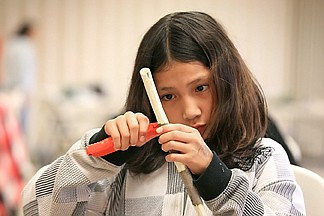
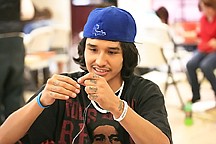
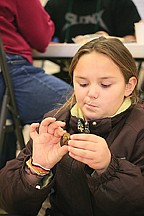
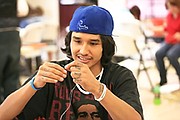
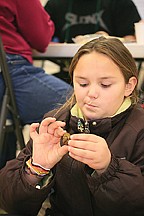
PABLO — Piles of long wooden sticks, buckets of sand, string, skins, rocks, paints, needles and beads… all were materials scattered across the tables and floor of the Joe McDonald Health and Fitness Center cafeteria Thursday and Friday in Pablo. Instructors with the International Traditional Games Society, based in Great Falls, visited the college for a two-day workshop that highlighted 63 traditional Native games from all across the country. Teachers, students and family members from Arlee to Elmo participated in the certificate program, which required them to study the complete curriculum of each game: it’s rules, equipment, stories and songs. Then, it was time to make all the pieces from scratch and play.
According to Native game instructor Arleen Adams, the whole idea around everything is to get Native games into action for the students. The more culturally relevant things are to students, the more likely they are to participate in school.
“It encompasses math, science, English and history,” she said. “We’ve done studies and most of our Native students would have excelled if they’d had that upbringing and that training.”
The key, she added, to a culturally rich educational experience is for the entire community to get involved in the process.
“It all comes from the community,” she said. “A lot of times our education systems don’t look at the whole community, but with these games, we provide an avenue for teachers to get these different activities into the curriculum.”
Instructors have logged thousands of hours of research and thousands of miles of travel since the program’s inception in 1997 in order to put together the level one clinic held at SKC last week. Longtime ITGS instructor, Richard Horn, said the instruction is an “enormous value” for today’s students because Native games are not merely past times, but instrumental learning tools that originated in survival skills for Native peoples.
“They’re not just games, they’re the complete curriculum of life and survival because it involves everything,” he said. “The games build upon each other into areas that were required necessities in life in ancient times.”
The only ancient culture to play team sports, Native American peoples are communal and instruction on these necessities began in the family unit, often in the form of games. In light of that tradition, the workshop asked qualified teachers to attend with their own children, partners and parents. This way, the whole family learns the background and skills they need to carry on the games for generations. Participants have varied in age from six to 76, Horn said.
“It brings in the whole family unit to learn together, teach together and have time spent together,” Horn said.
In the virtual age of the video game, email and the various online social networks, people both young and old are losing touch with reality. In a virtual world, it is no longer the norm to walk out the back door and see what’s really out there, Horn said. These games, however, can all be created from things in one’s backyard.
“[Today], we are teaching our kids not to know each other,” he said. “You never know that person by emailing, you have to spend time in person. This really goes a long way in strengthening the family, so we encourage kids to be here.”
In fact, some of the program’s best certified instructors are the very young.
“They earn a sense of accomplishment,” Horn said. “Sewing a double ball, learning to use their hands and trust themselves instead of waiting for someone to come by and do it for them.”
All these skills and more made for a valuable experience for the workshop’s participants.
Ozzie J. Old Person, an SKC student from Arlee, said he wants to be a science teacher, and the certificate he earned from the workshop will allow him to share his culture, and the science behind it at schools. When he heard about the workshop during Coffee Hour at the college, he immediately filled out an application to participate.
“I learned how they play them, why they play them,” he said. “I’m learning a lot about Native people, my people, and their history.”
And, he’s having fun.
“It’s a lot more fun than I thought it would be,” he added.
ARTICLES BY ALI BRONSDON
Note from the Newsroom
It won’t be long now. As the days become longer and the sun beats down upon us, working to melt the frozen earth, I can’t help but be warmed inside as I anticipate another summer in the Mission Valley. I know it’s only March, and another big snowstorm wouldn’t be unheard of, but we’re on the up-swing now, and it’s about time.

City adopts parks master plan
RONAN — On Monday night, clear heads and common sense prevailed at Ronan City Hall when the city council approved the Ronan Parks and Recreation Department’s Master Plan, which was presented last month and put to a vote on March 12, earning different results.

New life, new hope, new voice
Indigenous Summer Theater performance brings Dixon storyteller’s play to life