
Breast-feeding counselors can help
Cynthia Taggart | Hagadone News Network | UPDATED 14 years, 4 months AGO
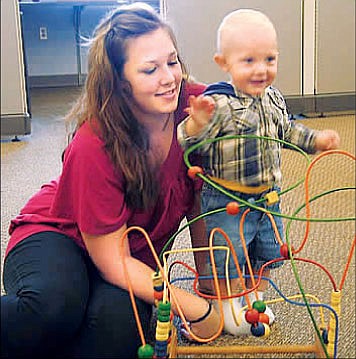
Breast-feeding counselors can help
Justin English was hungry, but his tiny newborn mouth couldn't hold on to his mother's breast. For three days, his mother, Crystal English, tried to breast-feed her new son, resisting the urge to move to infant formula.
Finally, she called Aubrey Howlett, one of two peer counselors with the Women, Infants and Children (WIC) program at the Panhandle Health District (PHD).
"I burst into tears and she told me to come in right away," English said. "She saw the problem and helped me latch him on. I would've never made it without her."
English is one of hundreds of women PHD's breast-feeding peer counselors have helped since the program began in the five northern counties in June 2010. WIC, a federal program, started peer counseling in an attempt to boost breast-feeding rates among women on WIC and to increase the length of time new mothers were breast-feeding.
WIC defined peer counselors as women in the community who are currently or had been previously on WIC, which has income-based eligibility requirements, and had breast-feeding experience. Their job was to provide information and support to other mothers.
Pilot programs in several states showed peer counseling resulted in huge increases in the number of mothers who breast-fed. When money became available to states to start peer counseling programs, PHD applied.
"There are so many advantages to breast-feeding," said Shelly Amos, PHD's WIC coordinator. "It lays a foundation for the rest of life. It's a first defense against obesity. I could go on and on."
The U.S. Department of Health and Human Services (HHS) promotes breast-feeding because breast milk is rich in nutrients and antibodies that protect babies. It has the right amount of fat, carbohydrates, water and protein for a baby's optimum growth and development. Breast milk is easier to digest than formula and it protects babies from illness.
HHS maintains that formula-fed babies are at greater risk for asthma, obesity, diabetes, childhood leukemia and Sudden Infant Death Syndrome.
It cites plenty of benefits for mothers who breast-feed: no money or time spent on formula and equipment, stronger bond with baby, lower rates of diabetes, breast cancer, ovarian cancer and postpartum depression.
Howlett breast-fed three of her children and each presented a different problem. She solved them with her own determination and research and the support of her mother. She's helped her friends through breast-feeding problems for years. When the peer counseling position opened at PHD, Howlett knew the job was made for her.
"Most of our moms don't have moms who are involved with them, so I get to be my mom to them," she said.
In prenatal breast-feeding classes, peer counselors teach pregnant women the benefits of breast-feeding for their babies and for them. The peer counselors contact the mothers in the first week after their baby is born and weekly for the first month, at two months and at three months to find out how breast-feeding is working and if they're having problems.
Teryn Helnore of Rathdrum welcomed Howlett's call. Her newborn son Evan was having trouble latching on to her breast.
"She helped me position him and taught me to relax," Helnore said. "I'm so thankful for Aubrey. She's patient and showed me what to do and Evan ended up eating well."
A PHD cell phone enables mothers to reach the two peer counselors for immediate help with their problems. Howlett took 116 calls over three months. Several were from English, who gave birth to Justin on April 15.
English fed her first two children formula. After learning about the benefits of breast-feeding, she was determined to nurse Justin herself. Howlett's help in the first week earned her English's confidence.
"She educated me about smoking without telling me I had to quit," English said. "I quit on my own. Aubrey is there for me. I love her to death."
Education is Howlett's not-so-secret weapon. She reads everything she can find on breast-feeding and formula and shares it with the mothers in her lactation classes and who seek her help. Her goal is to give mothers the tools they need to breast-feed their babies for the first year or more.
"If I can get them through the first month, I can get them through a year," she said.
About 400 pregnant women are on PHD's WIC program at any one time. PHD plans to add a third peer counselor in its Sandpoint office later this year. Visit www.phd1.idaho.gov for information on and eligibility requirements for WIC.
Cynthia Taggart is the public information officer for the Panhandle Health District. She can be reached at [email protected].
ARTICLES BY CYNTHIA TAGGART
Preparing for emergencies is common sense
People in tornado country prepare for disaster. We don't hear about the people who sit out killer tornadoes in underground shelters equipped with emergency supplies of food and water. They're not in the news unless they've lost their homes. Have you ever wondered how people who've lost everything survived to talk about it on the 6 p.m. news?
Maintain septic systems to save big bucks
Septic systems are under-appreciated. Unless you live in a city on a municipal water system, septic systems dispose of all the waste that goes down the drains in your household, small business, church, school, restaurant and more.

Area restaurants go for the gold
PHD gold stars are a sign of high food safety standards
When I go out to eat, I look for a Panhandle Health District gold star on display by the establishment's cash register or in the window. The giant gold star is part of PHD's Award of Excellence in food safety.