
Brad Dugdale: Finances and the future
BILL BULEY | Hagadone News Network | UPDATED 14 years, 4 months AGO
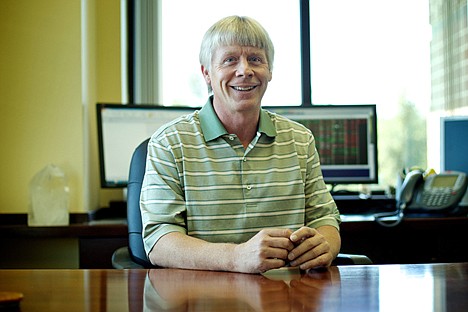
<p>Bradley E. Dugdale, Jr.Êbegan his venture in financial responsibility as a newspaper boy in Montana. He now serves as a financial consultant and senior vice president of D.A. Davidson & Co.Êin Coeur d'Alene.</p>
Bill Buley covers the city of Coeur d'Alene for the Coeur d’Alene Press. He has worked here since January 2020, after spending seven years on Kauai as editor-in-chief of The Garden Island newspaper. He enjoys running. | August 7, 2011 9:00 PM
Brad Dugdale has told the story over and over and over. He loves this story. So here is it again.
To set the stage, he's attending the University of Montana, where he was studying for a degree in finance, which he would earn in 1980.
"I'm taking a finance class in 1978 and it's my first finance class. One of the things we had to do was calculate the formula of compound interest. And so what the problem said was, 'What do you have to do to accumulate a $1 million dollars?' Back then we had these HP 12Cs that were kind of like a calculator that did future value. I'm sitting there and I'm playing the hunt and peck method. At the time, the formula read $85 a month times 12 percent interest for 40 years was a million dollars.
"When that popped up on that screen, I sat there in disbelief. I grabbed someone else's calculator, I thought it was broke. I did the same thing: 85 times 12 for 40 years was a million dollars. And I'm sitting there going, 'You've got to be kidding me. I could have left school right then. For me, that was such a powerful experience."
When Dugdale went home that night, he called his father, Bradley Dugdale Sr., an attorney in Havre, Mont. (who by the way is 75 and has worked at the same law firm since 1965)
"Are you doing this compound interest thing?" he asked his dad.
Anybody, says Dugdale, can figure out how to save $85 a month.
"I think that whole concept drew me to this profession. Now, I get to share the message of compound interest with people. I'm home. I know this is what I should be doing."
Today, Dugdale is senior vice president, financial consultant with D.A. Davidson & Co. in Coeur d'Alene. He has been with the company since 1982.
The 53-year-old is a believer in vision. He's always learning, always willing to try something new. He believes in positive thinking. He welcomes change. Just ask him about the numbers scribbled on his office wall.
The 581 is how many times in a row he bounced a golf ball with a rubber mallet in his left hand. The number 1,030 is a new record for his right hand.
Why does he do this? There is reason to his madness.
It has to do with a book he's reading, "Whole Brain Power," by Michael Lavery.
"Michael developed this whole program that is trying to get people to build the opposite side of your brain. I'm right-handed. He has you start doing things with your left hand. It's actually fascinating. He feels you can grow your brain and most of us let our brains start to atrophy over a period of time."
Brad Dugdale is not about to let that happen. He has too much left to do, starting with saving America from its monetary mess, one person at a time. Just so happens he wrote a book, "Let's Save America! Nine Lessons to Financial Success."
And yes, he believes better days are ahead. A "green period," when the stock market will steadily climb, is coming. Perhaps in three or four years, but it's coming.
When he speaks, you listen, perhaps because he combines passion and enthusiasm with numbers and knowledge.
Dugdale produces a copy of the Investor's Business Daily and turns to page 2, where he points to a little section, "Trends and Innovations" in the lower left corner.
"If you read this segment for the next 30 days, you see all the breakthroughs in technology and healthcare and software, the future that's coming at us is unbelievable," he says.
"Even though we seem to be in this recession, I would not bet against America. I'm telling you, the stuff that is in the hopper, the stuff that is about to come out of the test tube, the medical devices, it's absolutely amazing. There is breakthrough after breakthrough coming to the world, and it's going to change and influence our lives."
Where did your view on life develop?
A guy I met in 1990 named Bob Dunwoody really changed the whole way I view life. This guy was kind of a motivational/philosophical speaker. He has two really famous concepts. One of them is, 'Be, Do, Have.' Figure how who you want to be, do the activities. Interestingly enough, you typically end up having results.
He contends most Americans just want the have part and they don't want to do the activities. Most successful people develop a vision of what outcome they want, they figure out what activities need to be done to produce that outcome and then they end up having the results. As simple as that may seem, it is such a great model to live life. You develop whatever vision it is. It doesn't matter if it's in golf, health, marriage, business. It kind of transcends. You can look at any segment you want in your life and develop a vision for what you want to have happen. Can you stay consistent with the activities?
The other thing he coined this phrase, "sounds crazy, might work."
He studied a lot of successful people, and most are willing to sit there and try things, sounds crazy, might work. It's not uncommon for me to sit there, read a book and try some of these things. I've just had so many different things like that evolve out of trying a different concept and seeing how it works, if that makes sense.
When you were starting your career, what did you see for yourself?
I always had a vision I would be financially successful. I don't know that I knew exactly what that looked like, I think that education played an important role in the process.
When you look back on your life, what comes to mind?
I would say I've been blessed to make some good decisions. We all make certain decisions and you don't know what the outcome will be. I can think of three or four phenomenal decisions I made. One of them was marry my wife. My wife and I just celebrated our 30th wedding anniversary July 18. It's hard to explain how comforting it's been to have a life partner. In general, we still love each other and we're having a great time going through life together.
Another great decision in my life was going to work for D.A. Davidson, not that I probably knew it at the time. What a phenomenal company. It's a company that cares about its employees, it's a company that's been growth oriented, that cares about its community. There's a lot of us that just like to stick around because of those principles.
A third one was moving to Coeur d'Alene. I was starting to develop a very successful practice in Butte, Mont., this opportunity kind of presented itself. I took some risks. I picked up my family, left a big part of my business just to move here back in 1989. What a blessing it's been. What a great community.
Why did you write your book, 'Let's Save America?'
For me, writing the book was more saying, 'Guess what, this is not just a secret one person needs to know.' It's trying to share a message. It's why our team is passionate about financial education. We're getting better, but we still don't really teach this. I don't know that most people have any idea on how little bits of capital can change their lives. We set money aside every month. You do that for 20 years and holy cow.
Why do so many people struggle financially?
I think there's a lot of answers to why it hasn't been important. I think there's a more complicated answer. Bob Dunwoody talked about belief systems. For a long time in America, the belief system was work and die. You would work 50 or 60 years, and then you would die. So, if you work and you die, do you need to save any money? Generationally, I think people observed their parents and grandparents, some of them would retire and then they would die, so you didn't really need any money so why wouldn't you spend it as you went? Social Security was actually designed not to pay out what it pays, it was designed to be a tax, but the medical technology has extended life expectancies. So I think we have this gap now called work and live. Clients tell me all the time, I had no idea I was going to live this long. I think we're starting to slowly see a shift where people are starting to look at life expectancies different that may start to shift the need to accumulate more capital. The reason this current generation didn't over save is because they looked at their parents and grandparents and didn't see any immediate reason to save.
If you would tell people one thing to do for their financial future, what would it be?
Darin (Hayes) and I conduct several literacy classes, and one of the themes, make it automatic. One of the greatest blessings right now, if is you work for a company that has a 401(k) plan and you took a balanced approach, 50 percent stock and 50 percent bonds, and you saved $50 a month and you work for a company 35-40 years and all you did was $50, people would be absolutely shocked how much money they would have at the end of their career. If you work for a company like that and you can have it taken out of your paycheck, there's no reason you can't become a financial success.
Is this hard to do?
You get the process going and pretty soon, the way you view things is different. You feel like you've got a chance. But it starts by making it automatic. If you can have an automatic withdrawal taken out of your checking account or money taken out of your paycheck you've got a fighting chance to actually amass a decent amount of wealth.
The power of doing just a little bit every day, it's magic.
What are your thoughts on the direction of the stock market?
(He pulls out a spreadsheet with graphs of green and red). See here? There are these green periods, the market goes up, great. Then there's these red consolidation periods.
Initially when I was trained, they said guess what? Stocks grow at 10 percent a year. What they don't tell you is about these various cycles that we're in. If you look at the cycle we're in now (red), we're in year 12 of this cycle. There's a good chance this cycle has another 3 or 4 years. Depending on where you are in your retirement, guess what? There's a green zone coming. A lot of the tail end of the Baby Boomers are going to get toward retirement and see this green zone again, and watch the values in equity returns increase accordingly.
When you were a kid, were you good at saving money?
Yes. I had a paper route. Started with 53 papers and by the time I was through I added 153 papers on my route. It was the Havre Daily News, an afternoon daily newspaper. What a great business for a kid. You got to interact with a lot of people, You had to collect your subscription payments, you had to pay the newspaper company, you learned a lot about business.
Do you still enjoy finance as much today?
I'm more passionate today than I've ever been. Our team, we never stop learning. In fact, the technology and some of the processes we use are more powerful than any time in my career. To me, it's exciting. It's very exciting.
Do you ever get tired of talking about finances?
No. I don't plan on retiring. Seriously, I don't know how you would turn this off. I'd be doing the same thing at home, anyway. I love this stuff.
How can we deal with all the change coming our way?
One of the things that I've noticed, a lot of people in life try to get in circumstances where things don't change. What I've noticed is, that things change all the time. It's one of these things where people fear change. What I would tell you is, probably the more successful approach is to embrace change. It's better to anticipate change. Change is going to happen.
Date of birth: April 18, 1958
Education: University of Montana, finance degree, 1980.
Family: Wife, Shariae, two sons, Bradley and Chase.
Number of hours on average you work in a week: 60-70
Number of hours on average you sleep in a night: 6
Hobbies: Golfing, reading
Favorite book: I've read "Think and Grow Rich" at least 10 times.
Favorite type of music: I like a variety of music.
Favorite spectator sport: Golf
Person who most influenced your life: There would be three. My father, Bradley Dugdale; Bob Dunwoody, and the leader of our company, Ian Davidson.
Quality you admire most in a person: Integrity
One thing you consider your greatest accomplishment: I don't think I'm through yet.
Best advice you ever received: It's hard to say. It's more than one. Keep your word. Your word is so important. It's who you are. There are so many people who don't keep their word. You really stand out when you're a person of integrity. And be kind. Be nice to people. Smile. It's sounds simple. It's sounds kindergarten. What a great way to go through life.
ARTICLES BY BILL BULEY
Nonprofit foundation helps family become homeowners for first time
Nonprofit foundation helps family become homeowners for first time
The Young Family’s Foundation launched about a year ago with a mission "to empower young, hardworking families to achieve the dream of home ownership. Even if a family saved $25,000, they would still be $19,000 short of the down payment needed to buy a $550,000 home, which is the median price in Kootenai County. It’s estimated that only about 20% of area households can afford to buy a home.

Nancy Edinger decorates Coeur d'Alene home, keeps husband Ron's spirit alive
Nancy Edinger decorates Coeur d'Alene home, keeps husband Ron's spirit alive
Nancy Edinger decorates Coeur d'Alene home, keeps husband Ron's spirit alive
Nonprofit foundation helps family become homeowners for first time
Nonprofit foundation helps family become homeowners for first time
The Young Family’s Foundation launched about a year ago with a mission "to empower young, hardworking families to achieve the dream of home ownership. Even if a family saved $25,000, they would still be $19,000 short of the down payment needed to buy a $550,000 home, which is the median price in Kootenai County. It’s estimated that only about 20% of area households can afford to buy a home.