
Ray Garland: Return to Pearl Harbor
BILL BULEY | Hagadone News Network | UPDATED 14 years AGO
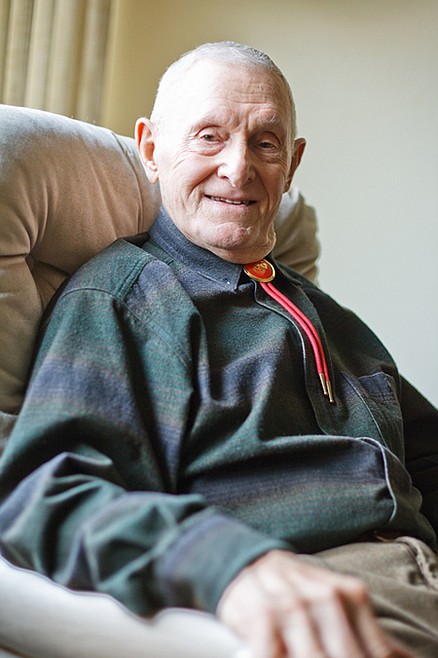
<p>Ray Garland, of Coeur d'Alene, will join 26 other Pearl Harbor survivors for the 70th anniversary event of the December 7, 1941 bombing.</p>
Bill Buley covers the city of Coeur d'Alene for the Coeur d’Alene Press. He has worked here since January 2020, after spending seven years on Kauai as editor-in-chief of The Garden Island newspaper. He enjoys running. | December 4, 2011 8:00 PM
The license plate on the SUV in the driveway outside the Coeur d'Alene home tells you who lives inside:
"Pearl Harbor Survivor."
Ray Garland is one of the few remaining who was there that day, Dec. 7, 1941, when Japan's bombs rained down, killing nearly 2,500 Americans and launching the U.S. into World War II. He was just 19 years old and aboard the battleship USS Tennessee when he found himself fighting for survival.
Today, Garland is 89 years old. Despite a cough due to a cold, he smiles as he sits in the living room of his modest house that he shares with his wife, Bev.
"I've got a ship's log of this and I can't find it," he explains. "It tells you the whole story."
The neatly dressed, 5-foot-11 man will be attending the Pearl Harbor 70th anniversary commemoration from Dec. 3-11, courtesy of The Greatest Generations Foundation. He is one of 27 Pearl survivors being flown in for eight days of ceremonies, tours, dedications and visits with active soldiers.
It is his first return to Pearl Harbor since he attended the 55th anniversary.
"I thought this is my last chance," he said Wednesday.
Following the attack on Pearl Harbor, Garland would spend another 30 months at sea with the 7th Division Marine Detachment before returning home to Butte, Mont. and working in the mines. Later, he trained and became a bomb disposal technician, and served nine months with the Second Bomb Disposal Company attached to the 1st Marine Division. He also went on to serve in Korea, fighting at the Battle of Chosin Reservoir.
It is Pearl Harbor, though, that he often thinks about.
"I don't dwell on it, but it's there," he said. "It's always there."
What does it mean for you to attend this event on the 70th anniversary of Pearl Harbor?
It's going to be something because there aren't very many of us left anymore.
Bev and I were thinking about going, then we got to thinking about it, I wouldn't hardly know anybody, most of the guys are no longer with us. So we kind of gave up on going, then this came up.
Can you talk about what happened that day?
I had the 4-8 watch. Before I was relieved on my watch, I was in the Color Guard and we were on the aft end of the ship and there were six Marines lined up and the Navy bugler, and prep had gone up. Prep is when they raise a flag to be prepared for colors, that's five minutes before 8 o'clock. The flag never got up. I was standing there, and I was one of the newest Marines aboard the ship, I had just turned 19.
Why didn't the flag go up?
I looked back over my shoulder and I saw these planes coming in and this corporal says, 'Hey, turn around Garland,' so I turned around, and the next thing I knew, from about here across the street, here comes a Japanese divebomber. They bombed all the airfields first. We were tied up next to Ford Island. So the first Japanese I saw, he was right there. They bombed us and they were shooting at us as they came by and they strafed us. That's when it started for me.
What did you do?
We went to our battle stations. The Marines at that time manned five-inch broadside guns. They were just open guns that were on each side of the ship. Ours pointed right toward the island. We couldn't fire those type of guns. They weren't anti-aircraft. They were surface guns.
And the Arizona was from here across the street from us. When it blew up, that was something to see.
How was the ship you were on, the Tennessee, doing?
After the first wave had come through, oil was coming from the Arizona, burning the back end of the ship, two one-ton bombs had hit the Tennessee. One of them hit up in the front end, it hit the turret, and it sprayed the front end of the Tennessee. The West Virginia was tied alongside us. That saved us from any torpedo hits, we just took one-ton bomb hits. One of them was actually a low-order detonation.
The Tennessee was lucky. The bombs that hit the Arizona, went down and hit the magazine. The same bombs that hit us, one of them hit turret 3, which was real close to our gun bucket and it was a partial detonation, it didn't go off all the way. But if either one of them would have went three feet either way, it would have went to a magazine. So, Tennessee was a lucky ship.
When did you get hurt?
I went up on the front part of the ship where this one-ton bomb had hit and it was a mess up there. So we had buckets and were picking up stuff. So we were cleaning up, we got that done and went to the back end of the Tennessee and I was manning a fire hose. Because the oil was coming from the Arizona, it was burning the back end of the ship, so we were spraying it to keep the oil away.
What happened next?
They opened the hatch of the ship on the back end on the quarter deck and we went down below. The water had started seeping through, it had buckled the plates of the Tennessee.
What had happened, the main power lines alongside the ship, the fire had burned the insulation off. What we did, we were standing in the water and we put the fire hose on that, and you can light a city with the charge that's going through there. That's all I remember. The electric charge came up that fire hose.
I ended up in sick bay.
How badly were you hurt?
It wasn't that bad. I couldn't see real good for a week or so, two weeks maybe. They were going to take the wounded off the ship and I heard them talking like that when they asked me how I was doing. I didn't want to leave the ship, they let me stay aboard. I couldn't shoot at anything, but I could see to help. But there were a lot of people in worse shape than me.
What was going on around you at the time?
I looked over, and the Oklahoma was just turning over. I watched it and it just turned over. The Arizona blew up and I saw that. The West Virginia, it got hit by four or five torpedoes. It was tied up next to us, it would have turned over, probably, like the Oklahoma, but they counter-flooded it. But when it came back like this, it pinched the Tennessee against the pilings.
What really saved the ship from the fire was, they attempted to get it underway a little bit. They turned on the engines, we were pinched too tight, we were supposed to be making five or seven knots, and the props pushed all the oil back away from the ship.
Were you scared?
I think everybody was scared, but on those ships in the old days, they were manned by people who had been in the service for quite a while. They were pretty well seasoned. They knew what they were doing. Everything was pretty well manned.
Was there ever any talk of a Japanese attack on Pearl Harbor?
We never heard anything like that. Not to me, anyhow, obviously, a recruit.
What did you do when the war was over?
I was born in Butte, Mont. I went home and went to work. I worked in the mines and then I moved to Spokane in '47 or '48.
I served 10 months in Korea with the 1st Marine Division. We went to Inchon and the Chosin Reservoir.
I often say, the Japanese singed me on Dec. 7, and the Chinese shot me on Dec. 5.
Would you say you're a survivor?
I was lucky.
ARTICLES BY BILL BULEY

Nancy Edinger decorates Coeur d'Alene home, keeps husband Ron's spirit alive
Nancy Edinger decorates Coeur d'Alene home, keeps husband Ron's spirit alive
Nancy Edinger decorates Coeur d'Alene home, keeps husband Ron's spirit alive

Nonprofit foundation helps family become homeowners for first time
Nonprofit foundation helps family become homeowners for first time
The Young Family’s Foundation launched about a year ago with a mission "to empower young, hardworking families to achieve the dream of home ownership. Even if a family saved $25,000, they would still be $19,000 short of the down payment needed to buy a $550,000 home, which is the median price in Kootenai County. It’s estimated that only about 20% of area households can afford to buy a home.

Day of Remembrance highlights being homeless in North Idaho, people encouraged to help
Day of Remembrance highlights being homeless in North Idaho, people encouraged to help
According to the 2025 Point in Time Homeless Count in January, Idaho has 2,697 homeless people, down slightly from the previous year. Most, 56%, were adults males between the ages of 18 and 54. In Idaho's Region One, which includes Kootenai, Bonner, Boundary, Shoshone and Benewah counties, there were 246 homeless in the PIT 2025 count.