
Bob Wood: Sink or swim
BILL BULEY | Hagadone News Network | UPDATED 14 years, 10 months AGO
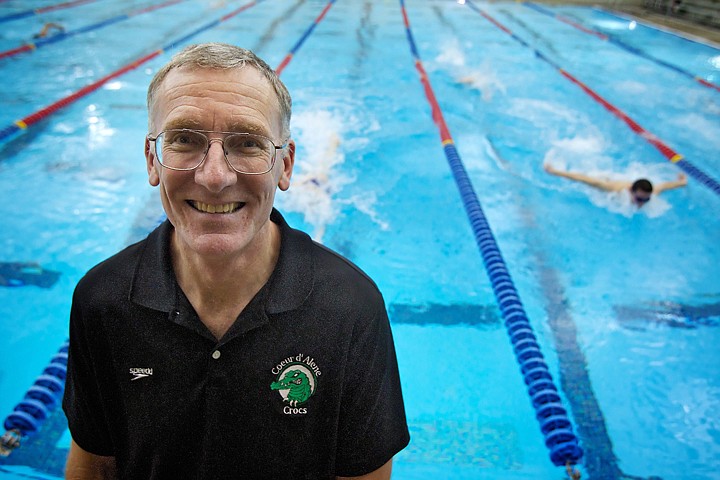
<p>Bob Wood is the head coach of the Coeur d'Alene Area Swim Team.</p>
Bill Buley covers the city of Coeur d'Alene for the Coeur d’Alene Press. He has worked here since January 2020, after spending seven years on Kauai as editor-in-chief of The Garden Island newspaper. He enjoys running. | February 20, 2011 8:00 PM
Sitting, talking with Bob Wood, head coach of the Coeur d'Alene Area Swim Team. Eventually, of course, the conversation leads to a request for swimming tips.
He obliges.
"One of the most important things in swimming is balance. Really the first thing we teach our kids is not how to move their hands through the water, but how to balance themselves in the water using their muscles. You have to be able to keep your hips and legs high using your core muscles."
Sounds good. Go on.
"When you have a good day swimming, it's always, always because you're doing a better job keeping your butt up on the surface on the water. It's really all about reducing drag, about body position, keeping your hips up, reducing drag. That makes for successful swimming. That's the No. 1 thing I teach. It doesn't matter what age you are."
Wood, who stands an imposing 6-foot-6, has been the head coach of CAST for more than five years. He's also the coach of the Lake City High School swim team.
He was an engineer by profession before moving into swimming instruction full time. When he speaks, he refers often to propulsion and pressure and pushing water aside.
"Water is 580 times as dense as air. Drag is really the thing. As an engineer, I really get it. To me, it makes total sense."
How is CAST doing these days?
I took the team over when we had about 30 active swimmers on the team. We were practicing out at Liberty Lake Athletic Club. Over about three years, the team grew from 30 to about 105 kids and then the Kroc Center opened and we moved over to the Kroc Center, which is great. We dropped down to about 90 kids when we moved because we had a lot of kids from the Spokane Valley. Now we're back up to 151.
What's the age range of your swimmers?
Our youngest is 6, our oldest is 18. I have three seniors graduating this year, all three are going to swim in college. In swimming, it's pretty cut and dried how you stand. Every result for every swimmer is in a national data base so you can go to USA Swimming and see exactly where you stand. You know exactly how fast your swimmers are. We have one swimmer in the top 10 in the nation and several others in the top 50 in the nation.
I have to say that everybody on my junior and senior team, that's about 35 swimmers, they're all planning on swimming in college. This is really the real deal. We could have as many as four kids go to Olympic trials next year. We have some very fast swimmers on the team.
What does it take to be a good swimmer?
It takes a lot of hard work. I swam when I was young. I had to because I grew 11 inches in one year so I had a bad back. I couldn't compete in swimmin g, but I had to swim every day. It was part of my therapy, an hour every day. I couldn't dive and I couldn't do flip-turns because my back was so degraded. I worked pretty hard, but it just amazes me how hard our kids work today. I have five swimmers on the team who rarely miss a practice. On the senior squad, they can come 11 times a week to practice, mornings and evenings. It is surprising when they miss.
It takes an incredible amount of drive and determination and it takes time to be a great swimmer. To the casual observer, it looks like not much is going on. It really is a finesse sport. Every little thing you do has a huge impact on how fast you swim. To get to that top level, you have to have an incredible work ethic. I know more than half my kids on the team are on the honor roll at school. I think the average GPA on the team is 3.7, which is stunning, especially considering the amount of time they have to put in the pool to really get to be good.
I've been really proud of all their accomplishments, even away from the pool.
Do most people realize how technical swimming is?
I've had other coaches say to me, 'There must be not much to coaching swimming. All they do is go back and forth in the pool.'
They don't see the thousands of adjustments that have to be made to be successful. I have a background in engineering, I worked for 30 years in mechanical engineering and refrigeration engineering. My mind is very mathematical. I look at things in function to drag and propulsion and things like that. I think that really gives me an advantage as a coach. A lot of coaches don't look at this way. It is all about drag and propulsion and exactly how to apply pressure in the water, when to apply pressure, when that pressure changes. Biomechanics. It's incredibly complex and you don't really see that until you have a fairly high knowledge level about swimming.
Swimming looks like jump in, flail your legs, flail your arms, go fast. You won't swim fast if you do that. The more precise that swimmer is, the faster they're going to swim. My best swimmers, they're all precise and exact swimmers, they're ever technical swimmer. They take instruction well.
Do you use cameras under water to record swimmers to work on form?
Absolutely. We have a camera system that will record above and below water. We do that regularly. We have all kinds of tools. I invented a whole bunch of stuff for motivating the kids. I developed paddles to improve their feel of the water and technical expertise.
Do you follow Olympic swimming closely?
Of course.
Do you think Michael Phelps will win more golds at the 2012 Olympics?
Absolutely.
Why is he so good?
He's absolutely gifted. They recognized very early he had a range of motion and flexibility which were extremely unusual and it's one of the things that gives him a secret weapon.
When he kicks down, his leg actually bends about that far forward. He has that type of flexibility in his joints. He has a range of motion that's ungodly, it's unbelievable.
If you could genetically engineer a swimmer, he has the ideal swimming proportions, which is a long trunk, shorter legs and extremely long arms. You find that the ideal swimmer has a very long trunk here. So much of your power does not come from your arms and legs. It comes from your core muscles.
Ripped swimmers like Michael Phelps, even some of the swimmers on my team, they're ripped, absolutely ripped. It's because you have to have so much core strength to connect the legs to the arms.
In your opinion, who is the all-time greatest swimmer?
Phelps, hands down. He's arguably one of the great athletes ever. Jordanesque. His gifts are enormous. His work ethic, unbelievable.
Why should parents encourage their kids to swim?
If you work hard, that reward will come. It will happen. It's kind of a self-reward system. They get involved, and then they get more involved and there's more and more goal setting. There's always a measure in swimming about how well you're doing.
Hard work pays off. And the kids realize it. You don't have to tell them that.
Have you had to cut swimmers from your teams?
I never cut people from any of my teams. Everybody makes it. I'm one of the few high school coaches that doesn't cut. I've had disciplinary problems and let kids go, but not often.
You don't have to tell someone swimming isn't their sport?
No, I never do that. If they're putting in the work, it's up to me as a coach to figure out what buttons to push. It's up to me to figure out how to get them to succeed. That's my job. That's our coaching staff's job.
What's next for you and CAST?
I would like to see one, two, three of four of our swimmers make the Olympic trials. In the long run, my next goal is to try and get this team up to 200 swimmers. I don't know if we have the pool space for that. At 151 swimmers, that's a lot of people to fit in the pool. We only get four lanes over at the Kroc Center, so we have to make that work. I honestly think if we had unlimited pool space, we'd probably have 250, 300 kids.
We also want to see our swimmers succeed. My long-term goal is that every one of our junior and senior swimmers that wants to swim in college, swims in college. There's a lot more work to be done. We have a great young group of kids on our team.
Is swimming the best sport for overall fitness?
You'd be hard-pressed to find anything athletic that's more difficult. Swimming, you're using such a wide range of muscles and aerobic capacity. It's a wonderful sport. You use virtually every muscle in your body to swim.
If you watch someone swim just once, can you tell what they're doing wrong?
That's what I do day in and day out. For me, with my better swimmers it's making those really small adjustments they need. For a learning swimmer, it's making the big adjustment that needs to be made. If I watch someone swim 25 yards, I can usually see eight or 12 things that need to be adjusted.
What else do you want to say about swimming?
Everybody, no matter what ages, needs to learn how to swim. Not just splash around in the pool, but be able to swim back and forth. It's really an important life skill.
ARTICLES BY BILL BULEY

Companions Animal Center has adopted out nearly 2,000 dogs, cats in 2025
Companions Animal Center has adopted out nearly 2,000 dogs, cats in 2025
As if to prove it, signs on two kennel doors proclaim “I have been adopted! I’m currently waiting to be picked up by my new parents.” One is a timid black mastiff. But the shelter remains crowded. Monday, it has about 50 large dogs filling kennels, including in the new wing oped this year, and there is still a four-month waiting list with names of about 80 dogs that people are looking to surrender pets.

Post Falls man named director of ministry with global reach
Post Falls man named director of ministry with global reach
Grassi, a longtime hunter and fisherman, started what was originally called “Let’s Go Fishing Ministry, Inc.” with a focus on outdoors, men and God. It was later changed to “Men’s Ministry Catalyst." The emphasis was on helping men understand their role as defined in the Bible.

Nonprofit foundation helps family become homeowners for first time
Nonprofit foundation helps family become homeowners for first time
The Young Family’s Foundation launched about a year ago with a mission "to empower young, hardworking families to achieve the dream of home ownership. Even if a family saved $25,000, they would still be $19,000 short of the down payment needed to buy a $550,000 home, which is the median price in Kootenai County. It’s estimated that only about 20% of area households can afford to buy a home.