
Sharing facts reduces the risk of teen pregnancy
Cynthia Taggart | Hagadone News Network | UPDATED 14 years, 9 months AGO
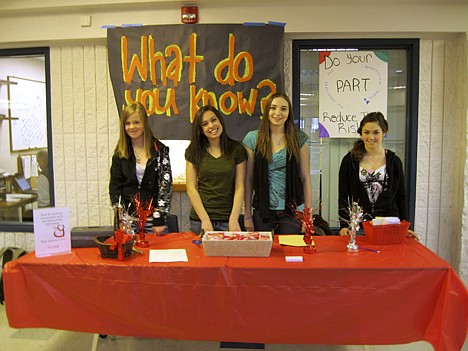
<p>Peer Advocates for Responsible Teens (PART) promoted pregnancy prevention through school activities at Coeur d'Alene High School on Valentine's day.</p>
The boys in Mareva Kammeyer's Reduce the Risk class at Coeur d'Alene High couldn't believe what they'd heard.
"They were really surprised," Kammeyer said. "They thought only two percent of the boys in their school weren't having sex."
Kammeyer, a Registered Nurse at the Panhandle Health District, told the 25 ninth- through 12-graders in the class that a nationwide Youth Risk Behavior Survey shows that 54 percent of all high school students are not having sex.
The same survey shows that 60 percent of ninth-grade girls, 45 percent of 12th grade girls and 40 percent of 12th grade boys are not having sex.
"They think everyone is having sex and it's not true. Many choose abstinence," says Kammeyer, who coordinates the Adolescent Pregnancy Prevention program at PHD.
This year is the first for the pregnancy prevention program, a curriculum approved by the state Board of Education. Coeur d'Alene High is the first school to give it a try. Kammeyer and others from the health district teach a research-based program, Reducing the Risk, in 12, 55-minute segments to one health class. Students must return a signed parent permission form to participate.
Reducing the risk covers pregnancy and sexually transmitted diseases (STDs), including HIV (human immunodeficiency virus). It teaches delay tactics and refusal skills that students practice in role-playing.
In 2009, Kootenai County had 61 pregnancies in girls younger than 18. Of those, 36 gave birth. The same year, Kootenai County had 449 cases of Chlamydia, a bacterial STD. Forty-one percent of those cases were younger than 20.
"We're trying to change attitudes and give them skills to work with," Kammeyer said. "Students need to have a plan prior to being in a risky situation."
Changing attitudes starts with statistics that correct teens' belief that everyone at school is having sex and other misconceptions. Kammeyer and her team from PHD correct such ideas as pregnancy can be prevented by drinking Mountain Dew or that a girl can't get pregnant while in a pool.
It continues with discussions on healthy and unhealthy relationships - mutual appreciation of each other vs. loving a boy for his car or popularity or a girl for her hair or money.
Kammeyer and her team teach refusal skills and delay tactics that provide time away from a developing situation to think. One suggested refusal: "No, I don't want to have sex. My mom will kill me." A suggested delay tactic: "Wait, I have to go to the bathroom," which grants a person time alone.
Communication with parents is encouraged. Students take home a list of questions - for example, how should teens show affection, should a teen have sex if they plan to marry their partner - to start a discussion.
"We don't care how they answer the questions, as long as they're talking," Kammeyer said.
The Adolescent Pregnancy Prevention program includes a student group, Peer Advocates for Responsible Teens (PART), in the school that plans activities to promote the prevention of pregnancy. On Valentine's Day, the CHS student group hosted an information table about the program with a roulette wheel with questions from 10 different categories. Students won candy for answering such questions as "What is the most effective type of birth control?" Answer: abstinence.
The student group works with a teacher, school nurse, PHD nurses and parents on a health promotion council. The council supports the student group and helps activate its plans.
"Kids are not stupid. They have to know the facts," said Kammeyer who has teenage children of her own. "We don't tell them what to do. That's their decision. But we give them the information and tools they need to make a decision."
Cynthia Taggart is the public information officer for the Panhandle Health District. She can be reached at [email protected].
ARTICLES BY CYNTHIA TAGGART
Preparing for emergencies is common sense
People in tornado country prepare for disaster. We don't hear about the people who sit out killer tornadoes in underground shelters equipped with emergency supplies of food and water. They're not in the news unless they've lost their homes. Have you ever wondered how people who've lost everything survived to talk about it on the 6 p.m. news?
Maintain septic systems to save big bucks
Septic systems are under-appreciated. Unless you live in a city on a municipal water system, septic systems dispose of all the waste that goes down the drains in your household, small business, church, school, restaurant and more.

Area restaurants go for the gold
PHD gold stars are a sign of high food safety standards
When I go out to eat, I look for a Panhandle Health District gold star on display by the establishment's cash register or in the window. The giant gold star is part of PHD's Award of Excellence in food safety.