
Oregon governor bans 'morally wrong' executions
Coeur d'Alene Press | UPDATED 14 years AGO
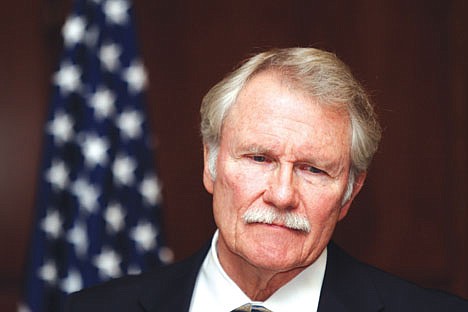
<p>Oregon Gov. John Kitzhaber pauses while announcing in Salem, Ore., Tuesday, Nov. 22, 2011, that the execution of convicted killer Gary Haugen will not go on as scheduled next month and no more executions will happen while he is in office. (AP Photo/Don Ryan)</p>
SALEM, Ore. (AP) - Haunted by regret for allowing two men to be executed more than a decade ago, Oregon Gov. John Kitzhaber now says it'll never happen again on his watch.
Calling Oregon's death penalty scheme "compromised and inequitable," the Democratic governor said Tuesday he'll issue a reprieve to a twice-convicted murderer who was scheduled to die by lethal injection in two weeks. He said he'd do the same for any other condemned inmates facing execution during his tenure in office.
"I simply cannot participate once again in something that I believe to be morally wrong," the governor said in uncharacteristically emotional remarks during a news conference in his office.
"It is time for this state to consider a different approach," he said.
Death penalty proponents quickly criticized the decision, saying the governor is usurping the will of voters who have supported capital punishment.
Kitzhaber's decision halts the execution of 49-year-old Gary Haugen, who had disregarded advice from his lawyers and asked to waive his remaining appeals in protest of a justice system he views as unjust and vindictive. Haugen, who was scheduled to be executed by lethal injection on Dec. 6, is one of 37 inmates on Oregon's death row.
Haugen was serving a life sentence for fatally bludgeoning his former girlfriend's mother, Mary Archer, when he was sentenced to death for the 2003 killing of fellow inmate David Polin, who had 84 stab wounds and a crushed skull.
Oregon has executed two men since voters reinstated the death penalty in 1984.
Both inmates, like Haugen, had abandoned appeals, but in those cases Kitzhaber didn't intervene, saying his oath of office required him to let the executions proceed.
Kitzhaber's first two terms as governor began in 1995. The next year, Douglas Wright was executed, Harry Moore the year after that. After eight years out of office, the Democratic governor was elected to a third term last year and, his voice shaking, said Tuesday he has long regretted those decisions.
He said he has come to believe that Oregon voters did not intend to create a death penalty scheme in which the only inmates who are put to death are those who volunteer.
"The reality is that, in Oregon, our death sentence is essentially an extremely expensive life prison term," Kitzhaber said. "Far more expensive than the terms of others who are sentenced to life in prison without parole, rather than to death row."
Kitzhaber fought tears as he said he spoke to relatives of Haugen's victims, saying they were difficult discussions and his "heart goes out to them." He declined to discuss them further, calling them "private conversations."
His moratorium means Oregon joins, at least temporarily, four other states that have halted executions. Illinois this year outlawed the death penalty after the discovery of wrongful convictions. New Mexico voters abolished it in 2009, two years after New Jersey's Legislature and governor did the same. A New York appeals court struck down a portion of the death penalty statute.