
Saving young hearts: Free screenings offered
Coeur d'Alene Press | UPDATED 13 years, 8 months AGO
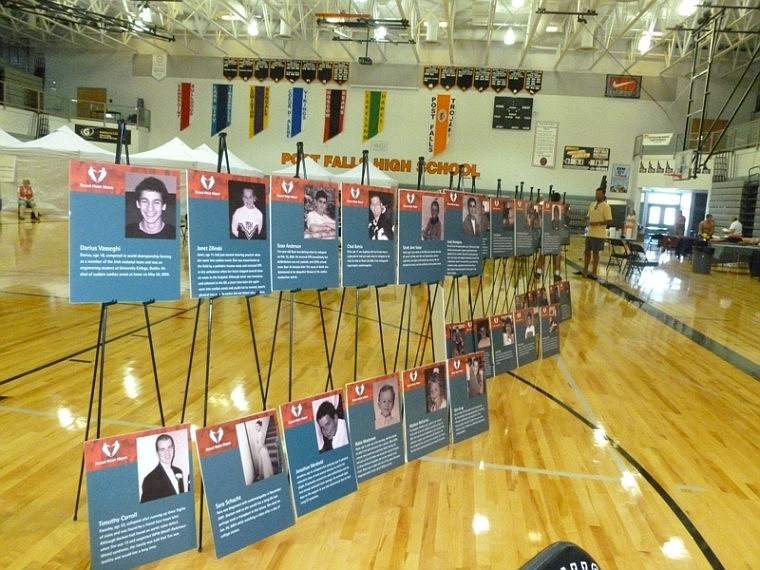
<p>Photos of children who died as a result of sudden cardiac arrest posted at the 2011 Youth Heart Screening at Post Falls High.</p>
Heart screening can save the lives of children and young adults not typically associated with heart disease. That’s why free youth heart screening will return for a second year to Kootenai County on Saturday, April 28.
The event is sponsored by Straight from the Heart, the Jordan Johnson Foundation. Jordan, a Post Falls High athlete, was 15 when he died of sudden cardiac arrest in 2006. Cyndie Johnson Lempesis, Jordan’s mother, formed Straight from the Heart, which sponsored its first free youth heart screening last year.
The screenings showed that 10 of the 220 young participants needed some type of medical follow-up. Sudden cardiac arrest is the No. 1 cause of death in young exercising athletes. But sudden cardiac arrest is not limited to athletes. One high school-age child dies every three days from it.
“Jordan had just finished swimming and football. He was trying out for basketball,” Lempesis says. “He had no symptoms—no fatigue, dizziness. That’s typical of people who’ve lost a child to this.”
Those losses have led to the start of heart screening events for youth throughout the nation. According to Parent Heart Watch, a nonprofit nationwide network of parents and others working to reduce the number of children lost to sudden cardiac arrest, most heart conditions that can lead to arrest in youth are not detectable with a stethoscope.
However, many are detectable with simple, painless tests, a review of family heart history, good assessment and follow-up, if necessary.
This year’s free youth heart screening for northern Idaho is at Lake City High, 6101 Ramsey Rd., in Coeur d’Alene from 9 a.m. to 4 p.m. on April 28. It’s directed at people age 14 to 24.
Families will start the process registering online at www.straightfromtheheart.us. Lempesis encourages participants to register for an appointment to avoid a long wait.
Participants should bring with them completed history and release forms that are available at the same website. Children under age 18 will need a parent’s signature on their forms. After checking in, kids will get their blood pressure checked and recorded and learn about CPR and the AED—automated external defibrillator—a device that can help a heart in distress return to its natural rhythm.
The electrocardiogram—ECG—is the next step. Screenings are in the school gym, but tents will provide privacy areas for boys and girls. They’ll get weighed and measured, then lay down for the ECG. ECGs measure the rate and rhythm of the heartbeat through electrodes attached to patches on the skin. The ECG takes just a few minutes; the entire screening process will take 30 to 45 minutes.
A team of doctors, including a cardiologist, will assess the results along with the heart health history. If doctors see anything amiss, they may direct youths to the echocardiogram machine. Two will be available at the screening. Echocardiograms use sound waves to show how a heart is beating and pumping blood. It helps doctors identify abnormalities in the heart muscle and valves.
All participants in the screening will leave with their heart health assessed and a recommendation for further treatment, if it’s needed.
Lempesis hopes to attract 300 young people to the screening.