
Quiet courage underscores unconventional career
Mike Satren | Hagadone News Network | UPDATED 13 years, 7 months AGO
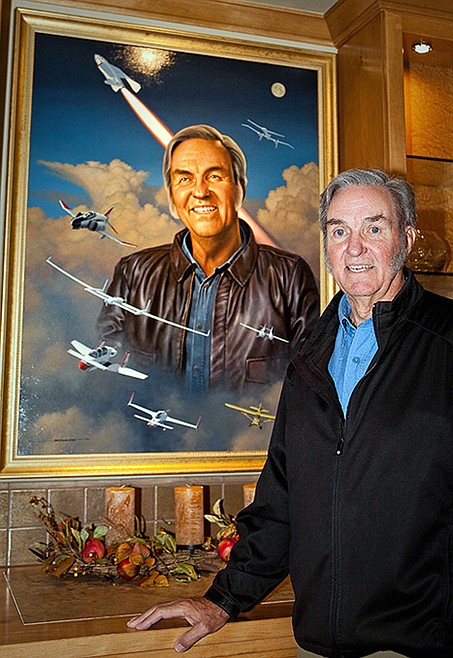
<p>Coeur d'Alene resident Burt Rutan stands beside a portrait of himself recognizing his major aviation and space achievements.</p>
COEUR d'ALENE - World-renowned aircraft designer and now North Idaho resident Burt Rutan won the Collier Trophy - for the most outstanding aviation event of the year - not once but twice in a career defined by innovation and a willingness to take risks.
Calculated risks, that is, financial and physical.
In 1986 his push-pull Voyager piloted by his brother Dick and Jeanna Yeager flew nonstop around the world against the prevailing wind with just the fuel it had onboard when it left. Then in 2004, Rutan won again when his SpaceShipOne was launched into space twice within two weeks to win the Ansari X-Prize awarded to the first private effort to achieve manned space flight.
Only two other individuals have ever won two Collier trophies, Glenn Curtis in 1911 and 1912 and Clarence "Kelly" Johnson of the Lockheed Skunk Works in 1958 and 1963.
Rutan thought outside the box even as a youngster when he would gather pieces of crashed model airplanes to rebuild them into entirely new and different forms.
"I liked to work with the materials rather than the kit with plans," Rutan said.
Although his father was a dentist in their hometown of Dinuba, Calif. - between Fresno and Visalia - Rutan never once considered following in his father's footsteps and neither did his five-year older brother Dick. Dick went on to join the Air Force and fly fighters but Burt, although he became a pilot, was utterly fascinated with aircraft design.
New designs built with new materials.
What drove him early on was winning prizes. As a junior high school teenager, Rutan was driven to the Bay Area every other week for controlled airplane contests by a kindly local bricklayer and he began bringing home trophies, it was a pattern that continued throughout his career.
In their new home in Coeur d'Alene, Burt and Tonya finally have room for and time to properly display Burt's lifetime of awards, which include the Medal of the City of Paris - also awarded to Charles Lindbergh - and the top U.S. civilian medal, the Presidential Citizen's Medal awarded by President Reagan.
Frank Sinatra's "I did it my way" could be Rutan's refrain as well. Remolding himself throughout his career, Rutan began working with the U.S. Air Force as a civilian flight test project engineer at Edwards Air Force Base after graduating with a degree in Aeronautical Engineering from Cal Poly in San Luis Obispo. After that he founded the Rutan Aircraft Factory in the little desolate town of Mojave, Calif., near Edwards AFB, in 1974. Then in 1982 he founded Scaled Composites, also in Mojave, which was to become his entrepreneurial legacy.
Highly efficient airfoils, forward canard wings and composite construction materials became Rutan's trademark but the ways he used them morphed from one project to the next.
When asked which was his favorite design Rutan remarked, "I used to always answer that question by saying, 'the next one.'"
Of course, the secretive nature of his company's pioneering work usually meant that his "next one" was well under way.
Rutan worked as a government employee at Edwards AFB and he took it for granted that he should be paid 60 to 70 percent of what private employees working for Lockheed or Boeing received at the time. It was the difference between taxpayer-funded work and privately funded work.
"I never thought or dreamed that a government worker would be paid more than the commercial worker," he said. "That doesn't make sense to me and yet they still call it government service, which is weird."
Aircraft design innovation is what Rutan and Scaled Composites is best known for but Rutan knows that a solid financial base is what kept his company in the black and operating all that time.
For the first 10 or 12 years Scaled Composites was very small, much like the town of Mojave, but as projects accumulated his staff grew as well.
All this time Scaled Composites kept out of debt.
"We were profitable for every quarter for 30 years," he said. "To me it was the most important thing to operate in such a way that protects the financial security of everybody that works there."
When he sits on his deck now looking out on his Coeur d'Alene Lake view, that is one of the accomplishments for which he is most proud.
"There's 400 families there who are being fed. I provided them with better health care, dental care, eyeglasses, than you get at Lockheed," he said. "And I provided them with a place that by its structure and its plans was a fun place to work."
His emphasis on fun helped to keep talented engineers busy with intriguing projects and their minds off the barren desert that they now called home.
Still by its very nature, the risks were substantial. Rutan does not think his business would have prospered with the degree of innovation necessary to succeed had it not been for the relative freedom from government oversight enjoyed in the figurative backwaters of Mojave.
"We did a lot of quasi illegal flying in those days, low-level aerobatics, the 500-foot rule, we tended to ignore it," he said.
Well-known aviation writer Peter Garrison called Mojave the "Last Bastion of Cowboy Flying."
Once Rutan was standing out on the ramp with an FAA examiner when Dick Rutan flew by right off the deck doing rolls. Rutan thought, "Oh my, we're in trouble."
But the FAA man just turned to Rutan and said, "Well Burt, if you can't do it here, where can you do it?"
That attitude helped Rutan keep the work fun and that spurred ideas and success.
"Nobody told me that I couldn't build a spaceship," he said. "I didn't tell the FAA or NASA what I was doing."
It was only when he had to open the hangar doors and roll out the ship that he had to talk to the FAA to get permission to fly it.
"I couldn't do what I did in my career if I were in any other country."
The next big project, Stratolaunch, which was announced last December in Seattle and sponsored by billionaire Paul Allen, will take the privately funded space program to the next level. Literally.
The idea is similar to the White Knight aircraft that launched SpaceShipOne in 2004. Stratolaunch will be able to take off - with its payload rocket slung beneath and between its twin fuselages - from an ordinary long airport (even Mojave), climb to 30,000 feet above most clouds, fly out to sea and then release the rocket, which then blasts into space.
Scaled Composites is already constructing an enormous hangar in Mojave that will have a 400-foot door. The Roc, as the launch aircraft is known in-house, will have a 385-foot wingspan (65 feet wider than the Spruce Goose). Two Boeing 747-400s are already sitting on the ramp waiting to be cherry picked for parts and systems to build the Roc.
The job is being made as simple as possible by the fact that Rutan structured it to have almost no systems development at all.
Six engines with pylons, three per wing, will power the twin fuselage composite behemoth. Intact landing gear systems, actuators, etc. will all be cannibalized and used such that new engineering tests are unnecessary.
And that is one way that private development, unlike government bureaucratic development, keeps costs under control.
Rutan has drawings dating back to 1991, outlining preliminary ideas for such a project.
"I was the only designer on it for a long time," he said. "I think most of the people around me, if not all, thought I was smoking something."
In the meantime Rutan's as happy as, well, a 60-hour-per-week engineer with nothing but time on his hands.
"I'm not committing to anything, I'm going to retire, move up to Coeur d'Alene, put my feet up knowing that I have nothing planned, and then do what I want to do as it comes up," he said before coming north.
Holding to that new lifestyle, Rutan cleared his calendar of everything, including annual events like golf tournaments.
Even so, he has already drawn plans for a trailerable two-person wingship - sort of a racing hydroplane that is meant to ride just out of the water. It will be powered by electric and gas fans and controlled by a tail section for stability just above the water in what is called "ground effect." Of course, he's already thought of adding removable outboard wings to make it a real seaplane to check out local lakes and rivers.
The Rutans love the people in North Idaho, too.
Jeff Foxworthy said you know you're in Idaho if you've been in a Home Depot and had someone come up to help and they don't even work there.
"It actually happened to me - twice," Rutan said. "We pinch ourselves every time we turn around."
Rutan to speak
• Entrepreneur and visionary aircraft designer Burt Rutan will speak at the Inventors Association of Idaho meeting Tuesday at 2 p.m. at the Bird Aviation Museum and Invention Center (9 miles east of Sagle on Sagle Road).
Preregistration is required so call to register through this afternoon.
Information: (208) 255-4321
ARTICLES BY MIKE SATREN
Whittle sets fire to Tea Party Patriots
YouTube video producer gives defense of conservative logic

Dwight Van Horn: North Idaho's own NRA director
IN PERSON NRA's political involvement preserves basic civil rights
COEUR d'ALENE - Not all communities have a National Rifle Association director as a neighbor but Hayden resident Dwight Van Horn has been on the NRA board since 1998 and has been reelected four times since. He is up for reelection this spring. At-large elections of directors are held annually for three-year terms with a third of the board up for election each year. That means new or returning directors are chosen irrespective of where they live.
Air races on display
Idaho rookie wins Silver Formula One Class at 50th Reno Air Races
RENO, Nev. - A Boise emergency physician won the Silver Heat of the Formula One class at the Reno Air Races in mid-September in his rookie year as a race pilot.