
Man's second-best friend
BILL BULEY | Hagadone News Network | UPDATED 13 years, 11 months AGO
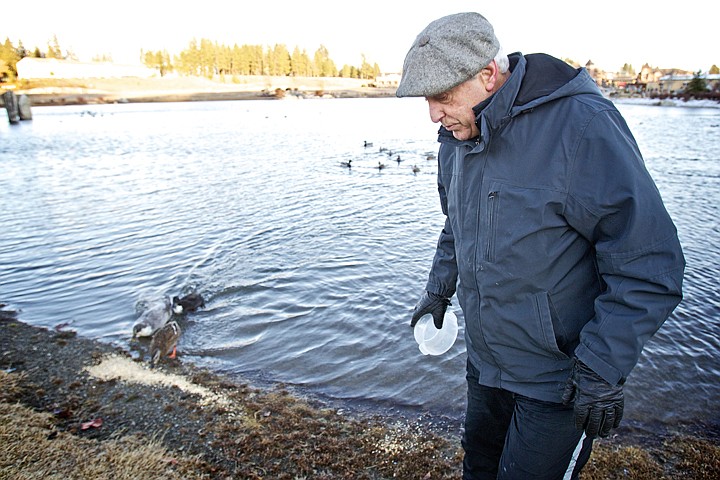
<p>JEROME A. POLLOS/Press David Albertini walks away from the shoreline of the Riverstone pond after dumping a bowlful of feed Tuesday for four ducks he's been feeding since he realized they couldn't fly in November.</p>
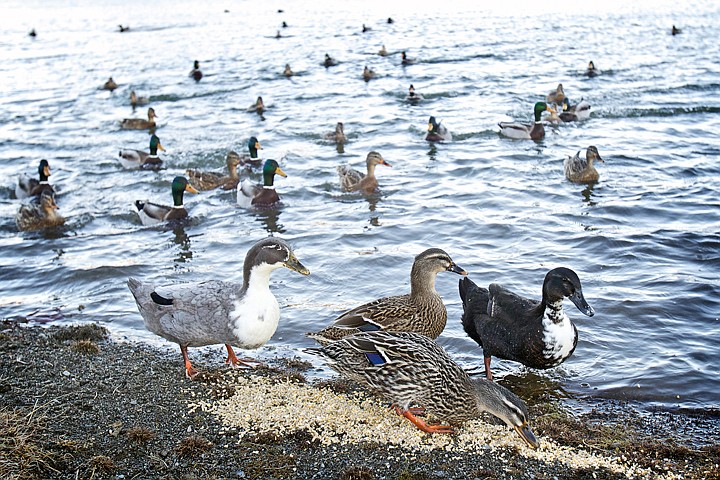
<p>JEROME A. POLLOS/Press The four ducks Albertini tends to try to get their fill of feed before a team of other ducks converge on the meal.</p>
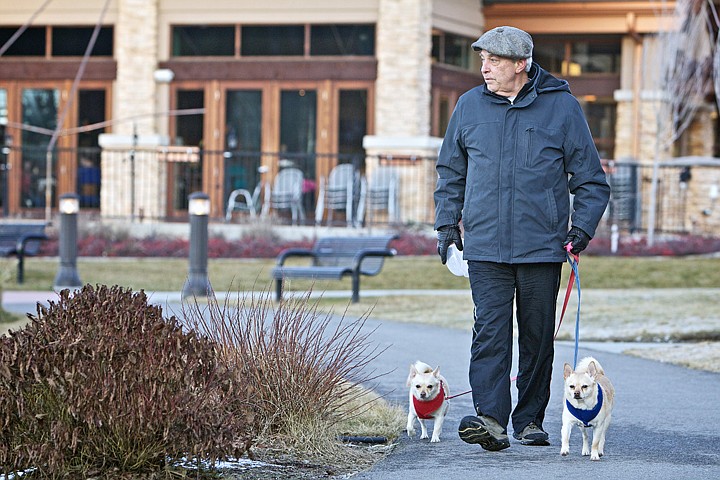
<p>JEROME A. POLLOS/Press David Albertini walks his two dogs around the Riverstone pond Monday as he looks out over the water.</p>
Bill Buley covers the city of Coeur d'Alene for the Coeur d’Alene Press. He has worked here since January 2020, after spending seven years on Kauai as editor-in-chief of The Garden Island newspaper. He enjoys running. | January 12, 2012 4:15 AM

COEUR d'ALENE - There are followers of David Albertini as he walks around the edge of the pond at Riverstone.
They see him coming, those ducks, and they begin paddling his way, drawing closer to the shore, slicing smoothly through the rippled water.
The Coeur d'Alene man, bundled against a wicked wind on a 30-degree, sunny Tuesday afternoon, wears a coat, gloves and hat.
He also carries a small plastic tub and in it, is a few scoops of fowl food and cracked corn. But he's not there to feed this entire horde of quacking, feathered waterfowl. Sure, they'll all likely get a little something, but there are four he's specifically interested in - four Albertini figures need his help to survive a North Idaho winter.
"See the black one in front, and the gray one?" he asks, pointing at a foursome that swims apart from the main bunch.
"Those four right there, they don't fly," he says.
Sure enough, something spooks the ducks and the 50 or so of them suddenly flap their wings, fly a short distance, then make a splash landing.
Those four, they turn, kicked their webbed feet, stop and float. Sure enough, they don't fly.
"See how the other ones go?" Albertini says. "They don't fly. I've been down here at night and they're the only four here, and the rest of them, something will scare them, they'll take off flying. These don't."
He walks up to the water's edge, and pours out that day's dinner. His favorite four, two with white chests, are far out in front of the pack, arrive first and quickly begin feasting on this treat from their provider.
A few seconds later, the rest glide up. Minutes later, it's gone. The ducks skim off and Albertini wanders back toward his 1979 blue Chevy pickup in the parking lot.
He glances toward the water, pulls his cap a bit tighter, and quickens his pace.
"That wind's biting," he says.
Since November, the 66-year-old has been providing sustenance for the ducks that he believes were domesticated, then left at this small, manmade pond.
"How else could they get here if they can't fly?" he asks.
Someone, he adds, suggested the ducks should just be put down if they can't fly, "so they don't have a whole pond full of genetic ducks that can't fly."
Albertini bristles at that, and at the same time, admits he doesn't know what should be done with them.
"I don't know anything about ducks," he says with a shrug. "Take them some place where they're not stuck. Build them a little nest or something where they can go in and get warm."
He first noticed them in the summer because they were always there. On days when other ducks took flight, these four never did.
They floated and paddled and waddled. And stayed.
No worries at first. But come November, when the temperatures dropped to the teens, he feared the worst.
One icy night, when he went home, he couldn't stop wondering if they were OK.
"I couldn't eat dinner. I felt bad for them," he said. "I started thinking, 'They're going to starve to death.'"
So he returns, mornings and afternoon, with that mixture of fowl food and cracked corn he buys in 50-pound bags at Big R.
Albertini still frets about those ducks. The Riverstone pond froze over for a time, and it's happening again. Temps in the teens are in the forecast.
"I think these guys get scared to leave the water, especially when it's dark out," he says. "They never leave that water. That's what I'm afraid of. If it gets real, real, cold, the water will just freeze them right in it."
Phil Cooper, Idaho Department of Fish and Game conservation officer, said feeding the ducks could encourage waterfowl to come in and stay.
But he said if the four ducks being fed by Albertini can't fly, he may be saving them.
"If they're wild, they'll leave anyway," he said. "If they're domestic, they may need supplemental food."
Albertini is the sort of man who notices the plight of animals.
He adopted two small rescue dogs a year ago, named them George and Gracie, and walks them twice daily at the Riverstone pond. It's part of his preparation, too, for Spokane's Bloomsday, which he has never, ever missed, starting from year one. He's one of those perennials, never gives up, never stops.
"All I can do is walk because of that hip," he says with a chuckle.
But Bloomsday is months away. Not even on the radar now for David Albertini. No, those ducks have his full attention.
So he pushes aside that hurting hip, brushes off the snow and rain, fires up his old pickup, and gathers up George and Gracie at 6 a.m. He repeats the routine come afternoon.
Walk the dogs. Feed the ducks.
He does, however, have one concern.
He points toward a sign that says don't feed the geese.
A smile crosses his face and he laughs softly.
"It doesn't say anything about the ducks."
ARTICLES BY BILL BULEY

Companions Animal Center has adopted out nearly 2,000 dogs, cats in 2025
Companions Animal Center has adopted out nearly 2,000 dogs, cats in 2025
As if to prove it, signs on two kennel doors proclaim “I have been adopted! I’m currently waiting to be picked up by my new parents.” One is a timid black mastiff. But the shelter remains crowded. Monday, it has about 50 large dogs filling kennels, including in the new wing oped this year, and there is still a four-month waiting list with names of about 80 dogs that people are looking to surrender pets.

Post Falls man named director of ministry with global reach
Post Falls man named director of ministry with global reach
Grassi, a longtime hunter and fisherman, started what was originally called “Let’s Go Fishing Ministry, Inc.” with a focus on outdoors, men and God. It was later changed to “Men’s Ministry Catalyst." The emphasis was on helping men understand their role as defined in the Bible.

Nonprofit foundation helps family become homeowners for first time
Nonprofit foundation helps family become homeowners for first time
The Young Family’s Foundation launched about a year ago with a mission "to empower young, hardworking families to achieve the dream of home ownership. Even if a family saved $25,000, they would still be $19,000 short of the down payment needed to buy a $550,000 home, which is the median price in Kootenai County. It’s estimated that only about 20% of area households can afford to buy a home.