
Mystic Farm helps animals return to the wild
MAUREEN DOLAN | Hagadone News Network | UPDATED 13 years, 5 months AGO

SAGLE - They're loved by hunters and wildlife enthusiasts, but what else do deer, elk and moose have in common?
They're Idaho's wild ungulates.
They also have Dory McIsaac, a Sagle woman who has made helping the hoofed mammals her life's mission.
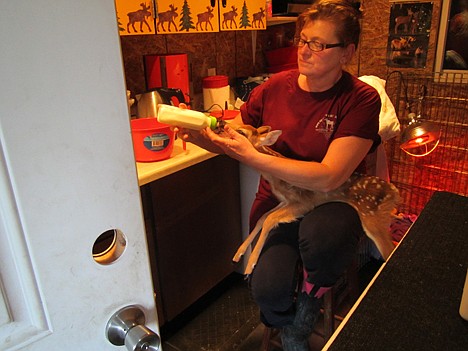
McIsaac is the driving force at Mystic Farm Wildlife Rescue, a nonprofit located south of Sandpoint that rescues and rehabilitates orphaned and injured deer, elk and moose and then releases them back into the wild.
You might call her the ungulate whisperer.
"I've always loved animals. I dragged home everything that was wounded or abandoned," McIsaac said.
She didn't set out to be a wildlife rescuer. There was no plan for this unusual career path.
"It just kind of happened," she said.
McIsaac became interested in rescuing and releasing wild animals when she lived in Alaska several years ago. She had friends who were wildlife biologists, and she learned a lot from them.
Later, when she was living in southern Idaho, outside Pocatello, she heard about an injured baby moose that had fallen into a window well and called Idaho Fish and Game and offered her help.
"I told them I knew what to do, that I could take care of it," McIsaac said.
They had already placed that animal elsewhere, but the next year, Fish and Game brought her two baby moose that she cared for and released back into the wild. The animals kept coming.
"I love it. It works for me," she said. The operation moved to Sagle two years ago, and McIsaac has been busy.
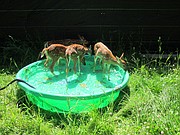
There are 11 fawns and two baby elk at the rescue right now.
McIsaac is the primary caregiver, with just one "hands-on" volunteer.
"We try not to touch these babies. I'm the only one, if possible," McIsaac said.
Getting the animals successfully back into the wild is her No. 1 goal.
A fawn McIsaac calls "Little Cliffie," is currently recovering at the rescue.
"He's pretty special," she said.
Not long ago, she got a call from Cocallala, from some people who said a baby deer was hanging over the edge of a rock cliff behind their barn.
"It was precariously perched on the ledge," McIsaac said.
When the tiny deer was brought down, its little eyes were completely swollen and crusted shut. The animal had a broken jaw, and puncture wounds, obviously from talons.
An eagle had been hanging around the area, McIsaac said, and she's sure the bird of prey picked up the deer and dropped it.
"It was on this ledge so the mom couldn't get to it," she said.
With McIsaac as his foster mother, Cliffie the deer is making a recovery.
"He's doing well. He looks like he ran into a train or something, but he's so cute," she said.
McIsaac starts each day at about 6 a.m., getting bottles ready, warming them up for the baby animals. Then, she feeds them and gives medication to those that need it. She washes bottles, cleans enclosures and starts the next round of feeding, which is every two hours when they first arrive at the rescue.
As time goes on, the animals need fewer and fewer bottles.
Toward the end of the summer, during the day, McIsaac opens the gates leading to the wild.
"They're free to come and go," she said. "They always come back for that last bottle."
And the gates are closed at night.
Once the animals are weaned off the bottles completely, the gates are left open 24 hours.
They usually come back for a while, McIsaac said, but eventually, she stops seeing them.
"They join other herds, hopefully adding to the population," McIsaac said. "It works. They don't get too imprinted."
McIsaac is aware of critics who think what she's doing is wrong, that it doesn't work, but McIsaac knows otherwise. She has had dozens of successful releases over the past few years. Then, there are those who think she's just an animal-lover turning wild animals into pets. Not so, McIsaac said.
There are others who criticize her because they say she's saving animals and returning them to the wild, where there are hunters.
"They still got a second chance," McIsaac said.
In fact, some of McIsaac's strongest supporters are hunters, although she herself doesn't hunt.
"I'm not anti-hunting, by any means," she said.
Not all animals brought to her can be saved, and have to be brought to a veterinarian to be euthanized.
"The little elk I got the other day was hit by a car and had a brain injury. There's no saving that," she said.
Mystic Farm Wildlife has been a 501c3 since 2007, and it is licensed by Idaho Fish and Game. They receive no state or federal funding, relying completely on grants, cash donations and volunteer man-hours.
Visit Mystic Farm Wildlife's Facebook page for more information, https://www.facebook.com/MysticFarmWildlifeRescue
ARTICLES BY MAUREEN DOLAN

Daylight saving time begins today
If you arrived an hour early to everywhere you went today, you might have forgotten to move your clock back. Yep, it's daylight saving time. Daylight saving time officially ends at 2 a.m. Sunday, Nov. 5, and returns on March 10, 2024, when clocks are moved an hour forward.

Time to 'fall back'
Daylight saving time officially ends at 2 a.m. Sunday, Nov. 5 and returns March 10, 2024, when the vast majority of Americans will then “spring forward” as clocks are set an hour later.

Fires, smoke continue to affect region
Smoke from the region's wildfires continued to affect air quality Monday as firefighting response teams continued to battle multiple blazes throughout North Idaho and Eastern Washington.