
Susan Smith: Leading the charge against Alzheimer's
BILL BULEY | Hagadone News Network | UPDATED 13 years, 3 months AGO
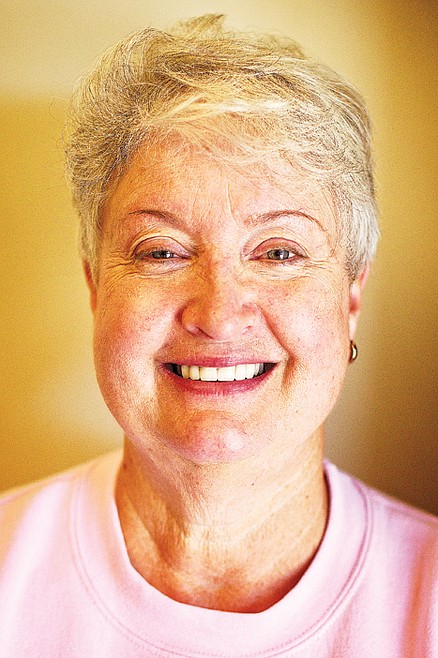
<p>Sue Smith</p>
Bill Buley covers the city of Coeur d'Alene for the Coeur d’Alene Press. He has worked here since January 2020, after spending seven years on Kauai as editor-in-chief of The Garden Island newspaper. He enjoys running. | September 23, 2012 9:00 PM
Susan Smith didn't think much of it when her husband of nearly 20 years began to forget things. Seemed routine, really. As you age, your memory goes, right?
Not so, Smith learned.
Her husband's forgetfulness was an early sign of Alzheimer's disease, a progressive and irreversible neurological disorder.
It was just the beginning of Susan Smith's efforts to raise money and awareness of Alzheimer's, which includes gradual memory loss, impairment of judgment, disorientation, personality change, difficulty in learning and loss of language skills.
The Coeur d'Alene woman helped with Saturday's North Idaho Alzheimer's Walk at Riverstone Park, and plans to continue pushing for research funding.
"The more money you put into it now, the more you save later. Not only in funds, but in human lives."
How is funding for research to find a cure for Alzheimer's?
Well, we're not getting enough funding from the government and private resources. We're getting funding, but we need so much more because the Alzheimer's epidemic is rising so rapidly, it's a tsunami coming into this country.
How bad is it?
Medicare statistics show it's the most expensive disease to care for. The difficulty with Alzheimer's in part is that it affects older citizens more often. As you know, the baby boomer generation, we're all getting up to an age where that is a factor now.
The rise in the numbers of people being diagnosed with Alzheimer's is tremendous and an enormous burden on private people who are dealing with loved one who have Alzheimer's and for medical care facilities.
So it's rising just because more people are getting older?
That's it, as far as they know. The research hasn't indicated there's a specific source we can find and eliminate. It just seems to be an aging process for many people. The more people who are aging, and around those timeframes, 55, 60, 65 and up, you just are going to have more people in those age groups diagnosed with Alzheimer's.
What should we do? Crossword puzzles, exercise our minds?
Those are all good bits of advice. There is no evidence we can prevent Alzheimer's, but there is some good evidence we can slow down the process, in part by exercising our brain. Exercising our bodies helps with blood flow to the brain and those are good things to do to keep your brain as healthy as possible. But if you are going to get Alzheimer's, you're going to get Alzheimer's, at least at this point of what we know about.
But if you want to slow it down and keep your brain as healthy as possible, there are a number of things you can do, like crossword puzzles, keeping your brain engaged, but there's one other thing you should know about that. If you've done crossword puzzles or Sudoku all your life, it is better, really, to do new things that challenge your brain. Not just the same brain activities over and over again. That is not as productive as if you engaged in new activities - especially social activities.
When was your husband diagnosed with Alzheimer's?
He was diagnosed about two years ago and we at the time closed our business, laid off our secretary, lost three jobs.
Did you notice anything about him before he was diagnosed?
It was gradual. He was in his 70s. We all are of the reasoning process that as you get older you get more forgetful. That's not necessarily true. I learned that the hard way.
If you kind of forget, you mislaid a piece of paper, you have to dig through to find it. I can't remember where I left my key. We all think that's just part of getting older, so we don't really put two and two together a lot of times until something more dramatic comes up.
What finally happened?
My husband had a minor stroke, woke up one morning and couldn't open one eye. We began the process of having him go to the hospital to be sure that was taken care of. After that for a short period of time it seemed that things were OK. But we began to feel there was a little too much forgetfulness. Because of the stroke, we decided we needed to start testing for brain difficulties and that's when we went through all the medical types of examinations that can determine the problem, including MRIs. And it was Alzheimer's, it was definitely Alzheimer's. He was diagnosed when he was 74.
What's been the impact?
It cut our income by a significant amount. It left us unemployed and we both had worked all our lives and enjoyed working. And our secretary, because the economy has been so bad, was unable to find full-time work for an awfully long period of time and it took its toll on her. It's a real beatdown in this economy to not be able to get a job and support yourself.
You face other problems that come along with Alzheimer's, too, a reduction of the ability to make good decisions, to take care of yourself, failing physical well being.
How was it caring for him at home?
I just thought we would be fine as long as I was home with him and we were doing things and he was still OK. The problem is, as the disease progresses, the caregiver is often seen as someone who is controlling them, and sometimes the disease makes them less willing to see how things really are and understand that things are for their well being. They don't like it, they don't want it.
He had no power of attorney he had signed, he had no guardian or conservator in the state of Idaho. He was able to come and go and do whatever he pleased. In the last year as the disease progressed, he was unable to keep track of his medications and he wasn't taking them properly. That is a problem for keeping your body healthy and your mind alert and on track as much as possible. It's very confusing and disorienting. That was happening to him and he wouldn't let me help and he began to resent me more and more. He also became very unwilling to eat healthy, he ate whatever he chose to eat, because there was no one able to stop him. He ate ice cream for breakfast, ice cream all day long and candy bars, and it really took a toll on his health.
Eventually, we had to file for guardian conservatorship. For his health and well being, we placed him in a specialty Alzheimer's care facility that is in Post Falls called Guardian Angel Homes and they are wonderful. They take good care of him. He is now eating properly, having his medication properly regimented, they see to his physical needs and they are always challenging the mind. They know the right kinds of activities for Alzheimer's patients.
How is he doing now?
He has been thriving the last couple of months. He's gaining some weight back, he's doing better with memory and cognitive level thinking and he's physically in better condition. I am thrilled.
Does he recognize you?
Yes, he doesn't have a severe problem with that. Some people, he remembers better than others but he still remembers most of his family and dear friends. That's a very helpful and wonderful sign.
What kind of man is he?
He is a wonderful man. He is bright and motivated, a good heart, a giving spirit. He was like your knight on a white charger.
He has been a good friend, loyal friend to every friend he's had. His family loves him dearly. He's a wonderful father, brother, uncle, all those things.
What's the next step?
We need to raise funds, not just for Alzheimer's research and development. We need to raise funds for the local organizations, like our Inland Northwest Alzheimer's Association because locally our association does so much for outreach and to make sure that people have access to education on how to be a good caregiver, what works best for Alzheimer's patients, where you can get help.
They provide group sessions where Alzheimer's caregivers like me can go and we can talk with other people caregiving for their loved ones. And they also educate professional caregivers and make them better qualified to deal properly with Alzheimer's and some behaviors that come with Alzheimer's. They have been lifesavers for me and my husband.
So the fundraising is critical. The awareness is critical. People need to start writing and sending letters to their local legislators and Congress, they need to know you understand how expensive the coming flood of Alzheimer's patients is going to be on the healthcare system of this country. And telling and pressuring the right people who can make those good decisions now may help us resolve some of the issues we don't have a handle on yet with Alzheimer's onset.
Do you believe there will one day be a cure?
Maybe there will be a way. Maybe they'll find a way to stop Alzheimer's. That would be glorious for everyone who would ever have gotten it, and all the caregivers of those people, and all the financial resources that are now and will be going into it. If you can stop it before it happens, that is huge.
ARTICLES BY BILL BULEY

Companions Animal Center has adopted out nearly 2,000 dogs, cats in 2025
Companions Animal Center has adopted out nearly 2,000 dogs, cats in 2025
As if to prove it, signs on two kennel doors proclaim “I have been adopted! I’m currently waiting to be picked up by my new parents.” One is a timid black mastiff. But the shelter remains crowded. Monday, it has about 50 large dogs filling kennels, including in the new wing oped this year, and there is still a four-month waiting list with names of about 80 dogs that people are looking to surrender pets.

Post Falls man named director of ministry with global reach
Post Falls man named director of ministry with global reach
Grassi, a longtime hunter and fisherman, started what was originally called “Let’s Go Fishing Ministry, Inc.” with a focus on outdoors, men and God. It was later changed to “Men’s Ministry Catalyst." The emphasis was on helping men understand their role as defined in the Bible.

Nonprofit foundation helps family become homeowners for first time
Nonprofit foundation helps family become homeowners for first time
The Young Family’s Foundation launched about a year ago with a mission "to empower young, hardworking families to achieve the dream of home ownership. Even if a family saved $25,000, they would still be $19,000 short of the down payment needed to buy a $550,000 home, which is the median price in Kootenai County. It’s estimated that only about 20% of area households can afford to buy a home.