
More to a fire than flames and ashes
Laura Roady | Hagadone News Network | UPDATED 11 years, 12 months AGO
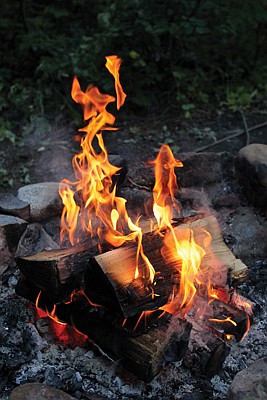
<p>When certain gases released from wood reach 450 degrees Fahrenheit they ignite but some gases don’t ignite until the temperature is near 1,100 degrees Fahrenheit.</p>
Staring into a campfire, watching the flames flicker and flare until the wood is reduced to glowing red coals can be mesmerizing. The warmth of a campfire is welcome on cool summer nights while camping or on cold, winter hikes during a lunch break.
How does wood produce heat and light? Or even the wax in a candle?
Fire is a chemical reaction between oxygen in the air and a fuel source, such as wood, wax or methane.
In order for a fire to be sustainable, there needs to be fuel, oxygen and heat — the fire triangle — and without all three the fire goes out. Put a jar over a lit candle and the flame will burn out. Throw water on a fire and the heat dissipates.
There is spontaneous combustion but most fires require an ignition source, such as a match or lightning. A match head contains chemicals that ignite at a relatively low temperature, around 360 degrees Fahrenheit. When a match is pulled across a rough surface, heat is generated by friction. If the match is struck fast enough, the friction will generate enough heat for the match to ignite because there is heat, fuel (chemicals in the match head) and oxygen.
When looking at a fuel source, it is easy to assume the wood, wax or paper is burning. However, solids and liquids don’t burn — only gas burns. Heat is needed to vaporize gases from the solid or liquid.
For example, when a lit match touches a piece of paper, the flame from the match heats up the paper until flammable gases are released, whether from being vaporized or from the heat breaking down the paper molecules into gases.
These gases then combust when a certain temperature is reached. The heat generated by the combustion causes more flammable gases to be released and the fire is sustained.
Each fuel source has a certain temperature at which it ignites.
A piece of paper is a lot easier to ignite with a match than a piece of plastic.
At the ignition temperature, the fuel can rapidly unite with oxygen.
The chemical reaction that takes place during combustion combines hydrogen molecules with oxygen molecules to form water molecules, carbon dioxide and/or carbon monoxide, and energy (released as heat).
For example, when methane (CH4), the main component of natural gas, burns it reacts with two molecules of oxygen (O2) to form two water molecules, one carbon dioxide molecule and heat.
If a component needed in the reaction is minimal (such as not enough oxygen), the combustion is termed incomplete combustion. If there isn’t enough oxygen present when methane is burning to fully oxide the carbon, carbon monoxide forms instead of carbon dioxide.
Incomplete combustion also creates soot. Soot is microscopic particles of carbon that didn’t have any oxygen to combine with during combustion. Soot creates flame, such as a candle flame.
When soot becomes hot enough, it begins to glow and the glow of hot soot creates a yellow or orange flame.
Smoke is also the result of incomplete combustion. Smoke is the suspension of small particles in the air leftover from incomplete combustion of a fuel.
Not everything in a fuel source is combustible. The ashes remaining after a campfire are minerals in the wood that didn’t burn, such as calcium and potassium.
From wood to flame to ash, the chemical reaction behind fire can be mind-boggling enough to let oneself just enjoy the flames as they flicker.
ARTICLES BY LAURA ROADY
Why do some animals delay pregnancy?
Spring is birthing time for many animals in order for the young to have adequate time to grow and develop before the onset of winter. For many animals, that means mating in mid- to late winter. Raccoons begin mating in February and March and give birth in April.
Some animals capable of growing new appendages
Lizards are one of the more well-known animals to regrow their tail after shedding it to evade predators. Last week, I wrote about autotomy (the process of voluntarily shedding a body part) and how it is advantageous at first but can cause hardship afterwards. Certain animals alleviate these hardships by regenerating the lost body part.

Tiny salamander delivers big surprise to predators
What has large bulbous eyes, a blunt snout, a long fourth toe on its hind foot and is three to four inches long? A long-toed salamander.