
Hydration, breaks key to avoiding heat exhaustion
George Kingson | Hagadone News Network | UPDATED 12 years, 9 months AGO
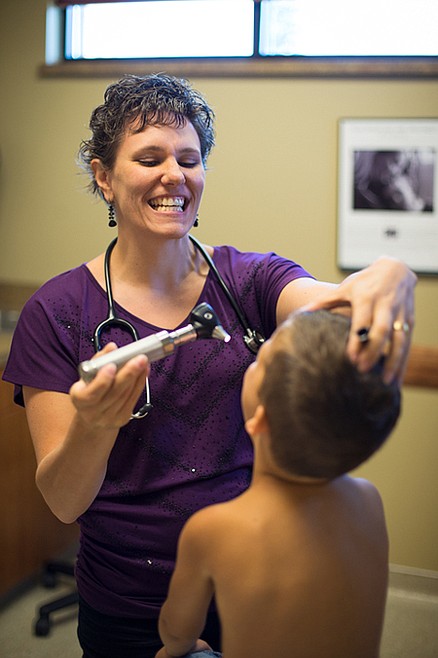
<p>Dr. Cheri Savage, with Coeur d'Alene Pediatrics, checks up on a patient Friday in the Hayden office. Savage emphasises proper hydration to help children stay healthy in hot temperatures.</p>

<p>Basking in the 95 degree heat, Melissa Gaetano enjoys a day in the sun with her family Tuesday afternoon at Independence Point in Coeur d'Alene. Steady hydration and regular breaks from being out in the sun are the key to avoiding heat-related illness, medical professionals say.</p>

Yeah, yeah, yeah.
You wait all year for beautiful weather and then, when it finally arrives, some newspaper story goes and tells you to get out of the sun.
Not true. We're only suggesting that you behave sanely.
Here's a reality check: Heat is the No. 1 weather-related killer in the U.S. According to the Centers for Disease Control (CDC), between 1979 and 2003, excessive heat caused more than 8,000 deaths nationally.
Dr. David Chun, an emergency-medicine physician at Kootenai Health, said, "Every day when I come to work during a heat wave in a community like this one - a community that normally doesn't suffer temperatures much above the 80s - it's pretty routine to see patients who may be ill as a consequence of the heat."
Who gets hit the hardest? The experts say it's the very young and the old. But that's just for starters. You're also at risk if you have a chronic condition such as heart or lung disease or are susceptible to seizures.
"Certain medications - heart medications in particular - also put people at significant risk when combined with heat," said Dr. Steven Malek, longtime ER physician at Kootenai Health. "We're changing the dynamics of the circulatory system with those medications."
Medications like diuretics and ADHD stimulants can also cause problems.
And even if you're young and strong, you can be at risk for heat problems. Heavy-duty activities like football, road construction, utility work or military basic training can easily turn into high-risk endeavors.
"All kids are at risk because they play outside more," said Dr. Cheri Savage, a pediatrician at Coeur d'Alene Pediatrics. "Infants are at even higher risk because they don't have a way of letting people know they're thirsty.
"Children who are obese are at higher risk because when they do drink fluids, those fluids get into their fat storage and don't make their way into the circulating blood supply as easily. Also, obese kids don't exercise regularly, so they're less acclimated (to the heat) when they do exercise."
The elderly also need to take special care in high-temperature environments. Chun said, "People in their 60s and beyond - particularly those with chronic medical conditions - are more susceptible to heat problems."
The two biggest moves you can make to protect yourself from the heat are drinking a lot of water and staying cool.
"Hydration, hydration, hydration," Malek said. "Any fluid is better than no fluid, though water is far and away the best. Stay away from alcohol because alcohol is definitely dehydrating."
He added that salt pills can be dangerous - especially for those with cardiac issues.
Savage recommends prehydration prior to going outside in the weather. "I tell athletes they need to be drinking well before they go out to a game or practice so they've got some underlying hydration. During practice, they need to break every 20 minutes, find some shade, take off their helmets and get some sports drinks in them. Under normal circumstances, sports drinks should be reserved for exercise that is planned to last longer than an hour."
What can happen to you if it's killer-hot outside and you haven't taken any precautions?
At the low end of the risk scale is heat exhaustion.
"Heat exhaustion is a pretty nebulous term," Malek said. "Symptoms like dehydration, light-headedness, nausea and cramping are all part of it. People can also develop fevers and headaches, but the most common thing we see here is dehydration."
Other symptoms may be sleepiness, goosebumps, blurry vision and clammy skin.
If you feel like you've been struck down with full-blown heat exhaustion, a trip to the ER might be in order. When you need to be seriously rehydrated, you won't be able to do it effectively at home.
"We use cool (intravenous) fluids to cool the central core of the body," Malek said. "We can reverse heat exhaustion pretty quickly here - usually within a couple of hours."
If you're in the earliest stages of heat stress, the Mayo Clinic recommends you get to a shady or air conditioned location immediately and cool off. Take a shower or a dip in a stream. And, as always, drink fluids and lots of them.
"When kids have a little fever from the heat, cold Gatorade is good, as is getting them to a cool environment," Savage said. "One way to cool kids off is to strip them down and put ice packs in their armpits and groin. I often feed them popsicles to cool their core temperature."
At the other end of the danger scale is heatstroke and this is definitely a 911 emergency.
"If we're seeing people in the hospital, they probably waited too long," Chun said. "Most people who are aware that heat is affecting their body generally remove themselves from that heat, drink water and find cool shelter. When we see people here, it's those who have not factored caution into their strategies for success."
According to Malek, "Heatstroke is basically a collapse of the body systems due to inability to compensate for heat exposure. What happens is you have the ability to try to regulate your body heat through skin and evaporation - people sweat and the evaporation from the sweat allows the body to cool.
"But when you reach a point where you can no longer create enough evaporation off your skin to cool your body - either because of dehydration or because the heat exposure is too great - you're at risk for heatstroke."
Some of the signs of heatstroke are: a body temperature greater than 103 degrees with accompanying delusion, rapid pulse and coma.
"Most people with heatstroke are really really sick," he cautions. "This is a whole different level of illness than heat exhaustion. Very careful fluid management is necessary to try to reestablish a normal level of hydration. This requires very close monitoring."
Savage said that heatstroke has a tendency to hit the elderly especially hard. She warned caregivers against leaving an immobile older person outside in the heat.
Now here's a sobering thought about what happens when you leave someone in a closed car - cracking the windows doesn't count - in 80-degree outside temperatures. In 10 minutes, the interior temperature will be 99; in 20, it will be 109 and at the end of an hour, temperatures inside that vehicle will be 123 degrees.
Remember your pets in the hot weather and don't forget the sunscreen. Idaho ranks No. 8 nationally in skin cancer cases.
When to worry:
n Warning signs of heat exhaustion include:
*Heavy sweating
*Paleness
*Muscle cramps
*Exhaustion
*Fainting
*Nausea
*Vomiting
n Warning signs of heatstroke include:
*Body temperature greater than 103 degrees
*Red, hot and dry skin
*Strong, rapid pulse
*Throbbing headache
*Dizziness and nausea
*Confusion
*Unconsciousness
Source: The Centers for Disease Control
ARTICLES BY GEORGE KINGSON

Rallies not really about machines

George Green: Passion to save the Playhouse
IN PERSON
George Green became executive artistic director of the Lake City Playhouse in 2010. Under his direction, playhouse budgets have increased dramatically as has the level of audience enthusiasm.

Pat Raffee: Grace under pressure
IN PERSON
Pat Raffee is Kootenai County chief deputy county clerk. She was hired in 2011 by County Clerk Cliff Hayes, who died in office last December. She currently works under Jim Brannon, who was appointed interim county clerk by the Kootenai County Commission. Raffee's background includes contract positions as executive director of two Idaho urban renewal agencies (Moscow and Post Falls), extensive consulting in the private sector and a recent appointment to the Idaho Commission for Libraries by Gov. Butch Otter.