
In Person: Ron and Nanci Jenkins
George Kingson | Hagadone News Network | UPDATED 12 years, 9 months AGO
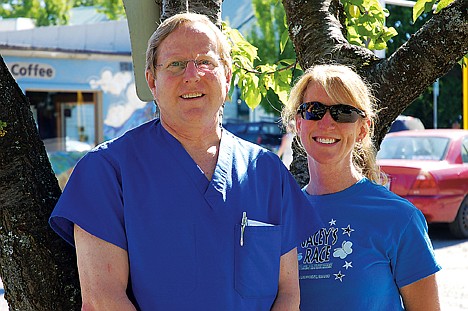
<p>Ron and Nanci Jenkins, organizers of next weekend's Jacey's Race in Sandpoint.</p>
For event organizers Ron and Nanci Jenkins, it's the busiest time of the year - the countdown to next Sunday's Jacey's Race in Sandpoint. A community event held to raise awareness of childhood cancer and other life-threatening illnesses, the race is now in its 11th year.
When Nanci's 4-year old daughter, Jacey, was diagnosed with a form of kidney cancer back in 2001, Nanci's colleagues rallied around to help with the steep out-of-pocket expenses she faced from her mounting medical bills. Out of the fine work of these volunteers came the first Jacey's Race.
It's not your ordinary race - it is, instead, a virtual community happening. In addition to the 5K, there's a 1K fun run, as well as a variety of games and activities throughout the morning.
Today Jacey herself is a healthy 16-year old with a 4.0 grade-point average. She's a cross-country runner, softball player and a daughter Nanci describes as, "the type you can trust to do what she says she'll do."
Following is an interview with Ron and Nanci Jenkins, the energetic family behind Jacey's Race.
How did it all start?
Ron: Our very first race was in Boulder, Colo., in 2001. Our intention was to benefit Jacey and her family (with expenses). I'm a cardiologist and Nanci's a dietitian and at the time we were colleagues. We were all trying to figure out what to do to help.
Nanci: I was out of the picture at that point. The doctors said that Jacey was Metastatic Stage IV Wilm's Tumor. I was learning a whole new vocabulary and doctors were after me to make decisions about things I didn't know anything about. I was so obsessed - I had absolutely nothing to do with that first race.
Ron, were you used to asking for help?
R: Not really, but I knew a lot of people. Thank goodness the people who really knew how to do these sorts of things stepped up and did something. I got an education quickly on how to make a race work.
Tell me about that first race.
N: Jacey was really sick that day and she wasn't supposed to go, but she wanted to go, so we did. And then she was surrounded by all these little kids who loved her - and she just lit up. I saw my patients there, but I also saw hundreds of people I didn't know.
I swear it was a turning point for Jacey. She started getting better and I believe it had everything to do with that day.
And after race day?
R: I thought it was done and yay! I think it was Nanci who said, "That was so good, I think we need to do this again." So I took a deep breath and said, "OK, we'll do it."
N: I wanted to give that feeling to somebody else. It felt like a real gift.
R: We knew about other families through Jacey's oncologists and asked them who else needed a boost. Finding kids who really really needed the help - psychological, family support and money.
What happened when you moved to Sandpoint?
R: We'd done the race for four years in Boulder - it wasn't going to go away. And I thought it was a great experience - so powerful. It was the right thing to do.
You have to know, though, that it's a huge undertaking. For a given race, there's all this background stuff: the permits, getting donations, the prizes, the advertising, the volunteers. You can't pull it off without a lot of help.
What motivates you to keep doing it?
R: Every time you have the race and you have these little kids and see them looking in awe at this huge crowd - you think you did something good.
And that's precisely why we do the race, so that the child sees the community there supporting them. As a physician I know we need more than pills, radiation and chemo for healing.
N: When we first moved up here, it was as if childhood cancer didn't happen. Nobody was aware of that child.
We need to publicize that there are children dealing with things you can't imagine. We need to tell the community they're here - be aware - let's have some love and kindness for our children.
What about the money?
R: It's given with no strings for the families. Typically families have received from $2,000 to $4,000. We often give the child a gift at the race and that might be a new bicycle, a new snowboard or maybe a laptop.
It doesn't matter how much we make. Whatever it is, we divvy it up among the children.
People always wonder how much money goes to the administrative end of any fundraiser. How does Jacey's Race handle this?
R: We have no administration, no salaries - no paid staff. We're all-volunteer. I'm usually the one writing the checks. Generally (after expenses) 30 percent goes to organizations such as Wishing Star Foundation and 65 percent is divided among four families.
I sit down and write the check and then Jacey and Nanci go to the house and say, "Here's your money."
Tell me a Jacey's Race success story.
R: We had one little girl who had leukemia and her family had abandoned her. When we initially met her, there was a problem with her getting a bone marrow transplant.
N: Jacey and I would go visit her in the hospital and nobody else was there for her. Her family ws falling apart, so we brought her into our circle and gave her a lot of attention. She eventually got the money for the bone marrow transplant in Seattle.
R: In some ways we made that happen.
What about community involvement?
R: The importance of giving back to your community cannot be overstated. At any given moment, you or your neighbor could have a disaster and we're kind of all in this together. You get to know people's character when you find out who has the time and energy to help and who doesn't
We try hard to get young adults - high school kids - involved and to teach the message of community service early in life.
It's one thing to say "hi" in a nursing home, but another thing entirely to get involved in something from start to finish."
What impact does Jacey herself have on the race?
N: We still do this for Jacey, so she can see the power of giving back. The fact that she's so healthy and vibrant - all these little children can see her that way - it's like the light at the end of the tunnel. She always makes sure she gets to know all the children. We call her the "race ambassador."
And next year?
R: You know, periodically, we'll say to each other, "Oh gosh, we can't keep doing it." But then, after the race, we always say, "That was a good thing."
Jacey's Race, a 5K & 1K run/walk, will start at Sandpoint High School on Sunday, July 14 at 8:30 a.m. for the race and 9:15 a.m. for the kids walk. For more information: www.jaceys-race.com
ARTICLES BY GEORGE KINGSON

Rallies not really about machines

George Green: Passion to save the Playhouse
IN PERSON
George Green became executive artistic director of the Lake City Playhouse in 2010. Under his direction, playhouse budgets have increased dramatically as has the level of audience enthusiasm.

Pat Raffee: Grace under pressure
IN PERSON
Pat Raffee is Kootenai County chief deputy county clerk. She was hired in 2011 by County Clerk Cliff Hayes, who died in office last December. She currently works under Jim Brannon, who was appointed interim county clerk by the Kootenai County Commission. Raffee's background includes contract positions as executive director of two Idaho urban renewal agencies (Moscow and Post Falls), extensive consulting in the private sector and a recent appointment to the Idaho Commission for Libraries by Gov. Butch Otter.