
Montana's federal economic footprint
Patrick Barkey | Hagadone News Network | UPDATED 13 years, 1 month AGO
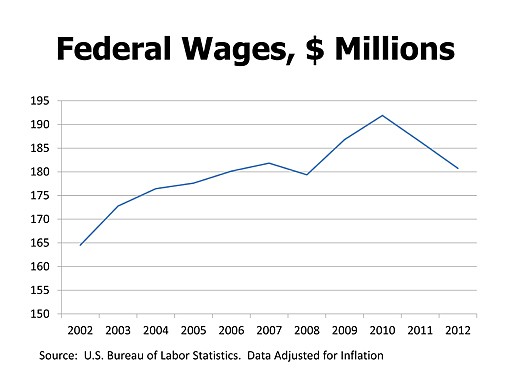
Federal wages in Montana
It’s been quite a party, but the hangover might be a doozy. After four straight years of trillion-dollar annual budget deficits, the news is dawning on all political parties that the federal budget is long due for serious repair, and that less spending is part of the process. As a state that historically has gotten $1.50 back for every dollar it sends to Washington, what does that future bode for Montana? Will our pain be more or less than other regions?
It is not just communities like Great Falls, home to Malmstrom Air Force Base, where the federal government presence in our state is felt. Federal agencies like the Forest Service, Bureau of Land Management, and Customs and Border Patrol provide some of the best paying jobs in Montana’s many smaller communities. Not to mention the veterans facilities, tribal governments and even Medicare and Social Security recipients with a stake in the federal government’s future path.
Talk of budget pain in Washington has been subdued in recent months, but this is illusory. Economic growth has closed this year’s federal budget deficit, just as has happened in the recoveries from previous recessions. But believe it or not, the ups and downs of deficits as the economy contracts and grows is not the problem that needs fixing. It’s the fundamental imbalance between spending on entitlements now upon us as baby boomers retire, on the one hand, and the tax burden on what will be a relatively smaller working population, on the other.
We’re not smart enough to predict how and when precisely that imbalance will be addressed. But as forecasters, we know that it has to be. And so as we prepare our predictions for the Montana economy as part of the Chamber’s Economic Update program, we must consider how a lower trajectory of federal government spending would play out in a state economy that has traditionally punched above its weight in attracting federal funds.
In fact, we’re already been seeing declines in government spending at all levels in Montana. The total payroll of federal workers in Montana has declined by about 6 percent, inflation-corrected, over the past two years. But those declines are largely a wind-down from the stimulus-related increases of similar magnitude in the two years prior to that. A change in the overall path of the federal government’s presence in Montana, as the accompanying graph makes clear, hasn’t happened yet.
But this is about the only graph that is heading downward for the Montana economy of late. The news on the private sector economy remains remarkably upbeat, with double-digit growth in income tax receipts in Helena persisting right through the year’s midway point.
It’s too early to be sure, but the evidence points to a strengthening in business proprietor income, related in part to construction and energy activity, as a main cause. All in all, our forecast of accelerating activity in Montana’s economy that we made at the beginning of this year is holding true.
—————
Patrick Barkey is director of the Bureau for Business and Economic Research at the University of Montana. He will speak on “Montana’s Federal Economic Footprint: The Local Impact of Changes in Washington” with BBER director emeritus Paul Polzin at the Montana Chamber Foundation’s eight annual Midyear Economic Update series. The series will be held in seven Montana cities and will kick off Thursday, Aug. 1, in Kalispell. For more information or to register, visit online at www.bber.umt.edu or call BBER at 406-243-5113.
ARTICLES BY PATRICK BARKEY
The puzzle of the Montana economy
You wouldn’t think that the economy we all live and work in would be such a mystery. Especially in this information age. Yet the state of the state economy — and especially for Montana’s cities and communities — can be frustratingly hard to assess sometimes. And this may be one such time.
There are questions we should ask about oil prices
After an election season that featured plenty of frowns about the state of the economy, a different kind of debate has broken out with the sudden plunge in crude oil prices. Will $2 per gallon gas prices be good for the economy? Or will they be fantastic? Less money being spent by all of us filling up our tanks has given the economy a boost, it is said, with the only squabble being over just how big that boost will be.
Montana's economy: smooth sailing toward a cliff?
A lot of things started to fall into place for the Montana economy in 2012. Strong income growth, led by counties in proximity to the Bakken oil fields, pushed up state income tax collections to near double-digit rates of growth. Dry conditions last summer were certainly felt by Montana farmers and ranchers, but most escaped the full brunt of the drought and heat that devastated our nation’s corn producers. And the slowdown in health care growth in 2009-2010 proved short-lived, as Montana’s hospitals, practitioners and other health facilities resumed faster growth last year.