
The reality of kidney stones
George Kingson | Hagadone News Network | UPDATED 12 years, 9 months AGO
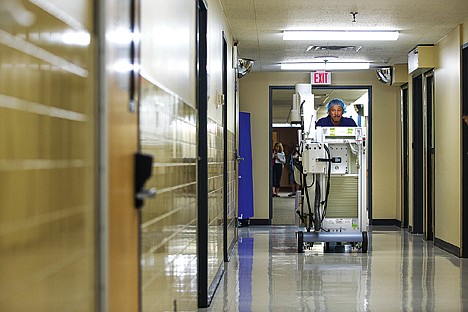
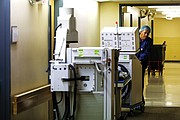
<p>Lithotripter tech for North Idaho Urology, Jonas Keys pushes the lithotripsy machine, nick named B.O.B (bucket of bolts), through the halls of the Kootenai Medical Center emergency room Wednesday.The machine uses sonic waves to break apart kidney stones in patients without surgical intervention.</p>
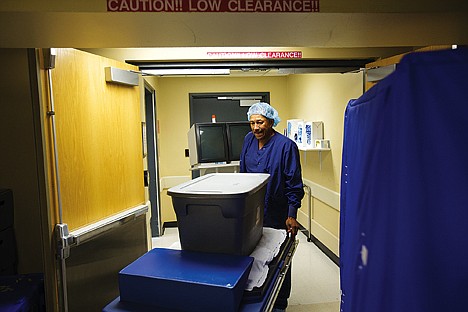
<p>Jonas Keys, a lithotripter tech, pulls parts of a lithotripsy machine from an elevator at Kootenai Medical Center Wednesday afternoon. Lithotripsy machines are used by urologists to break apart kidney stones without the use of surgery.</p>
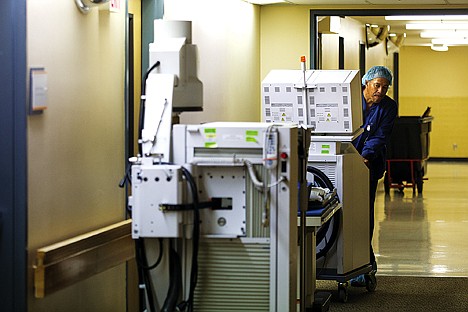
<p>Before it is transported to another hospital, lithotripter tech Jonas Keys puts all three parts to a lithotripsy machine into a hallway at the Kootenai Medical Center emergency room Wednesday afternoon. The machine is used to break apart kidney stones in patients without the need for surgery.</p>
So what does a kidney stone attack feel like?
"I woke up and thought my wife had stabbed me."
"I begged the doctor to kill me."
"Being flayed alive might be just a bit more painful."
The above comments were blogged by perfectly ordinary folks with kidney stones. They have all managed to capture the true essence of the experience.
Nearly four million people annually in this country are affected by kidney stones and that number is on the rise. According to the Mayo Clinic, heat, humidity and poor hydration are major contributors to the problem, making summertime an especially vulnerable season.
"We often see a lot of kidney stones in here at the end of summer and in the fall," said Dr. Edward Ellison, a board certified urologist at North Idaho Urology.
"If urine becomes too concentrated - if all the minerals, especially calcium, are pushed together in a tight space, these minerals can become supersaturated, fall out of solution and become crystals. Once a crystal starts, it can turn into a stone and enlarge."
The National Institutes of Health describes kidney stones as varying in size and shape. Some "may be as small as a grain of sand or as large as a pearl. Stones may be smooth or jagged and are usually yellow or brown."
Occasionally, though rarely, some stones may even become golf ball-sized.
Ellison said it typically takes stones months to develop, although sometimes it may take years.
Thankfully, not all stones will cause the above-described pain.
When it comes to kidney stones, movement is the enemy.
"The pain is typically caused by obstruction and blockage," Ellison said. "The stone may move down (the ureters) between the kidney and bladder and subsequently get lodged in the tube. This will create a back pressure in the system."
That particular configuration of the sun, moon and stars can constitute a four-alarm event.
According to the U.S. National Library of Medicine, kidney stones have many symptoms. The crown jewel among them, alas, is "severe pain that starts suddenly and may go away suddenly. It may be felt in the belly area or side of the back. It may also move on to the groin area."
Other symptoms include a nagging lower back pain - usually on one side or the other - blood in the urine, fever, nausea and vomiting.
What causes kidney stones?
Genetics, for one, Ellison said. If way back when you were a kid you can remember seeing your dad writhing in pain on the floor, chances are good you might have a predisposition for kidney stones yourself.
Poor hydration is another longstanding cause. Experts say that drinking too little water - or consuming too many soft drinks or caffeinated beverages - can produce concentrated urine. Recent excessive consumption of soft drinks may, in part, be responsible for the increase in childhood kidney stones.
Ellison advised people to pay attention not only to the amount of water they drink, but to the kind of activities they engage in. What's sufficient water for a sedentary reader may not be nearly sufficient for a runner. The key word here is "perspiration."
He also said that for people without a genetic predisposition for kidney stones and for those who have no prior experience of them, there is such a thing as drinking too much water.
For most people, the Mayo Clinic advises, "If you drink enough fluid so that you rarely feel thirsty and produce 1.5 liters (6.3 cups) or more of colorless or light yellow urine a day, your fluid intake is probably adequate."
Another cause of kidney stones - and one that has been on the rise in recent years - is obesity.
"We know and have known that obesity is a risk factor," Ellison said. "We know that people who have a high BMI (body mass index) have a higher incidence of kidney stones and we think that obesity in kids may be partially responsible for the increase in childhood kidney stones."
If you end up with a kidney stone, there are several ways it might be treated.
On the least invasive end, the urologist may give you painkillers and recommend simply "watching." If it's a small stone, it may pass fairly easily on its own.
If it's a larger stone, Ellison said, treatment may involve lithotripsy. This is a procedure where a machine capable of producing several thousand shock waves is used to blast the stone into fragments. The success rate of this is about 85 percent.
Moving up the invasiveness ladder, the next treatment is ureteroscopy, a procedure where a physician uses a laser scope to enter through the bladder and continue up through the ureter. The scope applies laser energy to the stone to help break it up and/or to get hold of it with a tiny basket device on the instrument.
At the top of the invasiveness scale is percutaneous surgery. In this case an incision is made into the kidney through the patient's back and the stone is surgically removed. The first two treatments are same-day procedures while percutaneous surgery involves a hospital stay.
Randy Collings has had hundreds of kidney stones in the past dozen years, all of them of the common calcium oxalate type.
"It's the worst pain I've ever been in and that includes a broken back. I had no noticeable symptoms and no prior pain and all of a sudden I woke up in the middle of the night and it was like a sonic boom."
Collings said that over the years he's had more than his share of stone-removing procedures. Today his care is closely managed by both a urologist and a nephrologist - the former a specialist in urinary tract problems and the latter an expert in kidney function.
"I'm on four daily medications," Collings said. "I drink as much liquid as I possibly can - I feel like a fish and that's no lie - and I follow as closely as I can with a low oxalate diet."
According to information provided by Tamara Smith, RD, Clinical Nutrition Manager at Kootenai Health, "Nutrition therapy for people with calcium oxalate stones is directed at limiting high-sodium (salt) foods, high oxalate foods and adequate fluid intake. Increased sodium intake causes increased calcium excretion because high sodium intake decreases calcium re-absorption by the kidneys."
High-oxalate foods include rhubarb, spinach, wheat germ, peanuts and chocolate. A more comprehensive list from the University of Pittsburgh can be found at http://www.upmc.com/patients-visitors/education/nutrition/pages/low-oxalate-diet.aspx
Good advice on how to avoid kidney stones comes from Ellison: "Lead a healthy life. Stay hydrated; if you're overweight lose weight; and if you have symptoms, get medical care."
Kidney stones
Tips for avoiding
* Drink water
* Dial down the amount of protein, sodium and sugar in your diet.
* Ease up on oxalate-rich foods like spinach, nuts, wheat bran, tofu and chocolate.
* Drink water
How common are they?
* Up to 13 percent of men will get one
* Six to seven percent of women can expect one
* The median age of children with kidney stones is now down to 10
* Once you've had one kidney stone, you're at risk of getting another.
- The Mayo Clinic
ARTICLES BY GEORGE KINGSON

Rallies not really about machines

George Green: Passion to save the Playhouse
IN PERSON
George Green became executive artistic director of the Lake City Playhouse in 2010. Under his direction, playhouse budgets have increased dramatically as has the level of audience enthusiasm.

Pat Raffee: Grace under pressure
IN PERSON
Pat Raffee is Kootenai County chief deputy county clerk. She was hired in 2011 by County Clerk Cliff Hayes, who died in office last December. She currently works under Jim Brannon, who was appointed interim county clerk by the Kootenai County Commission. Raffee's background includes contract positions as executive director of two Idaho urban renewal agencies (Moscow and Post Falls), extensive consulting in the private sector and a recent appointment to the Idaho Commission for Libraries by Gov. Butch Otter.