
Living history
MAUREEN DOLAN | Hagadone News Network | UPDATED 12 years, 9 months AGO
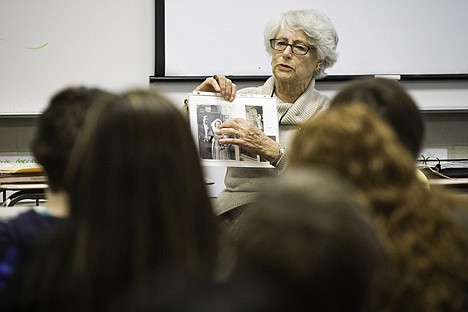
<p>Carla Peperzak shows photographs from Germany in the 1940s while telling stories of her childhood and how she was able to survive the Holocaust during a presentation Monday at Woodland Middle School.</p>
COEUR d'ALENE - Carla Peperzak held up an old photo of a bride and groom taken in the Netherlands on their wedding day.
Speaking to a group of students Monday at Woodland Middle School in Coeur d'Alene, Peperzak said there was something hidden from the photographer's lens on that day in 1941 - two stars. Required to be stitched on to Jewish citizens' clothing, one adorned the bride's gown; the other was on the groom's suit.
Not long after the wedding, Peperzak, a member of the Dutch Resistance, helped the Jewish couple go into hiding from the Nazis then occupying Holland.
The Spokane woman, Jewish herself, was born and raised in Amsterdam. She was in her late teens in the spring of 1940 when the Germans invaded the Netherlands.
"They promised they wouldn't do anything to the Jewish people like they were doing in Germany," Peperzak said. "But of course, they did."
Peperzak, born in 1923, recalled a happy childhood in Amsterdam before the war.
Peperzak's father was Jewish. Her mother was not Jewish by birth, but had been orphaned as a child and was raised by a Jewish family.
"The Netherlands was a very open and very tolerant country," Peperzak said.
For hundreds of years, the government had allowed people from other countries to seek refuge there, she said. As a result, there was a large, very integrated Jewish population living in Amsterdam at the time of the war.
Following the Nazi occupation, younger men began to become scarce in the city, she said.
"They were all sent to work in German camps or they went into hiding," she said.
When Nazis began requiring Jewish residents to register their ethnic status, Peperzak said many of Amsterdam's Jewish citizens did so.
"They didn't think it would be a problem," she said. "Some didn't register. Those were the wise ones."
Soon, the Jewish residents who registered had their businesses raided and their money confiscated from their bank accounts. The children were not allowed to attend public schools, Peperzak said.
All residents were forced to carry identification cards with photos and if a person was Jewish, there was a large "J" next to his or her photo.
Peperzak's father found a way to purchase an ID card for her that did not indicate she was Jewish.
"The result was I did not have to put on a star," she said.
Jewish citizens were not allowed in most shops, nor were they allowed to use most forms of public transportation.
When the Germans started to round up Jewish people to be sent to Germany, Peperzak's uncle asked her to help his family go into hiding. She got them new identities, with paperwork bearing non-Jewish names.
Peperzak helped them get medicine and food while in hiding, using rationing cards either stolen from a distribution center or smuggled into the Netherlands from England.
During the German occupation of her country, she helped about 20 people go into hiding in this manner.
Peperzak lost about 80 percent of her own relatives during the Holocaust.
One relative, a woman, was put on a train headed for Germany with her children. Peperzak put on a German nurse's uniform and boarded the train and took the woman's youngest child, a 2-year-old boy. She was stopped by the Nazi soldiers who checked her papers and let her go. Peperzak told them the boy was her son and he needed medical attention.
The husband of one of Peperzak's good friends was picked up by the Germans. The friend was pregnant at the time. When she was at the hospital giving birth, the Nazi soldiers went to her house to get her. Some neighbors got a message to the woman that the soldiers were headed to the hospital for her. She didn't think the Nazis would take a 2-day-old baby, that it would be safe, so she left the infant there and escaped.
The woman was wrong, Peperzak said. The soldiers took the baby.
Peperzak tried desperately to find a way to get the infant, until she got a call from an uncle.
"He heard that I was trying to get this baby away from the Germans," she said. "He told me to stop, that it was too dangerous."
Peperzak moved, with her husband, to the United States in 1948. She has lived in Spokane for eight years.
During a question and answer session following her talk at Woodland Middle School, Peperzak was asked what the consequences would have been had she been caught helping the people in hiding.
"I wouldn't be sitting here now," she said.
Before the Germans invaded Holland, Peperzak's family lived a block away from the family of Anne Frank, before the Franks went into hiding in Amsterdam. Anne's sister, Margot, was in Peperzak's Hebrew class. Anne was six years younger than Peperzak, so she didn't know the famous diary writer.
"Her book has tremendous insight. It's more important than any other book on the Holocaust. It made more of an impact than the Nuremberg Trials," she said.
Peperzak encouraged the students to do what Frank did, to document their own experiences, especially when things aren't going well.
"If you feel angry, mad or upset about something, write your feelings down," Peperzak said. "Then you don't have to take your hate and misery out on people."
She suggested to the students that they consider entering an essay contest now under way through the Human Rights Education Institute in Coeur d'Alene.
The deadline for middle and high school students to submit an entry is Saturday.
Details are available online at www.hrei.org
ARTICLES BY MAUREEN DOLAN

Daylight saving time begins today
If you arrived an hour early to everywhere you went today, you might have forgotten to move your clock back. Yep, it's daylight saving time. Daylight saving time officially ends at 2 a.m. Sunday, Nov. 5, and returns on March 10, 2024, when clocks are moved an hour forward.

Time to 'fall back'
Daylight saving time officially ends at 2 a.m. Sunday, Nov. 5 and returns March 10, 2024, when the vast majority of Americans will then “spring forward” as clocks are set an hour later.

Fires, smoke continue to affect region
Smoke from the region's wildfires continued to affect air quality Monday as firefighting response teams continued to battle multiple blazes throughout North Idaho and Eastern Washington.