
Outdoors classroom
Phil Cooper | Hagadone News Network | UPDATED 12 years, 10 months AGO
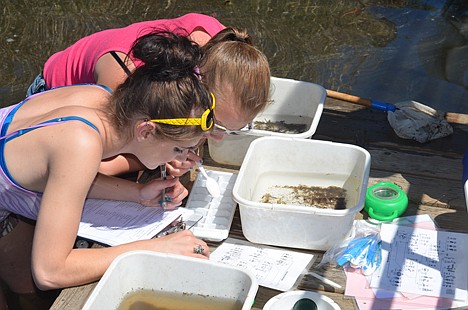
<p>St. Maries High School sophomores Julianne Shearer, left, and Kristin Womack classify aquatic insects in The Lands Council's Project Sustain program.</p>
Recognizing the challenges that school districts face in funding field trips for science classes, The Lands Council solicits sponsorship funding from business partners to help students get outside to learn about the environment.
TLC is a Spokane-based nonprofit whose mission is to preserve and revitalize Inland Northwest forests, water and wildlife through education and community engagement.
Once in the field, they become engaged in hands-on, science-based educational activities that enhance their classroom learning.
Business partner funding through TLC covers school field trip transportation costs, lesson plan materials, activities and other associated expenses.
Called Project Sustain, the program gives kids a chance to apply what they learn in the classroom in an outdoor setting.
Schools apply for Lands Council grants of $1,200 per school to cover expenses associated with four or five field trips. They also receive up to 10 hours of TLC-led classroom lessons during the school year as part of the grant.
The program closely aligns with existing school curricula. By participating in activities in the field, students increase their knowledge and field skills and develop a heightened sense of environmental stewardship.
Idaho Department of Fish and Game Aquatic Educator Jim Burkholder, IDFG Fisheries Biologist Pete Rust and I recently had the opportunity to work with The Lands Council's Conservation Program Director Kat Hall on the Project Sustain program.
We worked with high school students and teachers from Lake City, Post Falls and St. Maries.
Students collected water quality data from Rose Lake in the fall, winter and spring. Using sampling kits provided through the University of Idaho's IdaH20 Master Water Stewards program, they collected water quality data on the shoreline as well as in the center of the lake.
Knowing that their data would be entered into the Master Water Stewards online database upon their return to school, students experienced and learned firsthand the true value of accurate and precise measurements and data collection techniques.
Students measured water clarity, calculated dissolved oxygen levels, determined water pH, recorded water temperatures and had fun digging in the mud for macroinvertebrates and classifying them.
They learned the importance of consistency in scientific work by recording GPS locations where they sampled.
The experience took their comprehension of water quality testing, data collection, data recording ... and science in general to an entirely new level. They reached a level that would never be achievable in a classroom setting.
Students from all three high schools recorded and posted data and have been meeting through the Idaho Education Network to communicate results through live, interactive videoconferencing. Here are students from three different high schools, working collaboratively as citizen scientists to answer the question: "How do abiotic and biotic components of water quality at Rose Lake depend on seasonality?"
I don't know how education can get any better than that.
Through their studies of freshwater aquatic ecosystems and their background research in their classrooms, these students have developed a keen interest in the natural resources that could lead to rewarding and significant careers as natural resource managers.
The area business sponsors of the Lands Council fund this terrific learning opportunity and without them such experiences would not be possible.
Kat Hall of the Lands Council and teachers Jamie Esler of Lake City High, Cindy Rust of Post Falls High and Rusti Kreider of St. Maries High are to be congratulated for providing these valuable experiences to students in our area.
I am sure many of these students will remember these as among the best teachers they ever had.
On the bus ride back home over Fourth of July Pass, Esler asked a student how she felt after the day of field work out on the lake. "I'm tired," she said. "But it's a good tired. I feel like I accomplished something today. Learning about science meant something to me today."
Providing area youth with engaging, meaningful, outdoor, experiential, place-based educational experiences cannot be repeated within the walls of the classroom. When we work together, we can show the great state of Idaho why it is so important to take care and responsibility for our natural environments, resources and places of recreation.
"As a public educator, and as a local resident, I am very thankful for the hard work and generosity of all parties involved in this project," Esler said. "Our students are never going to forget this one. I am already looking forward to the next field trip."
So am I, Mr. Esler.
Phil Cooper is the wildlife conservation educator at the Idaho Department of Fish and Game.
ARTICLES BY PHIL COOPER
Controlled hunt tags must be purchased by August 1
Conversations this time of year among hunters often start with the question “Did you draw any controlled hunt tags?”
IFG: Dogs, deer don't mix
Last week brought the first snowfall of the season to much of the Panhandle. Relatively early snows are exciting news to skiers and snowmobilers who love to be enjoying their pursuits by Thanksgiving. With the holiday coming late in the month this year and snow already falling, many are optimistic they will be on the slopes and groomed trails on turkey day.
National Fishing Week is first week in June
The outstanding weather we have been experiencing the past couple of weeks makes it easy to understand why we have chosen to live in the great Pacific Northwest.