
When wolves and Montanan habitats collide
Adam Robertson/Mineral Independent | Hagadone News Network | UPDATED 12 years, 1 month AGO
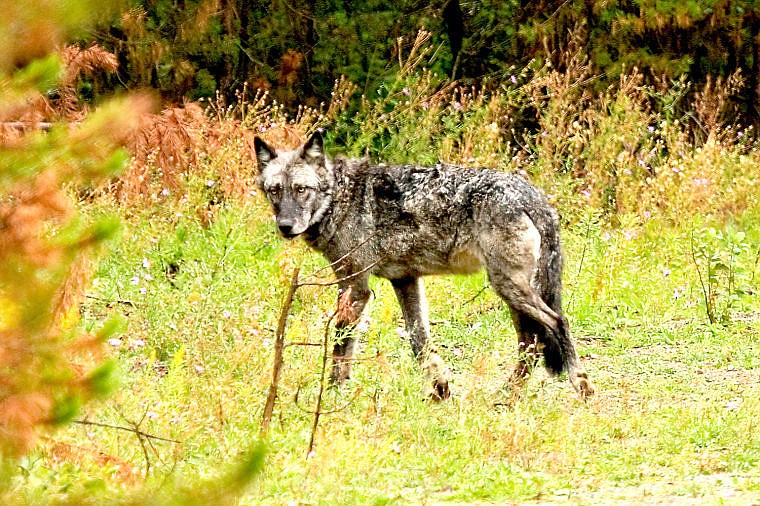
<p>A wolf wanders through a field. If a wolf or pack begins causing problems for a populated area, investigations will begin to find and potentially euthanize the problem wolves.</p>
Wolf experts give facts about the animals and what happens when they share human lands
MINERAL COUNTY – With how common wolves are in Western Montana a large amount of importance is placed on tracking their numbers and movements.
According to Game Warden Justin Singleterry hunters are one of the main controls of the wolf population. He mentioned the importance of getting the wolf population to a sustainable level, for the health of the area’s ecosystem, and said it was “very much needed.” He encouraged deer and elk hunters to get wolf tags, just in case they ran into some.
Singleterry related one story about a man and his daughter both getting wolves. He said they were hunting deer or elk but had wolf tags as well. As they were hunting, a pack of wolves crossed the area near them.
The man shot and killed a wolf, causing the rest of the pack to run. When his daughter went to check out the dead wolf, her father told her to wait so they could see what happened. About 45 minutes later, the pack returned to investigate their fallen member.
The wolves did not notice either hunter. While they looked over the dead wolf, the daughter was able to shoot and kill another one.
Singleterry described this as a good technique when hunting wolves with a friend. After shooting one, just wait a while and the rest of the pack will likely return, giving the rest of the group a chance at one.
Contrary to deer or elk, Singleterry said other hunters were a good source to find places with wolves.
“People are more apt to tell other hunters where they’ve seen wolves,” he said.
While it is rare, Singleterry admitted wolves have attacked people or livestock before. He said in these situations an investigation begins.
According to Singleterry, a Wildlife Human Attack Response Team would examine the evidence to determine what happened. The team has responded to attacks by bears, mountain lions, deer and wolves, although rare.
Using the puncture wounds, teeth marks and DNA, the team figures out what kind of animal was involved in the attack. From there, he said they would attempt to capture the animal, usually with traps placed near the attack site. Once they have a suspect, the team measures the teeth or horns to determine if it is the same animal. If they get a match, he said they usually euthanize it.
According to Singleterry the most humane method of killing the animal is to shoot it, though he also said they have also used drugs to put an animal to sleep. He explained the drugs were more common as a way to immobilize an animal and were mainly used to kill when shooting it was less ideal, like in a lab or a populated area.
Liz Bradley, a wolf management specialist from Montana Fish, Wildlife and Parks, also knows a lot on the subject of wolves.
One of Bradley’s jobs is monitoring the wolf populations. Her office does this by putting radio collars on wolves to track them.
According to Bradley, once a month she will go up in a plane and find the signals from the various collars. The plane will then circle lower so the number of wolves in a pack can be counted. This gives her a fairly accurate number of how many wolves are in a pack and how many packs there are in an area.
According to Bradley there is a fairly high amount of turnover on the collars as wolves will sometimes escape the collar or the collared wolf will be killed. She said it happens every year and was just part of the job. When this happens, they will try and get another wolf collared.
“It varies from one year to the next,” she said
Bradley said this tracking and population monitoring was part of why hunter reports were especially important. Such reports help identify new packs forming and allow FWP to keep track of their movements.
According to Bradley, the collars also help find wolves when they attack livestock. The collars can track down packs near the attack and determine whether any of those wolves, or the entire pack, were responsible as part of the WHART investigation.
Bradley related a story of a pack of wolves near Superior who killed a group of miniature horses in 2010. The wolves needed to be tracked down and euthanized.
Two of the wolves had tracking collars, so the investigators were able to locate the pack without much difficulty. The collars indicated the pack had been at the site of the attack. This, plus investigations confirming it as an attack by a pack of wolves, left little doubt of their guilt. While the collars do not keep track of their specific movements, the attack was in the middle of the pack’s recorded territory.
“That’s the middle of their territory, it’s not that common [for other packs to infringe on a pack’s territory],” said Bradley.
Once it was confirmed the pack was responsible, a helicopter flew out to track the wolves down and kill them. A gunner in the helicopter was able to shoot the wolves from the air.
Bradley explained how relocating problem packs, or individual wolves, was impractical. The federal government used to have a relocation program, but the wolves would often die shortly after the relocation or return to their original territory.
Over the whole state, the Forest Service removes a few packs every year. However, Bradley said there have not been many in Mineral County and this part of the state is not too big of a problem area.
ARTICLES BY ADAM ROBERTSON/MINERAL INDEPENDENT

Grand Opening
The new St. Regis Senior Center was dedicated to Maxine Flemming, a member of the center since 1983. Her name and picture appears on a plaque to be displayed in the new center.
Icy highways lead to a weekend of accidents
MINERAL COUNTY – As blizzard-like conditions swept through the area late last week Interstate 90 became an ice rink and accident reports flooded in as traffic tried to navigate the hazardous roads. The heavy snows began on Thursday, Feb. 27, and only let up periodically over the next few days. According to Mineral County Sheriff’s Office dispatch, approximately 12 accidents occurred between Thursday and Sunday, March 2. Most of these were cases where vehicles slid off the road or spun out. According to Montana Highway Patrol Trooper Charles Burton, they were almost all caused by people driving too fast on the slick roads. “The weather has definitely been a factor,” Burton said. “People need to slow down a bit.” Burton also responded to an accident where a vehicle with a trailer hit some ice and the trailer fell over. On Friday, Feb. 28, Mineral County Sheriff Ernie Ornelas and the Mineral County Sheriff’s Deputies were kept busy for most of the day assisting with the flood of calls. While there were no investigations opened, the sheriff’s office was on hand to help with the accidents. While the Superior ambulances were also busy responding to calls, there were very few serious injuries. According to Mineral Community Hospital personnel, the hospital did not see many people with injuries resulting from the conditions. Burton said the Montana Department of Transportation was doing the best they could to keep Interstate 90 and the state highways clear. It was a daunting task as the cold temperatures and heavy snow kept the roads slick. The Montana Highway Patrol recommends everyone drive safely and go a safe speed for the road conditions.

Bobcats
Tucker Smith moves to block a Hot Springs player during a Superior home game earlier this season.