
International ambassadors in Whitefish: Exchange students share their stories
Hilary MATHESONThe Daily Inter Lake | Hagadone News Network | UPDATED 12 years AGO
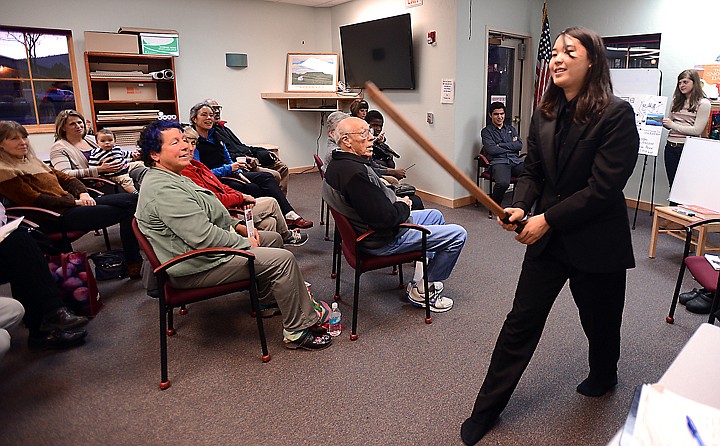
<p>Sonoko Maruyama of Tokyo, Japan, and other foreign exchange students give a presentation on their home countries on Nov. 21 at the Whitefish Community Library.</p>
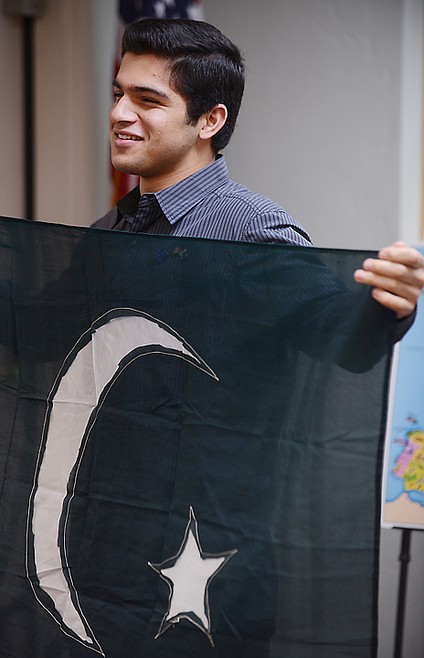
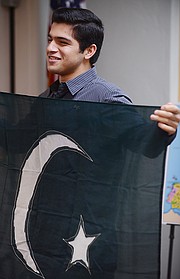
<p>Bahlol Khan of Quetta, Pakistan.</p>
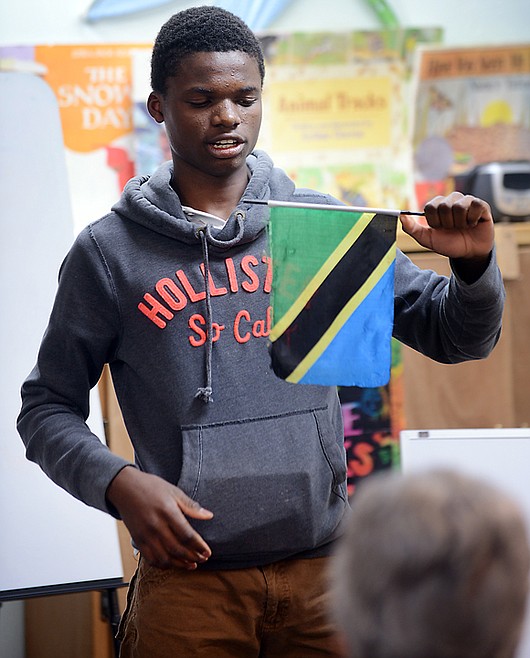
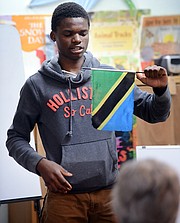
<p>Kelvin Mwangassa of Iringa, Tanzania.</p>
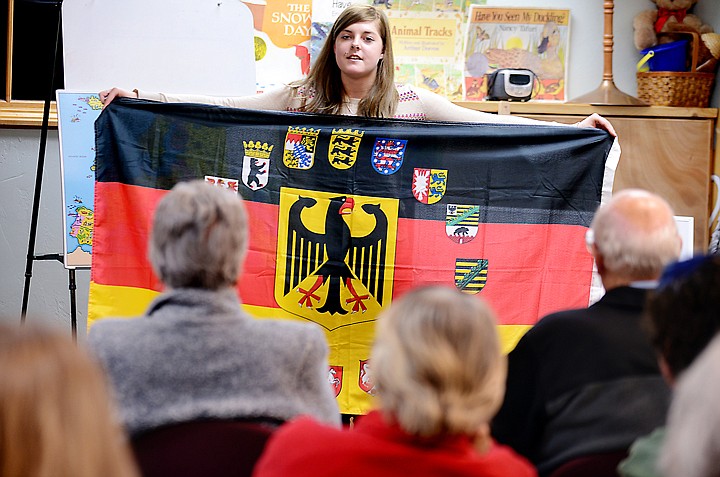
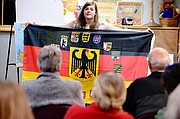
<p>Magdalena Hartenstein of Chemnitz, Germany, talks about the German education system.</p>
In a meeting room at the Whitefish Community Library, foreign exchange student Sonoko Maruyama of Tokyo, Japan, shouted spiritedly before slicing the air with a long wooden stick that mimics a sword.
With controlled movements she demonstrated basic stances and principles of Kendo, a Japanese martial art, as she finishes a presentation about her country.
Maruyama is one of four foreign exchange students attending Whitefish High School this year. Other foreign students include Magdalena Hartenstein, 17, of Chemnitz, Germany; Kelvin Mwangassa, 16, of Iringa, Tanzania, and Bahlol Khan, 17, of Quetta, Pakistan.
Whitefish has a long history of hosting not one, not two, but up to eight high school exchange students annually, according to Jerrie Boksich, a volunteer coordinator for AFS Intercultural Programs. She is responsible for making sure the students who have received various scholarships to study abroad fulfill the requirements.
Her husband, Ray, headed AFS in Montana for 15 years. Since 1989, the couple has hosted 21 exchange students through the program.
“I wanted my children to understand that Whitefish is an idyllic place to raise children, but it’s not the end all, be all,” Boksich said. “There’s a bigger world out there.”
She keeps in touch with all of her former exchange students, considering them like her children.
“They stay for a year, but they stay in your heart forever,” Boksich said.
During the recent presentation at the library, each exchange student talked about the differences and similarities between their home country and America, sharing about the food, school, family, sports, weather, government and language.
Education, for instance, is very selective and competitive in Germany. After primary school, students are channeled to different levels and formats of secondary school, Hartenstein explained, adding that schooling in America has been easier.
Hartenstein, for example, attends Gymnasium, which will prepare her for university courses. Admittance to Gymnasium and to a university hinges on grades and final exams that cannot be re-taken.
Khan receives what is considered an elite education in Pakistan, called the Cambridge system.
Instead of students switching classrooms for different periods, it is the teacher who moves from class to class.
A common tie between the students is that they are bilingual. Learning English is part of their education in addition to other language requirements. Often they learn the languages of bordering countries or tribes. Khan, for example, speaks four languages including Pakistan’s national language, Urudu, and British English. Khan speaks clearly and quickly.
“People say I’m good at English, but I got a ‘C’ grade,” Kahn said with a smile.
For most of the students school ends around 3 p.m., when extracurricular activities or what Americans consider school-day electives such as music or art take place.
For Maruyama, the school day doesn’t really end at 3 p.m. Students go to an after-school “school” where they study or participate in activities. Maruyama said she doesn’t get home until 9 p.m. in Japan.
The school day in their native countries also involves cleaning for all four students. Students are responsible for cleaning their classroom, shared areas such as a gym and bathrooms. It’s not fun, but a responsibility nonetheless.
“Cleaning is our duty,” Mwangassa said.
“We know the cleanup is very hard, so we try to keep it clean,” Maruyama added.
Kahn also broached the topic of women’s education and rights in response to Malala Yousafzai, a young Pakistani girl who gained an outpouring of international support after the Taliban shot her because of her activism for women’s education.
“Malala is famous for education. She was, unfortunately, from an area, a hub for terrorism near the Afghanistan border,” Khan said.
Women do have access to education in Pakistan, according to Khan, crediting Benazir Bhutto, the 11th prime minister of Pakistan. But the number of men attending universities there still far exceeds the number of women who get further education.
Despite the problems his country faces, Khan is proud to hail from Pakistan.
“I’m really proud of what I am because most of the things which are done from Pakistan are remarkable,” Khan said, naming a Pakistani nuclear scientist and famous cricket player. “It really doesn’t matter which tribe you belong to; it matters what determination you have, what bravery, what boldness you have to achieve your aims.”
There are new experiences for these students here. Snow is one of them.
And there are things they miss — for Hartenstein it is European chocolate and for Khan it is Pakistani pizza.
Khan and Mwangassa both noted their countries’ large Muslim populations. Both were able to study abroad with financial aid from Kennedy-Lugar Youth Exchange and Study program scholarships, which are funded by the U.S. State Department. The program supports students from countries with significant Muslim populations to come to the U.S.
Khan unrolled a Pakistani flag during his presentation and described the symbolism.
“Mostly green represents Muslims [the majority]. There are two sects, Shia and Sunni. I am a Sunni (the second largest branch of Islam). White represents the religious minorities living in Pakistan,” Khan said.
He points to the crescent moon and star.
“As you know, the crescent is an initial stage of the moon and after some time becomes a moon, so in our flag the crescent is the initial state of progress and after some time I hope it becomes a proper moon,” Khan said.
Wearing a lapel pin of the American and Pakistan flags, Kahn sees his study abroad as an opportunity to serve as an ambassador between the two countries that in recent years often have been critical of each other politically.
Answering questions and dispelling stereotypes of the two countries is his responsibility, Khan said. He has done just that, completing about 32 presentations so far.
Pakistan has two top priorities, according to Khan.
“Actually there are two most important things in Pakistan, cricket is one and the second is politics,” Khan said, smiling again.
On a serious note, he talked about Islam, which is intertwined in Pakistani culture. He elaborates on the month of fasting called Ramadan, and explained the required pilgrimage to Mecca.
In Islam, young teenagers are expected to pray five times a day. In sharing this, his sense of humor makes another appearance.
“I’m really lazy,” Khan said.
Someone in the crowd shouted, “You’re a teenager.”
“Right, most people don’t understand that,” Khan said. “In the morning it’s difficult to get up.”
Kahn also showed traditional outfits found in Pakistan, using Mwangassa as a model.
The province Khan belongs to is Balochistan, where the popular cap is the Balochi, a cylindrical decorative cap. He also showed a beret-style cap called a chitrali.
“My grandfather used to wear the same cap,” Khan said. “So this is the Pakistani cowboy hat from the northern areas of Pakistan.”
Being one of multiple exchange students has been a fun experience for the group.
After Khan finished his presentation the four students soon quickly clustered together in a corner of the room — talking and laughing like old friends.
For more information about hosting a student through AFS Intercultural Programs call Boksich at 862-3430 or visit www.afs.org.
Reporter Hilary Matheson may be reached at 758-4431 or by email at [email protected].
ARTICLES BY HILARY MATHESONTHE DAILY INTER LAKE
Board backs apartment proposal
The Kalispell Planning Board on Tuesday supported Cascade Professional Park’s bid for a conditional use permit on behalf of Chris Sund to build 12 residential apartment units along Financial Drive.

'Teach Like a Pirate'
Dave Burgess, author of “Teach Like a PIRATE — Increase Student Engagement, Boost Your Creativity, and Transform Your Life as an Educator,” does a card trick for Flathead Valley educators — some of them dressed in pirate garb — during the fifth annual Teacher Appreciation event.
