
A mild winter may be good for elk and deer herds
Adam Robertson/Mineral Independent | Hagadone News Network | UPDATED 12 years, 2 months AGO
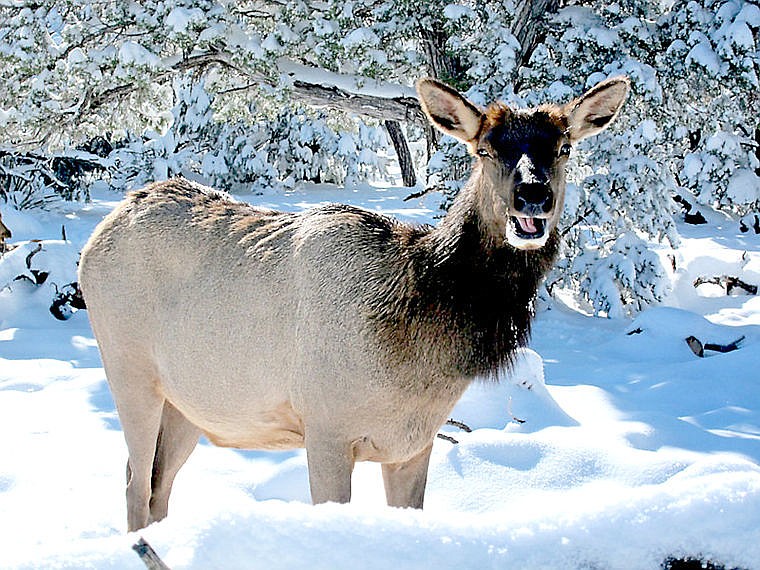
<p>An elk looks up from digging in the snow. A mild winter this year has allowed the elk and deer herds to have wider travel ranges while foraging for food.</p>
MINERAL COUNTY – A mild winter this season could lead to a hunter’s paradise later this year, as elk and deer herds prosper in mild conditions with low snowfall.
According to James Jonkel, wildlife management specialist for Montana Fish, Wildlife and Parks, this winter has been wonderful for the elk and deer populations.
“[There’s been] good survival of the fawns and calves,” said Jonkel. “Very little winter kill…so far it’s been a very mild winter in old Montana.”
As a result of the mild conditions, the deer and elk herds are more dispersed than in past years. According to Jonkel, the herds will usually migrate to lower elevations when snow falls to find better food sources. However, with such a small snowpack this year, migratory animals have not needed to go in search of new areas to find food.
“A lot of them have moved into that winter habitat,” said Jonkel. “But there’s still a lot in that transition zone, where there’s good feed and the snow’s not deep so it’s available.”
When especially strong winters strike, or ‘old Montana winters’ as Jonkel called them, the lower areas become especially important for the animal populations. However, these ideal winter habitats are usually right where towns are located. This could cause problems when residents and wildlife are forced into interactions.
When severe winters hit, elk and deer have been known to go after residential gardens as an easy food source. This is not expected to be much of a problem with the mild winter conditions currently in the area.
The migration of herds into populated areas did not include the ‘urban deer and elk’ that regularly enter human territory. Jonkel explained how the animals have begun to figure out how easy food can be found in towns and around houses.
“Why live in the mountains when you can gobble up all this wonderful food around these houses,” said Jonkel, as he voiced the perceptions of the deer. “Worn-out shrubbery, green lawns. We have more deer and elk figuring that out.”
Under the circumstances of the herds’ movements into lower elevations, the threat of predators around human settlements comes hand in hand.
With the elk and deer’s entrance into human population areas, it would seem like the threat of wolves would increase as well. However, Jonkel said this was not actually much of a problem. Wolves tend to avoid human population centers and focus more on the elk and deer trails.
The increased survivability brought on by the mild winter would lead to healthier herd populations, a trend, which can already be seen. Jonkel recalled how, in the 1950s and ‘60s, more severe winters meant fewer big game animals.
He said back then, there was not nearly the big game seen today. The larger herds would lead to a trickle-down effect to benefit all sorts of life, from plants to predators.
However, Jonkel did say the situation could change rapidly. If the area were to receive a heavy snow or cold snaps, it could lead to harder conditions for the herd populations.
The current trends look good and the winter weather has been mild for the last several years.
While the weather can change quickly, the threat of a sudden, severe winter is low and conditions look good for healthy herd populations later in the year.
ARTICLES BY ADAM ROBERTSON/MINERAL INDEPENDENT

Grand Opening
The new St. Regis Senior Center was dedicated to Maxine Flemming, a member of the center since 1983. Her name and picture appears on a plaque to be displayed in the new center.
Icy highways lead to a weekend of accidents
MINERAL COUNTY – As blizzard-like conditions swept through the area late last week Interstate 90 became an ice rink and accident reports flooded in as traffic tried to navigate the hazardous roads. The heavy snows began on Thursday, Feb. 27, and only let up periodically over the next few days. According to Mineral County Sheriff’s Office dispatch, approximately 12 accidents occurred between Thursday and Sunday, March 2. Most of these were cases where vehicles slid off the road or spun out. According to Montana Highway Patrol Trooper Charles Burton, they were almost all caused by people driving too fast on the slick roads. “The weather has definitely been a factor,” Burton said. “People need to slow down a bit.” Burton also responded to an accident where a vehicle with a trailer hit some ice and the trailer fell over. On Friday, Feb. 28, Mineral County Sheriff Ernie Ornelas and the Mineral County Sheriff’s Deputies were kept busy for most of the day assisting with the flood of calls. While there were no investigations opened, the sheriff’s office was on hand to help with the accidents. While the Superior ambulances were also busy responding to calls, there were very few serious injuries. According to Mineral Community Hospital personnel, the hospital did not see many people with injuries resulting from the conditions. Burton said the Montana Department of Transportation was doing the best they could to keep Interstate 90 and the state highways clear. It was a daunting task as the cold temperatures and heavy snow kept the roads slick. The Montana Highway Patrol recommends everyone drive safely and go a safe speed for the road conditions.

Bobcats
Tucker Smith moves to block a Hot Springs player during a Superior home game earlier this season.