
First day of summer longest but not hottest
Laura Roady Outdoor Column | Hagadone News Network | UPDATED 11 years, 9 months AGO
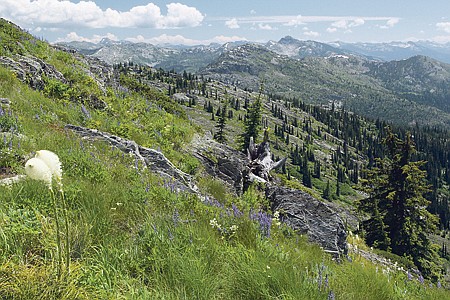
<p>Snow is still plentiful in the mountains on the summer solstice but the heat of summer quickly melts what remains, giving way to meadows of wildflowers.</p>
The warm, sunny days in early June made the last part of spring feel like summer. Summer technically doesn’t begin until the summer solstice on June 21 but we’ve enjoyed summer-like weather for a few weeks.
The summer solstice marks the day when the sun is at its farthest north position in the sky in the northern hemisphere north of the Tropic of Cancer just as the winter solstice marks the day when the sun is at its lowest position in the sky. On the summer solstice at the Tropic of Cancer (23.5 degrees north latitude), the sun is directly overhead at its highest point in the sky, such as in the Bahamas.
For many locations the summer solstice isn’t the day with the earliest sunrise or latest sunset due to the tilt of the Earth and the Earth’s elliptical path around the sun.
The earliest sunrise and latest sunset actually occur for several days. In Bonners Ferry, the earliest sunrise is at 4:42 a.m. from June 12 to June 20 while the latest sunset is at 8:52 p.m. from June 20 to June 30.
Therefore in Bonners Ferry, the longest day occurs on June 20 when daylight hours peak at 16 hours and 10 minutes. On June 20, the sun rises at 4:42 a.m. and sets at 8:52 p.m. whereas on June 21 (summer solstice), the sun rises at 4:43 a.m. and sets at 8:52 p.m. The summer solstice officially begins at 3:51 a.m. Pacific Time on Saturday, June 21 and the days start to become shorter.
While the first day of summer may be the longest day of the year north of the Tropic of Cancer, it definitely won’t be the hottest. Both April 12 and August 31 are the same number of days away from the summer solstice but a significant amount of snow can be on the ground on April 12 while a 90 degree heat wave can persist on August 31.
The difference in temperatures is that the northern hemisphere is still warming up in April and releasing heat in August. The Earth’s oceans and atmosphere act as heat sinks and absorb the sun’s warm rays. During the longest days of the year, they absorb the most heat and then retain that heat. This retention makes July and August the hottest months of the year.
After a certain point, more heat is lost at night than is gained during the day, causing the northern hemisphere to cool. This cooling trend continues until after the winter solstice when the days become longer and more heat enters the atmosphere. Similarly, the shortest day of the year isn’t the coldest, January and February are usually the coldest months.
The Earth takes longer to warm up than it does to cool down--on a yearly scale and a daily scale. After sunset, the coolness of night quickly rushes in while the warmth of the morning sun slowly warms the land. Just as the coolness of autumn rushes in and cools the land faster than the warmth of spring warms the land.
With the summer solstice occurring on June 21, the hottest days of summer aren’t far behind.
For previous columns, visits http://goexploreit.blogspot.com
ARTICLES BY LAURA ROADY OUTDOOR COLUMN

Nuthatches: The upside-down bird
While woodpeckers search for insects by spiraling up a tree, the nuthatch zig-zags down the trunk head-first. Foraging upside-down may seem unnatural to us but nuthatches have a knack for it.

How do animals beat the heat?
On sweltering 90-plus degree days we can retreat to basements or air conditioned buildings but how do animals beat the heat?

Bird nests range from simple to elaborate
Just when I think the robin can’t hold any more grass in its beak, it leans over and picks up one more piece before flying to a nearby tree. Without any guidance, the robin knows exactly what materials to collect to build its nest and how to construct its nest.