
The cost of declining enrollment
MAUREEN DOLAN | Hagadone News Network | UPDATED 11 years, 9 months AGO
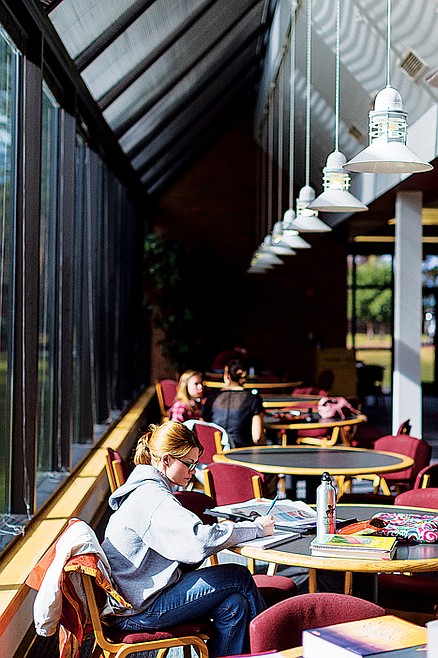
<p>Jennie Treadwell, 32, a medical assistant student at North Idaho College, works on an assignment in the student union building Friday on the Coeur d’Alene campus. Enrollment at the junior college has been steadily declining since the recession.</p>
North Idaho College’s declining enrollment is getting a lot of attention lately, and it will continue to as administrators and trustees seek to cut $2.3 million from next year’s budget.
Enrollment declined by 11 percent this year and is expected to drop another 10 percent next year, and with fewer students come less tuition dollars, a source of revenue that represents more than a third of NIC’s current $44.8 million budget.
NIC President Joe Dunlap and Athletics Director Al Williams pointed to the enrollment drop when they recently recommended that the college switch from a national athletics conference to a less costly regional community college sports association. The trustees will meet Thursday to decide whether to follow that recommendation, a move expected to chop an estimated $600,000 per year from the college budget.
Department heads at the college are preparing their initial budget presentations now, said NIC spokesman Mark Browning.
“President Dunlap has told everyone to bring what’s going to work best but have the least impact on student instruction,” Browning said.
The dwindling number of students signing up for classes is the downside of a dramatic enrollment increase that NIC and other community colleges experienced several years ago when the economy took a downturn and unemployment skyrocketed.
At that time, the jobless flocked to community colleges throughout the nation.
As the economy has rebounded, those enrollments have dipped regionally and beyond.
Flathead Valley Community College in Kalispell, Mont., is reporting a 10 percent enrollment decline this year.
The Bend Bulletin in Oregon reported last week that Central Oregon Community College’s enrollment is continuing to drop after reaching historic highs in 2012.
Newspapers from Kalamazoo, Mich., to Springfield, Mo., have recently reported significant drops in community college enrollments in those areas.
Across the state line in Washington, where Spokane Community College, Spokane Falls Community College and an extended learning center form the Community Colleges of Spokane, enrollment is also declining. The community college system’s board’s minutes last year reflect that enrollment there has been softening since 2009.
Back in 2007, NIC’s enrollment was 4,650. The unemployment rate at that time in Kootenai County was just 3.1 percent.
Then the economy tanked, and by 2010, the unemployment rate in Kootenai County had risen to 10.4 percent. By 2011, NIC’s enrollment jumped by 45 percent to 6,750 students.
The experience was much the same at the College of Southern Idaho in Twin Falls, another one of the state’s three community colleges. CSI reported a 10 percent enrollment dip this year.
Enrollment at CSI was 7,117 in 2007, and unemployment was 2.6 percent. By 2009, the college’s enrollment jumped to 8,395 and the unemployment rate was on its way to a high of 8.1 percent which it hit in 2010.
Browning said that in Idaho, the different community colleges — CSI, the College of Western Idaho, and NIC — each have very different economies and infrastructures, making it difficult to compare them. For example, the relatively new College of Western Idaho in Nampa serves the Boise metropolitan area. Before the school opened in 2009, that was the largest metropolitan area in the nation without a community college.
“There was a lot of pent-up demand,” Browning said. “They have had record-setting growth.”
There are other factors affecting enrollment at NIC, in addition to the economy’s recovery.
Browning said the college is losing students because they are unable to meet the high demand for spots in technical programs like welding and machining. The college doesn’t have the space to accommodate many students and they are placed on wait lists.
“If we had facilities where we could expand those programs, that’s one area where we could offset this,” Browning said.
The emergence of more opportunities for students to receive their degrees online is also likely a factor.
NIC trustees will meet Thursday at 5 p.m. in the Edminster Student Union Building’s Lake Coeur d’Alene Room to discuss whether to transition the college’s sports programs from the National Junior College Athletic Association to the Northwest Athletic Association of Community Colleges.
Coming up
- NIC trustees will meet Thursday at 5 p.m. in the Edminster Student Union Building's Lake Coeur d'Alene Room to discuss whether to transition the college's sports programs from the National Junior College Athletic Association to the Northwest Athletic Association of Community Colleges.
ARTICLES BY MAUREEN DOLAN

Daylight saving time begins today
If you arrived an hour early to everywhere you went today, you might have forgotten to move your clock back. Yep, it's daylight saving time. Daylight saving time officially ends at 2 a.m. Sunday, Nov. 5, and returns on March 10, 2024, when clocks are moved an hour forward.

Time to 'fall back'
Daylight saving time officially ends at 2 a.m. Sunday, Nov. 5 and returns March 10, 2024, when the vast majority of Americans will then “spring forward” as clocks are set an hour later.

Fires, smoke continue to affect region
Smoke from the region's wildfires continued to affect air quality Monday as firefighting response teams continued to battle multiple blazes throughout North Idaho and Eastern Washington.