
You can bank on this
DAVID COLE/[email protected] | Hagadone News Network | UPDATED 11 years, 5 months AGO
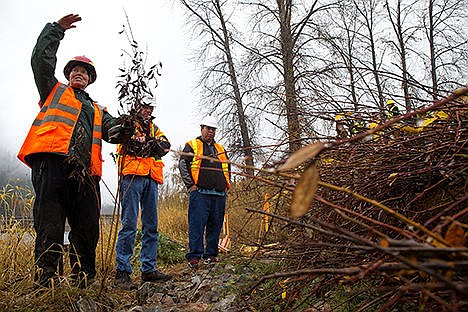
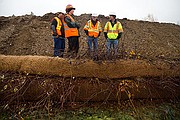
<p>Jo Christensen, Idaho Panhandle National Forest Restoration Biologist, explains the benefits of using willows in the Kahnderosa Bank Remediation Pilot Project on the banks of the Coeur d’Alene River on Monday afternoon. The project was designed and engineered by the EPA and uses willows keep the bank of the Coeur d’Alene River from eroding.</p>
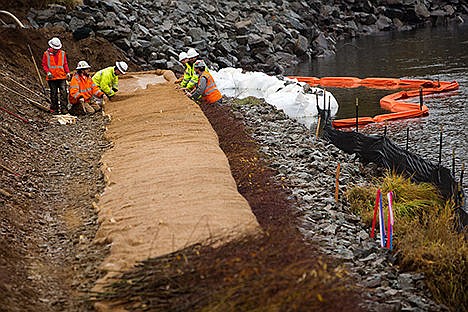
<p>Contractors from Stewart Contracting and the Basin Project install coco fibers over a layer of willow branches and soil to stabilize the banks of the Coeur d’Alene River next to Kahnderosa Campground.</p>
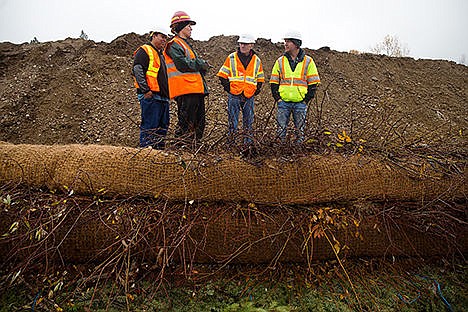
<p>Jo Christensen, second from left, explains to Caj Matheson, left, of Restoration Partnership, Bill Parker, of Knife River, center, and Jack Borley, right, of CWR Enterprises LCC the infrastructure of the Kahnderosa Bank Remediation Pilot Project on the banks of the Coeur d’Alene River on Monday afternoon.</p>
CATALDO - A pilot project showcasing a new way to stabilize eroding stream banks is wrapping up along the Coeur d'Alene River.
Riprap has historically been used for stabilization, but it's not the best solution because it's not a naturally occurring feature of a river and it's poor habitat for fish. It's also expensive.
The U.S. Environmental Protection Agency and the Coeur d'Alene Trust - through its contractors - have opted for a more biology-friendly technique.
"So what we're doing here is we're using willows," said Mike Reiter, an engineer with Maul Foster Alongi in Kellogg, a consultant hired by the Coeur d'Alene Trust. "We have over 13,000 willows that were harvested across the river."
The stream bank is being built in layers, with soil wrapped up, burrito-style, using brown fabric made of coconut fibers.
The willows are being planted, horizontally, between the layers of wrapped soil. As the hearty willows grow and flourish, the fabric disintegrates.
"These willows will grow these thick root masses and hold this bank back," Reiter said Monday at the site, the Kahnderosa RV Park and Campground. "They extend out and they provide roughness that slows down the water velocity close to the bank and helps prevent erosion."
The project, known as the Kahnderosa Bank Remediation Pilot Project, was designed by engineering company CH2M Hill. Its approximate cost is $250,000 for roughly 500 feet of stream-bank stabilization. The project is on the main stem of the Coeur d'Alene River, about 22 river miles from Lake Coeur d'Alene.
"It's important that people know that this technology will provide an alternative to landowners who want to stabilize their riverbanks, and will provide a cost-effective method to do so since the vegetative materials can be gathered from their property," said Ed Moreen, project manager for the EPA.
The river has been eroding the bank at the site, made worse because the bank is contaminated with mine tailings. The contaminated soil is the result of 100 years of mining, said Jim Finlay, assistant program manager with the Coeur d'Alene Trust.
The Trust and EPA want to limit any disturbance of the contamination, and reduce its spread through the Coeur d'Alene Basin.
Flooding is a problem at the site - the project won't prevent flooding. It will, however, slow the water down and create a smooth, seamless shoreline.
"This is an up-and-coming technique which has a lot of benefits," Reiter said.
ARTICLES BY DAVID COLE/[email protected]
Another busy year for EPA cleanup projects
Feds spending $35M on Silver Valley work this summer
COEUR d'ALENE - Federal officials plan to spend $35 million this spring and summer in the Silver Valley doing cleanup of historic mining waste and pollution.
Wolf-shooter waiting for day in court
Trial of wolf shooter likely to be continued
COEUR d'ALENE - The Kootenai County trial of the man who shot and killed a wolf on Rathdrum Mountain might not go forward as scheduled next week.