
Quakes: All done or more to come?
DAVID COLE/[email protected] | Hagadone News Network | UPDATED 10 years, 11 months AGO
Quakes: All done or more to come?
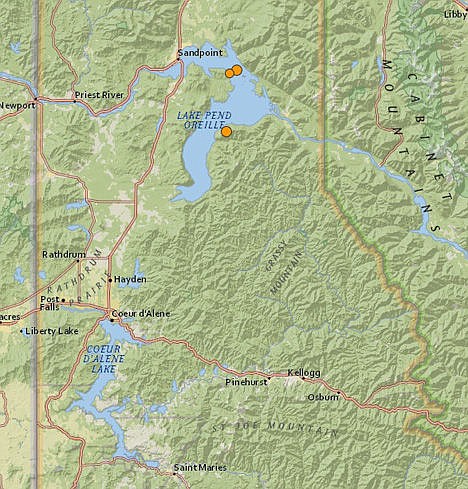
COEUR d'ALENE - Earthquakes around Lake Pend Oreille Thursday and Friday could signal the area may experience a swarm of them or that a big one might be on the way.
It could also be decades before the area shakes again.
"I would be warning people to take their grandmother's precious crystal off the shelves and put it on the floor for a few days," said Ken Sprenke, a professor of geophysics in the University of Idaho's geological sciences department. "I think there's a good chance we'll continue to get little temblors like that."
Earthquake swarms are common in Idaho, he said Friday.
"I wouldn't be surprised if this turns into a swarm up there," he said.
It's also possible the quakes are foreshocks for a larger event, he said.
The first earthquake struck at 7:32 p.m. Thursday and registered magnitude 4.1, with an epicenter north of Granite Creek on the east side of Lake Pend Oreille.
The second hit at 10:43 p.m. Thursday and registered magnitude 4.2., with an epicenter under the lake and west of Hope. Magnitude 3.3 and 3.0 quakes struck hours later, one east of Sandpoint and one 7 miles north of Ponderay, according to the U.S. Geological Survey.
Bill Phillips, a UI research geologist with the Idaho Geological Survey, said if it turns out to be a swarm the quakes are likely to bounce around the area with epicenters being several miles apart. He also said it's possible the recent quakes are foreshocks for a big one.
Michael Jeniken, who lives near Bayview, said he was reading in bed when Thursday's second quake hit.
"It's so quiet out here in the country," he said. "It really broke the peace and quiet."
He said it was like a train or jet going by the house, shaking doors and making the house sound like it was cracking. He said the first one didn't sound as strong in his location.
Sandra Murdock, who lives east of Silverwood, said she was outside during the first quake.
"It sounded more like an explosion or a landslide," Murdock said. "It was a noise more than anything."
The second one did more shaking, she said.
She said it's exciting and interesting having earthquakes that don't cause any damage or hurt anybody. It reminds people of the earth's strength.
"It's great to have little ones like this," Murdock said.
Sprenke said the quakes Thursday and Friday are possibly associated with the Hope Fault, which is capable of producing a magnitude 6 event that could cause severe damage.
The Hope Fault forms the northeast shore of Lake Pend Oreille.
It is one of a series of faults in North Idaho that are part of the larger Lewis and Clark Seismic Zone, considered by geologists to be a "megashear" in the earth's crust as much as 30 miles wide. The faults in the zone have been active for a billion years.
The Hope Fault is the northern boundary of the zone, he said. Also part of the zone is the Osburn Fault system that runs along Interstate 90 and through Coeur d'Alene.
Phillips said he's not totally convinced the recent quakes are associated with the Hope Fault.
"It looks very prominent, but it doesn't look like an active fault," Phillips said.
The earthquakes will give scientists like Sprenke and Phillips a lot of information about the nature of the stresses in the Sandpoint area.
New scientific tools, which can measure very tiny movements of the earth, will help to determine what's happening now that there is some activity, Phillips said.
The closest government seismograph is in Newport, Wash. Mining companies, however, also have seismographs in the area, and Sprenke said those companies are cooperative and will provide data collected.
"These events will be really helpful for us as we nail down the type of fault motion that's going on there," Sprenke said. "The conventional wisdom would be like a San Andreas (Fault) type motion sideways."
But scientists haven't determined the exact motion, he said.
"We're not sure at all," he said. "The stress (seen in the recent quakes) doesn't fit into our preconceived picture of what it should be like up there."
Sprenke wants to get into the field and look for other faults which might be attached to the Hope Fault, but possibly moving in a different direction. Those faults might be responsible for the quakes.
Thursday and Friday's were shallow - in a geologic sense - as they were between 3 to 6 miles below the surface.
The Hope Fault is capable of releasing a magnitude 6 or greater quake, which could trigger a seiche on Lake Pend Oreille, he said. Seismic seiches are standing waves that occur on an enclosed or partially enclosed body of water when seismic waves from an earthquake pass through an area.
"They're like waves in a bathtub," Sprenke said.
Rock falls in the lake are another possible hazard, Phillips said.
"Earthquakes are great at causing rock falls," he said.
ARTICLES BY DAVID COLE/[email protected]
Another busy year for EPA cleanup projects
Feds spending $35M on Silver Valley work this summer
COEUR d'ALENE - Federal officials plan to spend $35 million this spring and summer in the Silver Valley doing cleanup of historic mining waste and pollution.
Wolf-shooter waiting for day in court
Trial of wolf shooter likely to be continued
COEUR d'ALENE - The Kootenai County trial of the man who shot and killed a wolf on Rathdrum Mountain might not go forward as scheduled next week.