
Science siblings strike again at international fair
HILARY MATHESON | Hagadone News Network | UPDATED 11 years, 4 months AGO
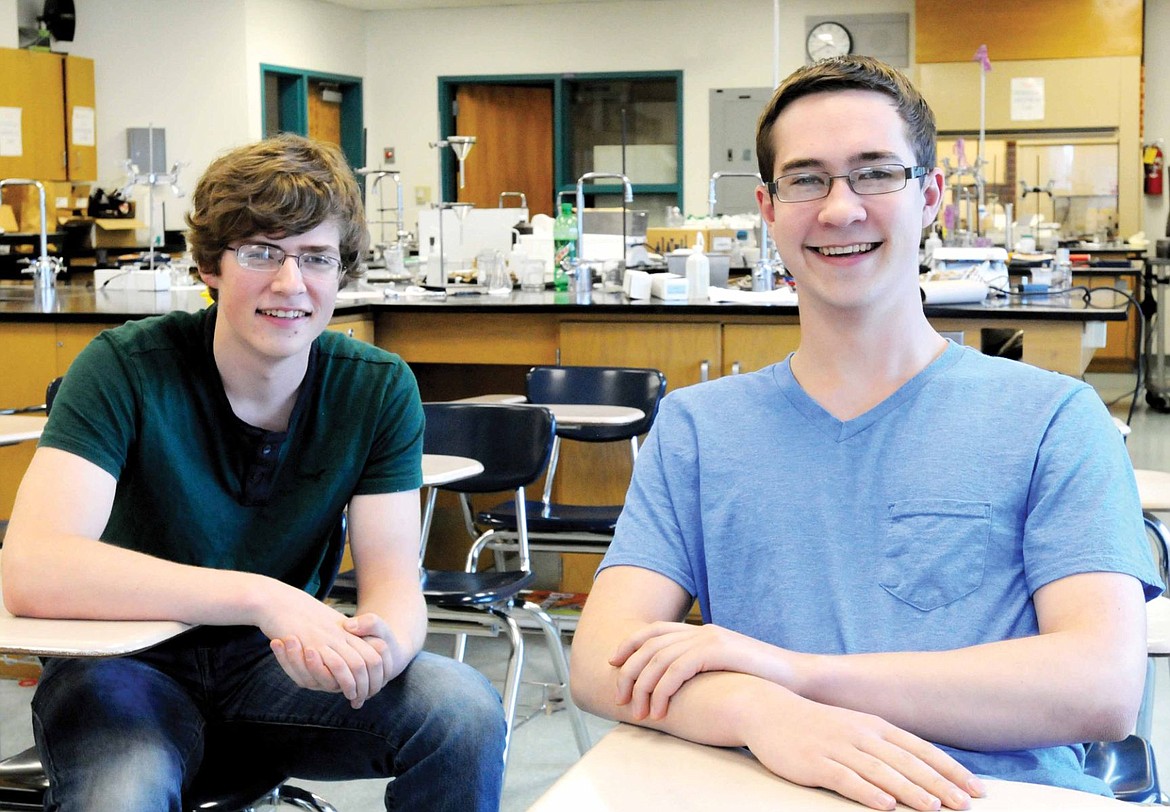
<p><strong>Columbia Falls</strong> brothers Colin Norick, left, and Colter Norick earned third-place awards at the Intel International Science and Engineering Fair. (Aaric Bryan/Daily Inter Lake)</p>
EDUCATION REPORTER Hilary Matheson covers education for the Daily Inter Lake. Her reporting focuses on schools, students, and the policies that shape public education across Northwest Montana. Matheson regularly reports on school boards, district decisions and issues affecting teachers and families. Her work examines how funding, enrollment and state policy influence local school systems. She helps readers understand how education decisions affect students and communities throughout the region. IMPACT: Hilary’s work provides transparency and insight into the schools that serve thousands of local families. | June 15, 2015 9:30 PM
The Norick brothers of Columbia Falls proved — once again — to be a powerhouse science team.
Colter a recent Columbia Falls High School graduate, and Colin, a junior this fall, earned the third-place grand award in behavioral and social sciences in addition to the third-place American Psychological Assistant award for their project, “The Effect of Multitasking on Reading Comprehension in Teens,” at the Intel International Science and Engineering Fair.
This is the second time they’ve teamed up to do a science project that resulted in top awards. They combine because it is easier to divide the workload.
“We’re too competitive to go against each other,” Colter said.
Colin added, “We don’t want a household divided.”
They said they picked the multitasking topic as a means to use science to prove their mom wrong.
“The main idea started as a argument with our mom,” Colter said.
Colin added, “We said we could play games and do homework at the same time. She said we couldn’t. We set out to prove her wrong, but it only validated her point.”
For the second year, the teens used students from Columbia Falls High School as test subjects for their science project. They were able to pull together 47 students of different ages, grade levels, genders and backgrounds.
While there is a bevy of devices that can wreak havoc with concentration, the Noricks chose texting on cellphones while taking a test. Students took the same test twice — once without texting as a baseline, and a second time while texting, then comparing results. Test questions were pulled from Scholastic Aptitude Test reading comprehension questions.
To be certain students received the same number of texts at the same time, they wrote a computer program that would send conversational text messages at regular intervals under the name “Bob.” The students were asked to reply to the text messages.
Students were also asked to do a self-evaluation on their perception of how well, if at all, they could multitask. The brothers said many students endorsed multitasking, and, like themselves, initially believed they were good at it.
Test results showed just the opposite, despite the fact that the students took the same test twice. Students scored roughly 10 percent worse when responding to texts. And that applied to all the students — boys and girls, older or younger.
“You would think they would do better the second time,” Colter said. “It didn’t matter if they thought they were good multitaskers or not. They did just as poorly.”
Colin elaborated on why he thinks texting and other social media interactions and alerts interrupt concentration.
“Humans prioritize social interaction over everything else, in this case at least,” Colin said. “They even interacted more with the fake conversations then the academic test.”
Have they changed their own behavior as a result of the results?
“A bit,” Colin said. “If I need to study I’ll turn off the computer and cellphone — unless it’s a really easy task.”
Colter said he has changed his multitasking behaviors.
The brothers teamed up last year to do a project on the effect of omega-3 and omega-6 fatty acid levels on cognition in teens. Their project, “The Correlation between Docosahexaenoic Acid (DHA) Levels and Cognitive Function in Healthy Teens,” earned a third-place award from the American Psychological Association.
Through the Montana Academy of Sciences, they qualified to present their work at the American Junior Academy of Science in Washington, D.C.
While there may be research and studies on adults regarding DHA, there isn’t much on the teen age group.
“We like doing topics not fully explored,” Colin said.
Reporter Hilary Matheson may be reached at 758-4431 or by email at [email protected].
ARTICLES BY HILARY MATHESON
Musically inclined students perform at the 2026 All-State Music Festival
Top high school musicians from the region performed at the All-State Music Festival Gala Concert Oct. 16 in Bozeman.

Evergreen educator named Montana Teacher of the Year
Evergreen Junior High special education teacher Kenny Ross is Montana's Teacher of the Year.

FVCC faculty issues no-confidence vote amid president contract negotiations
The FVCC Education Association, the Flathead Trades Instructors Association and the Federation of Flathead Valley Community College Adjunct Faculty have voted no confidence in FVCC Executive Director of Human Resources Karen Glasser, saying they have lost trust in her leadership and judgment.