
Bee-ware of the bugs
DAVID COLE/[email protected] | Hagadone News Network | UPDATED 11 years AGO
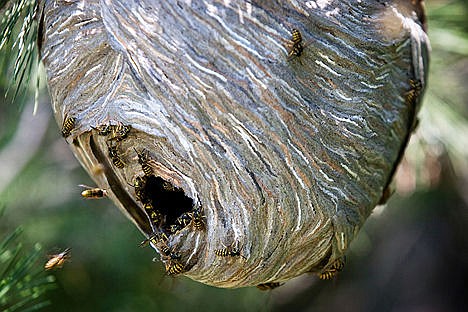
<p>Yellowjackets congregate around the opening of a volleyball-sized nest on South 19th Street in Coeur d'Alene in this August 3, 2009 Press file photo.</p>
COEUR d'ALENE - A mild winter and early spring mean people will be swatting, brushing away and sometimes squashing pesky insects sooner this year, making for a longer season.
Entomologists, public health officials and people in the bug-control business say it's too early to know if it will be a "bad year" for yellowjackets, mosquitoes, ticks and other insects that can sometimes make great weather less enjoyable. Weather this spring will have a lot to say about it.
A mild winter doesn't by itself promise a big yellowjacket season, said Ed Bechinski, professor of entomology at the University of Idaho.
Bechinski said the population of the potent stingers has a close relationship to weather.
While a mild winter enhances the survival rate of queens hunkered down for winter, a warm, sunny and dry spring would really help the royal ladies establish their nests.
"It sets the stage for a big yellowjacket year," Bechinski said Friday.
A cold and rainy spring would really slow the establishment of the nest population, he said.
"The warmer, the more active," he said.
Queens start building their nests from scratch each year. All the yellowjackets people saw last year are dead, except for queens who mated last fall and late last summer.
Bechinski said bald-faced hornets and paper wasps also establish populations and nests faster when spring weather is warm and dry.
Jacob Borg, owner Pointe Pest Control in Idaho, Washington and Oregon, said insects are a lot like people.
"We want to come out when the weather is nice," he said Friday. "Having such a light winter impacts how soon we start seeing insects."
In eight years of business, he said, this is the earliest spring he has experienced.
His business, which serves many North Idaho customers, has already responded to a greater volume of calls for ant control. Carpenter ants burrow into the wood of homes and cabins.
A longer season for bugs like ants means more time to reproduce and establish larger populations, he said.
"We're hiring additional people because of the weather," Borg said.
"We may see (insect) activity sooner if temperatures continue to be above normal," said Gina Davis, an entomologist and manager of the Forest Health and Stewardship Program at the Idaho Department of Lands.
The insects in Idaho's forest lands are native, with a couple of exotics. They are well-adapted to winters here and survive through hibernation.
"If it's a little bit warmer (in winter), it's not really going to affect their survival," Davis said.
There could be some increased survival, but it would be minor, she said.
Temperature fluctuations over a short period of time in spring could have negative effects on insect populations and survival.
"It's that shock" that harms the insects, Davis said. "Some of those that emerged earlier could die from a cold snap later on."
A longer insect season could affect people, said David Hylsky, a staff epidemiologist for the Panhandle Health District.
"The ticks and mosquitoes and that, they're getting an early start on the season," Hylsky said Tuesday. "The duration of time can make it a bad year."
He also said spring and early summer temperatures and precipitation levels will be a factor in determining conditions this insect season.
"We really haven't seen West Nile virus up here in North Idaho," he said.
With a longer mosquito season, and time for the virus to amplify in the population, there is a chance West Nile cases might appear in North Idaho, he said.
The virus has been in North Idaho, but the agency's investigations have shown people traveled outside the area and got infected before returning to the area.
"As for locally-acquired ones, we really haven't seen any cases here yet," he said. "And one of the reasons why is maybe we just don't have that long of mosquito or summer season."
Ticks lay dormant in the winter, and when they wake up their main hosts are rodents. Humans are not a primary host.
"When there are not rodents around, they'll try and get a blood meal anywhere," he said.
Ticks in North Idaho can cause "relapsing fever" in people, a bacterial infection that shows up as a fever that comes and goes. Antibiotics treat it, he said.
Rocky Mountain Spotted Fever is another tick-borne illness that comes with a body rash, but the infection is rare. It also is treated with antibiotics.
"We might see one or two cases a year, or none," he said.
Hikers breaking through brush are already seeing ticks on their clothing and bodies.
The Centers for Disease Control and Prevention recommends avoiding wooded and brushy areas with high grass. The agency also recommends using repellents that contain 20 percent to 30 percent DEET on exposed skin and clothing for protection that lasts several hours.
Once coming indoors from a hike or other activity, tumble dry clothes to kill remaining ticks, and take a bath or shower as soon as possible to wash off and more easily find ticks on the body.
ARTICLES BY DAVID COLE/[email protected]
Another busy year for EPA cleanup projects
Feds spending $35M on Silver Valley work this summer
COEUR d'ALENE - Federal officials plan to spend $35 million this spring and summer in the Silver Valley doing cleanup of historic mining waste and pollution.
Wolf-shooter waiting for day in court
Trial of wolf shooter likely to be continued
COEUR d'ALENE - The Kootenai County trial of the man who shot and killed a wolf on Rathdrum Mountain might not go forward as scheduled next week.