
Rate climb pending
MARTIN CRUTSINGER/Associated Press | Hagadone News Network | UPDATED 10 years, 10 months AGO
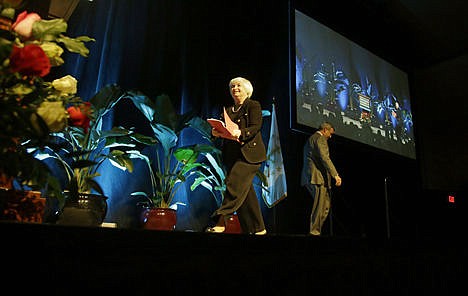
<p>Janet L. Yellen, chair of the Board of Governors of the Federal Reserve System, takes the stage after being introduce before delivering her address to the Greater Providence Chamber of Commerce at their annual Economic Outlook Luncheon on Friday.</p>
WASHINGTON - Federal Reserve Chair Janet Yellen said Friday she expects to begin raising interest rates later this year - if the job market improves and the Fed is confident inflation will climb closer toward its target rate.
She described the U.S. economy as "well positioned for continued growth," but at the same time highlighted a number of headwinds that threaten progress. Wages have been disappointing and too many people who want full-time jobs and instead working part-time, she said. She also noted a lackluster housing recovery and modest business investment.
The Fed has kept its key benchmark rate at a record low near zero since December 2008.
"I think it will be appropriate at some point this year to take the initial step to raise the federal-funds rate target and begin the process of normalizing monetary policy," Yellen said to the Greater Providence Chamber of Commerce in Providence, R.I.
But when the central bank finally begins to raise rates, Yellen said it would proceed cautiously, "which I expect would mean that it will be several years before the federal funds rate would be back to its normal, longer-run level."
Yellen's latest comments were made several weeks before the Fed's next policy meeting on June 16-17. Minutes from its April meeting released earlier this week all but ruled out a rate hike next month.
Many economists now predict the Fed will wait until at least September and that the central bank will move very gradually with one or two quarter-point rate hikes this year.
"Assuming that economic growth does rebound ... we don't think the Fed can wait any longer than September," said Paul Ashworth, chief U.S. economist at Capital Economics.
Yellen reiterated that policymakers need to see "continued improvement in labor market conditions." They also want to be "reasonably confident" that inflation will approach its 2 percent target in the medium term.
"The various headwinds that are still restraining the economy, as I said, will likely take some time to fully abate, and the pace of that improvement is highly uncertain," she said.
But Yellen also warned of waiting too long. Any changes to monetary policy will take time to work their way through the economy, so "delaying action to tighten monetary policy until employment and inflation are already back to our objectives would risk overheating the economy," she said.
Earlier Friday, the government reported that core consumer prices rose a bigger-than-expected 0.3 percent in April. It was the largest one-month gain since January 2013, although overall prices were up just 0.1 percent, held back by a further drop in energy costs. Yellen did not mention the inflation report in her remarks.
Financial markets were closely watching the comments for any clues Yellen might provide about monetary policy. The initial market reaction was muted given that much of what she said was in line with market expectations.
ARTICLES BY MARTIN CRUTSINGER/ASSOCIATED PRESS
US budget deficit swells in July due to calendar quirk
WASHINGTON - The U.S. government ran a much higher budget deficit in July than a year ago, but it's still on track for the lowest full-year deficit in eight years.

U.S. consumers increase borrowing
January numbers up by $11.6 billion, slowest pace since 2013
WASHINGTON - Consumers increased their borrowing in January at the slowest pace in more than a year with borrowing on credit cards actually declining for the second time in the last three months.

Ending the speculation
Fed leaves key interest rate unchanged, citing low inflation
WASHINGTON - The Federal Reserve ended weeks of speculation Thursday by keeping U.S. interest rates at record lows in the face of threats from a weak global economy, persistently low inflation and unstable financial markets.