
Tiny salamander delivers big surprise to predators
Laura Roady | Hagadone News Network | UPDATED 10 years, 1 month AGO
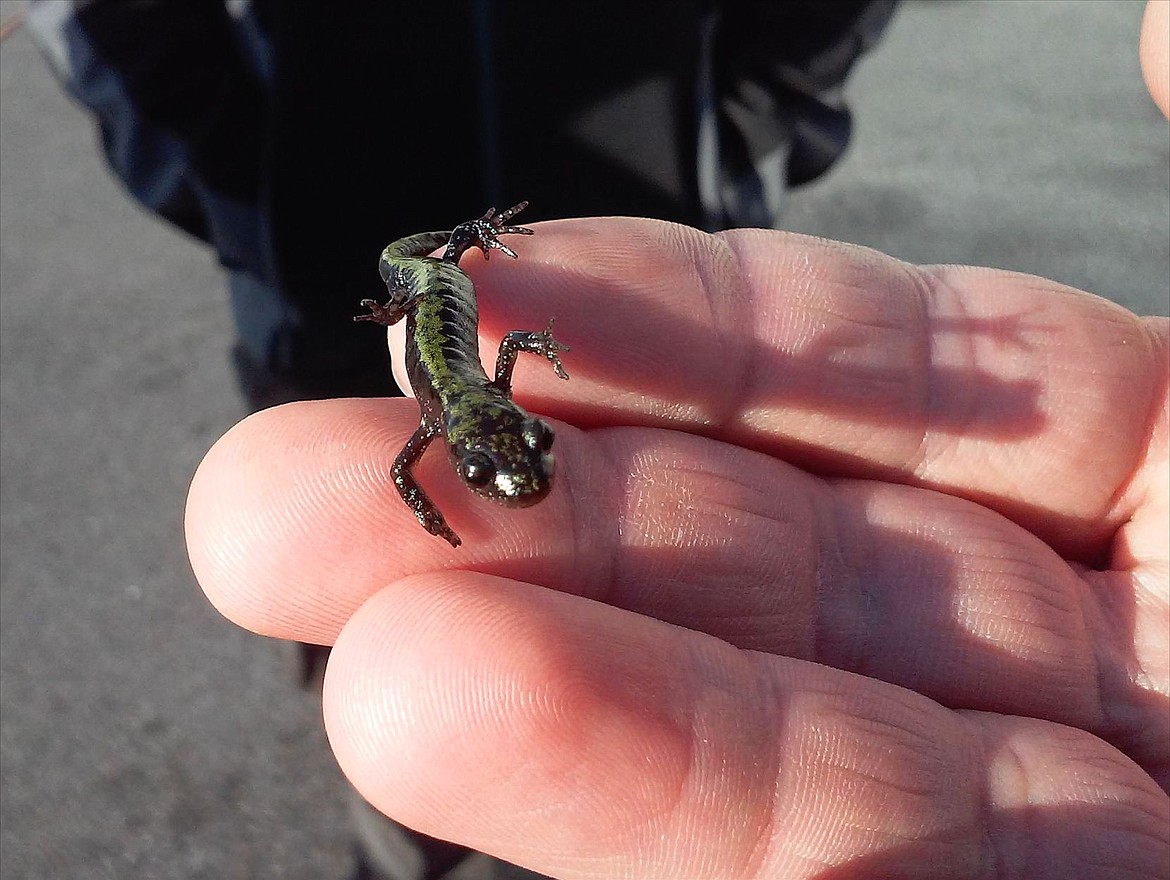
<p><strong>Long-toed salamanders are poor burrowers and spend most of their time underground in abandoned rodent burrows and hollows in the forest floor.</strong></p><p><strong> </strong></p>
What has large bulbous eyes, a blunt snout, a long fourth toe on its hind foot and is three to four inches long? A long-toed salamander.
The long-toed salamander is more widespread than any other salamander species in Idaho--living in northern and central Idaho--and is one of the most widely-distributed salamanders in North America.
Named for the extra-long fourth toe on its hind foot, the long-toed salamander is also identified by the irregular green or yellowish stripe running along the middle of its back. The stripe has uneven edges or is broken into blotches.
Salamanders are mainly active at night to avoid predators and to avoid drying out. If the brightly colored stripe on the salamander doesn’t warn predators of its distastefulness, the long-toed salamander has other defenses.
Glands in the salamander’s tail and on its back secrete a sticky poison when the salamander is threatened. The sticky poison is stronger than rubber cement and often results in the predator sticking to itself or the ground for up to 40 minutes---plenty of time for the salamander to escape. Predators of adult salamanders include garter snakes, bull frogs and birds.
If the poison doesn’t deter the predator, the salamander can drop its tail as a distraction and run away. Long-toed salamanders are capable of regrowing their tail and legs if pulled off by a predator or dropped in defense.
The long-toed salamander also secretes a mucous-like substance to keep its skin from drying out. The salamander’s skin needs to stay moist to absorb oxygen. If the skin dries out then the salamander cannot breathe.
While the salamander does breathe through its lungs, it can obtain more than a quarter of its oxygen through its skin--which is important in winter. Long-toed salamanders hibernate underground below the frost line. The salamander overwinters in mud at the bottom of ponds, in log burrows, or in burrows made by other animals.
The tail glands that serve up the sticky poison switch roles in winter and store fat instead. The salamander also slows its metabolism and heartbeat to conserve energy.
Long-toed salamanders aren’t marathon hibernators--they are one of the earliest salamanders to breed and lay eggs. Often they breed before the ice is completely gone from breeding ponds. From their hibernating location some salamanders travel up to one-third of a mile to a breeding pond which is an extraordinary distance for an animal three to four inches long.
Elevation influences breeding time and clutch size. Long-toed salamanders live in moist habitats from valley floors to alpine meadows and alpine lake shorelines. Those living at elevations above approximately 6,900 feet breed in midsummer while
those at lower elevations breed in spring.
Salamanders at lower elevations produce more eggs, often up to 400. Salamander larvae at lower elevations also metamorphose their first summer and overwinter as adults. Those at higher elevations may overwinter as larvae for one to two years before turning into adults.
Either way, adults overwinter when their prey (insects, spiders, slugs, earthworms, tadpoles and other invertebrates) disappears or takes shelter for the winter.
For more articles, visit www.naturallynorthidaho.com.
ARTICLES BY LAURA ROADY
Why do some animals delay pregnancy?
Spring is birthing time for many animals in order for the young to have adequate time to grow and develop before the onset of winter. For many animals, that means mating in mid- to late winter. Raccoons begin mating in February and March and give birth in April.

Some animals capable of growing new appendages
Lizards are one of the more well-known animals to regrow their tail after shedding it to evade predators. Last week, I wrote about autotomy (the process of voluntarily shedding a body part) and how it is advantageous at first but can cause hardship afterwards. Certain animals alleviate these hardships by regenerating the lost body part.

Tiny salamander delivers big surprise to predators
What has large bulbous eyes, a blunt snout, a long fourth toe on its hind foot and is three to four inches long? A long-toed salamander.