
Planning starts with a few pins
CHERYL SCHWEIZER | Hagadone News Network | UPDATED 10 years, 6 months AGO
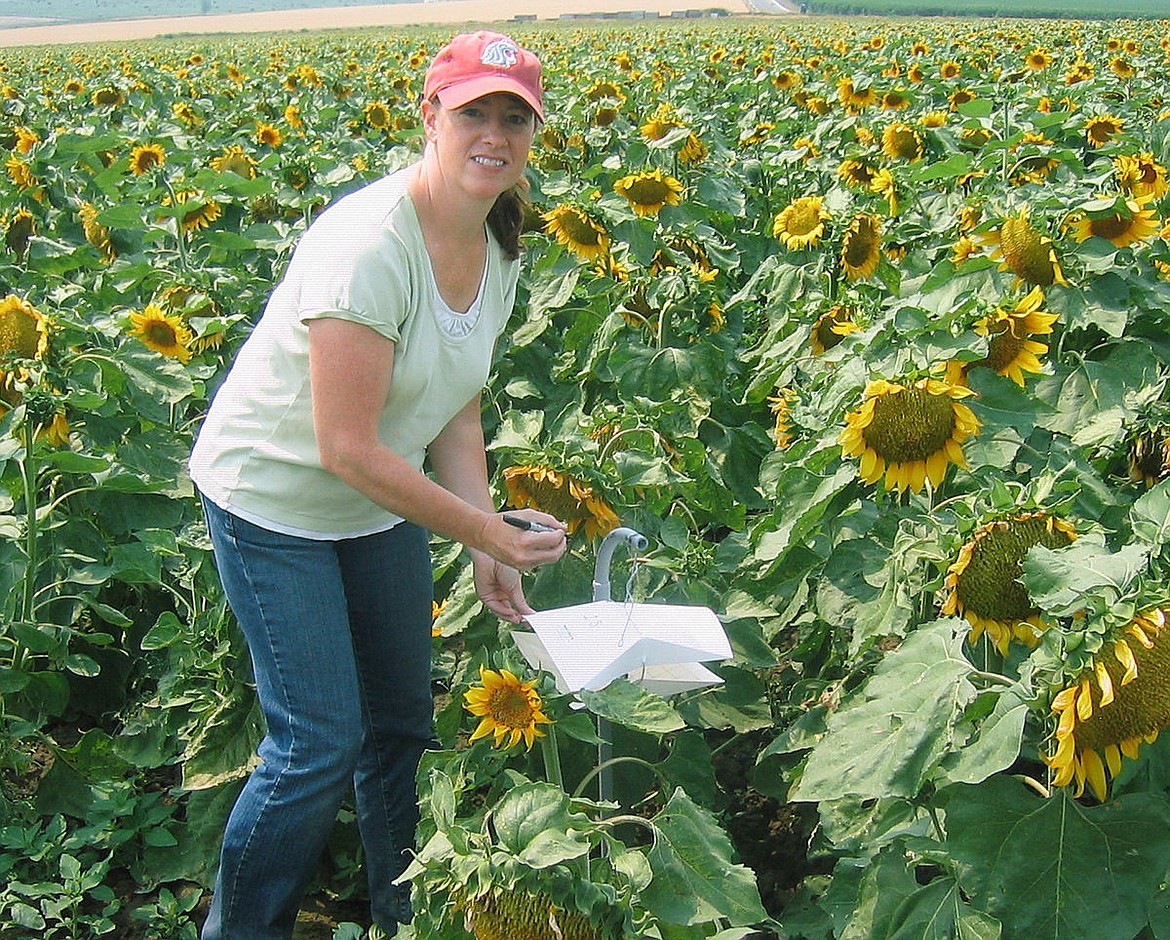
Grant-Adams County Extension agent Carrie Wohleb checks a field of sunflowers being grown for seed. Seed for commercial production is an important component of Grant County agriculture.
Senior Reporter Cheryl Schweizer is a journalist with more than 30 years of experience serving small communities in the Pacific Northwest. She began her post-high-school education at Treasure Valley Community College and enerned her journalism degree at Oregon State University. After working for multiple publications, she has settled down at the Columbia Basin Herald and has been a staple of the newsroom for more than a decade. Schweizer’s dedication to her communities and profession has earned her the nickname “The Baroness of Bylines.” She covers a variety of beats including health, business and various municipalities. | April 5, 2016 1:45 PM
MOSES LAKE — While farmers take advantage of all the latest technology – automated irrigation systems, satellite data to analyze fields, labor-saving machinery for harvest – some procedures are still pretty low-tech. The Grant County map on the wall at the WSU Grant-Adams County Extension office, the one full of pins, is one of those old-school ways of doing business.
Not that they signify a low-tech operation. There’s some really complex farming going on behind those pins.
The “Seed Field Isolation” program is the first step for farmers who grow seed for various commercial crops. After all, “onions you get at the grocery store have to start somewhere,” said Carrie Wohleb, regional specialist for potato, vegetable and seed crops for the extension office. And it turns out Grant County is an ideal spot for growing seeds.
Grant County’s biggest seed crops are onions and carrots, Wohleb said. But there are all kinds of seeds around the county – coriander, radishes, sugar beets, sunflowers, sweet and field corn, peas, beans “from garden beans to dry beans,” and more besides.
Grant County’s desert air makes it good for seeds. “Because our humidity is so low” the region is not as susceptible to fungal or bacterial diseases, Wohleb said.
“What’s really important is having disease-free seed that you can sell,” she said. If production starts with the seeds, so does disease – anything in the seed can transfer to the crop as it’s growing, she said.
It’s also crucial that carrot seed, for example, just be carrot seed and nothing else, no contamination from other varieties. “They have to be pure lines,” Wohleb said.
Like bugs, plant pollen can drift a long way, hence the need for isolating different seed-growing fields, hence the map and the pins.
“We have a whole list of isolation standards,” Wohleb said, so growers have to take care in choosing fields to plant in seed. Representatives, usually from the seed companies, meet in January or early February. “We draw a number out of a hat,” and the farmer with that number has first priority; he announces the location where he’s going to plant. The grower gets the first pin too, on the map marking the location of his fields. The second grower may have to adjust his (or her) planning accordingly, if they’re too close to the first grower.
The second farmer selects two fields and gets pins, and so on until all farmers have drawn. With the advent of technology a lot of this happens via email, Wohleb said, but there’s still a map, with pins.
Wohleb has both a postgraduate degree and PhD, and she specializes in potatoes, she said. “It took me years to figure this system out, by the way.”
Seed is a “high value crop,” she said. But “it takes the right grower to do it. Seed crops can be very challenging.” Seed crops are planted at different times and grow at different rates. Many depend on bees for pollination, and thus are vulnerable to weather that's too windy, cold or hot during pollination season. And in some cases, bee psychology. Bees don't like onions. "Onion flowers are not attractive," at least to bees, Wohleb said. On the other hand, "sunflowers – they love sunflowers."
There’s a niche for seed crops in the Columbia Basin, though, where there is room for a lot of different agricultural products. The Basin is second only to California among Western farming areas in the variety of crops grown, Wohleb said.
Cheryl Schweizer can be reached via email at [email protected].
ARTICLES BY CHERYL SCHWEIZER

Warden man injured in tractor-trailer collision with train
BRUCE — A Warden man was transported to an out-of-area hospital after the tractor-trailer he was driving was hit by a train near Bruce at about noon Tuesday. "The extent of the driver's injuries is not known at this time," wrote Adams County Sheriff Dale Wagner in a media release. "Preliminary information indicates the semi-truck was traveling above the speed limit and failed to obey posted requiring traffic to yield at the railroad crossing. The train was traveling at a slow speed," Wagner said. "He was moving. He wasn't stuck on the tracks," he said in an earlier interview.
Othello man arrested for Moses Lake attempted burglary
MOSES LAKE — An Othello man jumped into Moses Lake in an unsuccessful attempt to avoid Moses Lake Police Department officers last Friday. An MLPD media release issued Wednesday said Fernando Lira, 36, was booked into the Grant County Jail on suspicion of second-degree burglary in connection with the incident. Lira allegedly attempted to burglarize a business in the 600 block of East Broadway Friday morning. The business owner discovered him and chased him off the property, the release said.
Higher revenues, expenses projected in preliminary Moses Lake city budget
MOSES LAKE — While Moses Lake city officials have reduced expenses and revenues are projected to increase by about 7.9% in the city's preliminary budget, proposed expenditures are projected to go up by about 9.5%. Assistant City Manager James Richmond emphasized the preliminary budget presented earlier this month is not cast in stone. "The projected figures are not finalized. They are requests from departments based on projected 2027 operational costs. Largely, the figures are based on guidance from the city council during the financial sustainability plan analysis," Richmond wrote in answer to questions from the Columbia Basin Herald.