
Idaho's Johnny Appleseed
BETHANY BLITZ/Staff Writer | Hagadone News Network | UPDATED 9 years, 12 months AGO
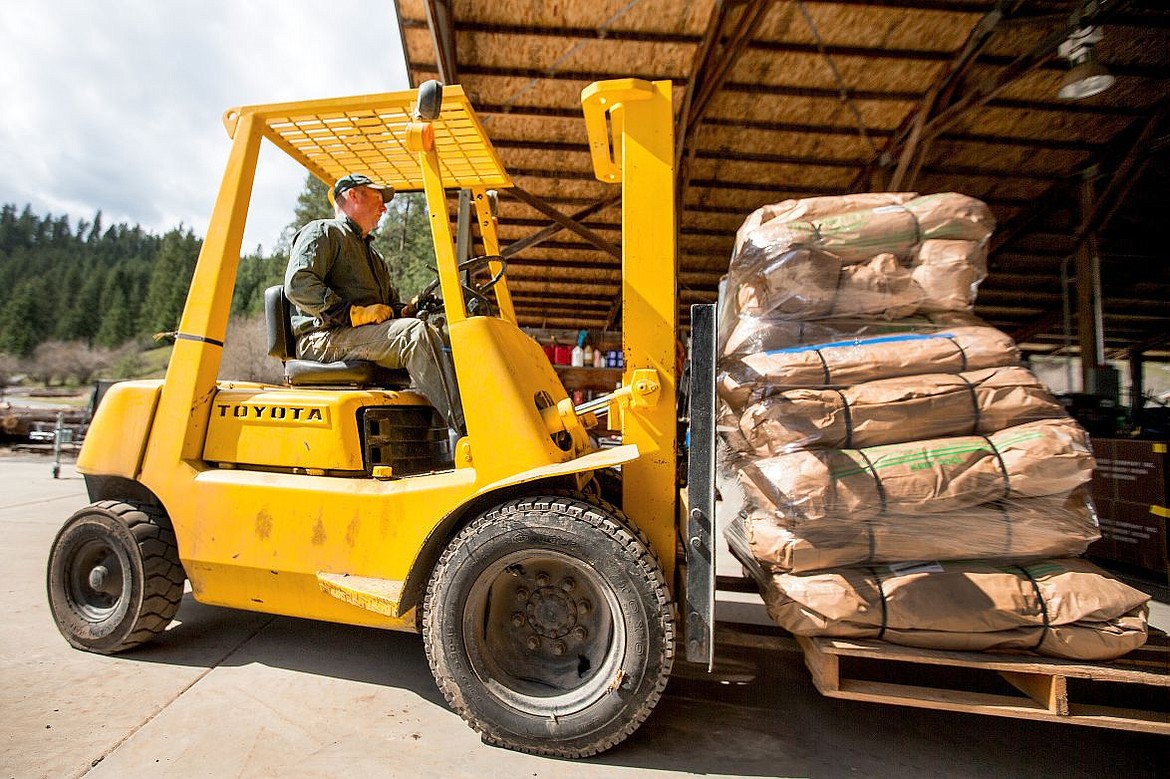
<p>Jeff Sells uses a forklift on Tuesday to move trees that are packaged up and ready to be transported to locations throughout the area to be planted.</p>
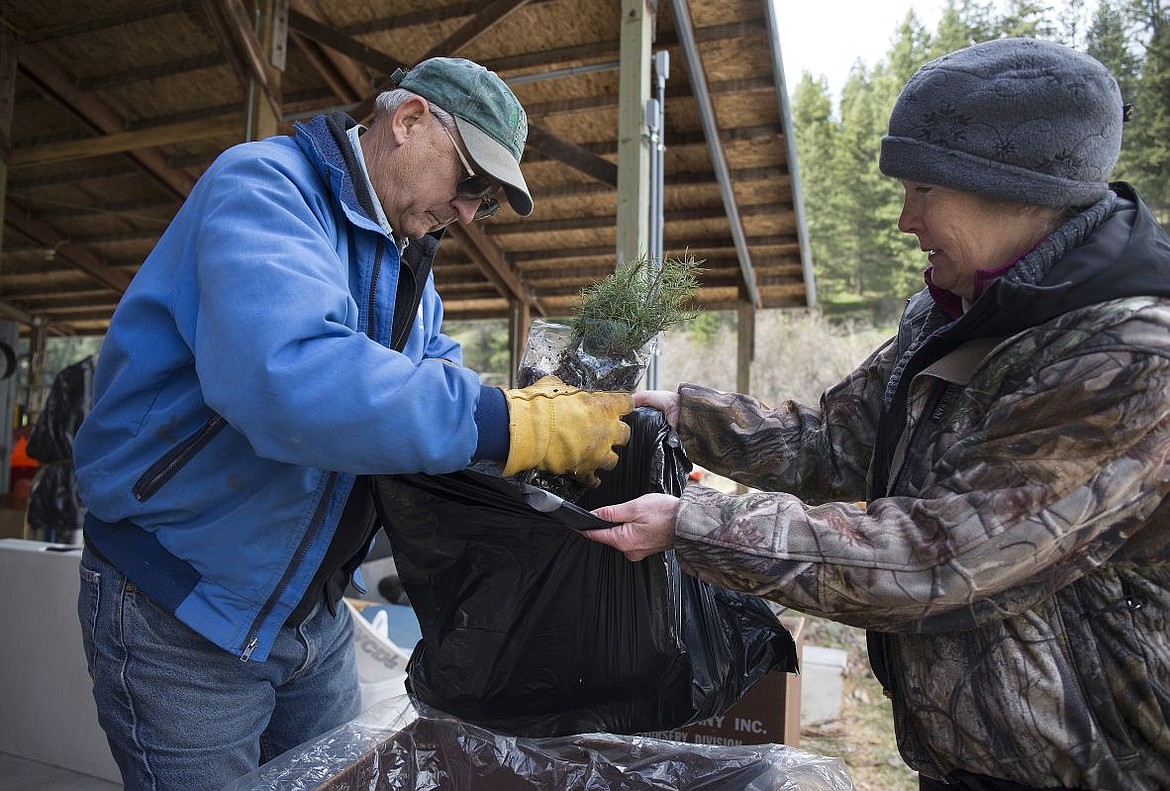
<p>Steve Funk, left, Director for the Idaho Forest Owners Association, and Julie Kincheloe, right, help box Ponderosa Pine seedlings for distribution to the 5 northern counties on Tuesday at Edgecreek Tree Farm.</p>
Steve Funk walked from his house to his shed on Edge Creek Tree Farm in Wolf Lodge. Normally the shed covers a sawmill, some logs and an old fire truck. But today, boxes labeled with yellow, orange and purple tape filled the open shed. The man in tan Carhartt overalls and a red flannel shirt hopped into the forklift and moved some of the boxes onto a truck.
The Idaho Forest Owners Association distributed more than 143,000 seedling trees to more than 70 different landowners in North Idaho Tuesday and Wednesday as part of the Forest Seedling Program.
The seedling program provides access to locally sourced seedlings for private landowners in the North Idaho area who want to replant and reforest their lands. The program used to be directed by the Panhandle Lakes Resource Conservation and Development Council until it closed in 2013 and IFOA took charge.
North Idaho landowners order seedlings from their district Soil and Water Conservation District. The conservation districts then place an order with IFOA, that has seeds stored in Roy, Wash. The nursery where the seeds are stored, Silvaseed, plants the seeds and grows them for one or two years, as specified by the order. It then ships the seedlings to IFOA.
Kirk David, executive vice president of the Idaho Forest Owners Association, said the IFOA “informs and educates people on good forestry practices and how to manage their forests and lands.” It does this for members of the association and members of the public.
“We advocate for laws and regulations that help people keep their forest lands working economically,” he added.
This is the third year in a row Steve Funk and his wife, Janet, volunteered their property to be a transition stop. They receive the seedlings from Washington and hand them over to the Soil and Water Conservation Districts. The conservation districts take their orders of seedlings back to their counties and distribute them from there.
“The reason they are here is because the seedlings go from the Canadian border down to Benewah County,” Janet said. “We’re pretty central. They can get off the interstate and get here easily with a big truck.”
The seedlings come from locally adapted seeds so they are genetically adapted to the climate and will grow healthier. The roots are grown in a special way so they stick straight down instead of radiate. This gives the tree a better chance of survival, too.
The Funks didn’t order any seedlings for themselves this year. Janet guesses they’ve planted more than 100,000 trees on their property. In 2011 they were named National Tree Farmer of the Year, the first time someone from Idaho won the award. This year they are focusing on thinning their forest and clearing out some of the “dead stuff.”
Forest maintenance is complicated and many factors play a role in maintaining a healthy stand.
“There’s a real kind of science to where and how to plant and what kind of soil you’ve got and much moisture and sunshine you’ve got,” Janet said. “And most people know it here.” She said trees should be planted further apart in areas with little moisture and can be planted closer together in areas with good moisture. But if trees are planted too close, they start competing for resources.
Different species of trees thrive better in different conditions. For example, ponderosa pines need a lot of sunlight, but other species like the Douglas fir and white pines do better in cooler temperatures with more moisture.
When the seedlings are shipped, they are kept at 28 degrees so they stay dormant. Once the trees are planted they start growing immediately. That’s why it’s such a rush once the seedlings are delivered to get them distributed and planted.
“Once they’re in the ground and it starts to warm up, they start to grow. So they’ve got to go quick,” Janet said. “Most of them will be in the ground by the end of the week.”
When the seedlings are planted, a plastic net in the shape of a tube is placed over them to prevent deer from eating them. Two bamboo sticks are also stuck in the ground at a criss-cross angle over the seedling. However, deer have been known to pull out the sticks and eat around the tubes.
As the tree limbs grow and push through the holes in the tube, the tube needs to be slid up to the top. The small branches stick out at the bottom, but deer tend to only be interested in the tops.
“There’s a misconception that trees grow and water flows,” Janet said. “That’s true to an extent but sometimes you have to do things to make them better. This is one of those efforts to make things better.”
ARTICLES BY BETHANY BLITZ/STAFF WRITER

Praise for the police
Cd’A department holds annual awards ceremony
COEUR d'ALENE — The Coeur d’Alene Police Department awarded 38 sworn and non-sworn members of the police department Monday, for their commitment to the safety of Coeur d’Alene.

Reconnecting with the canoe
Project unites tribe members with their cultural heritage as ‘water people’
A giant log sits in a warehouse on the Coeur d’Alene reservation. It is destined for greatness. Protected by a tin roof, the log waits for its transformation into a shovel-nosed canoe.

Cutthroat Trout Conservation Project resumes
Plan aims to move pike from Windy Bay in Lake Cd’A to Cougar Bay
PLUMMER — The Coeur d’Alene Tribe and Idaho Department of Fish and Game are resuming their Cutthroat Trout Conservation Project this month.