
Glacier Logan Pass goat study wraps up
CHRIS PETERSON | Hagadone News Network | UPDATED 9 years AGO
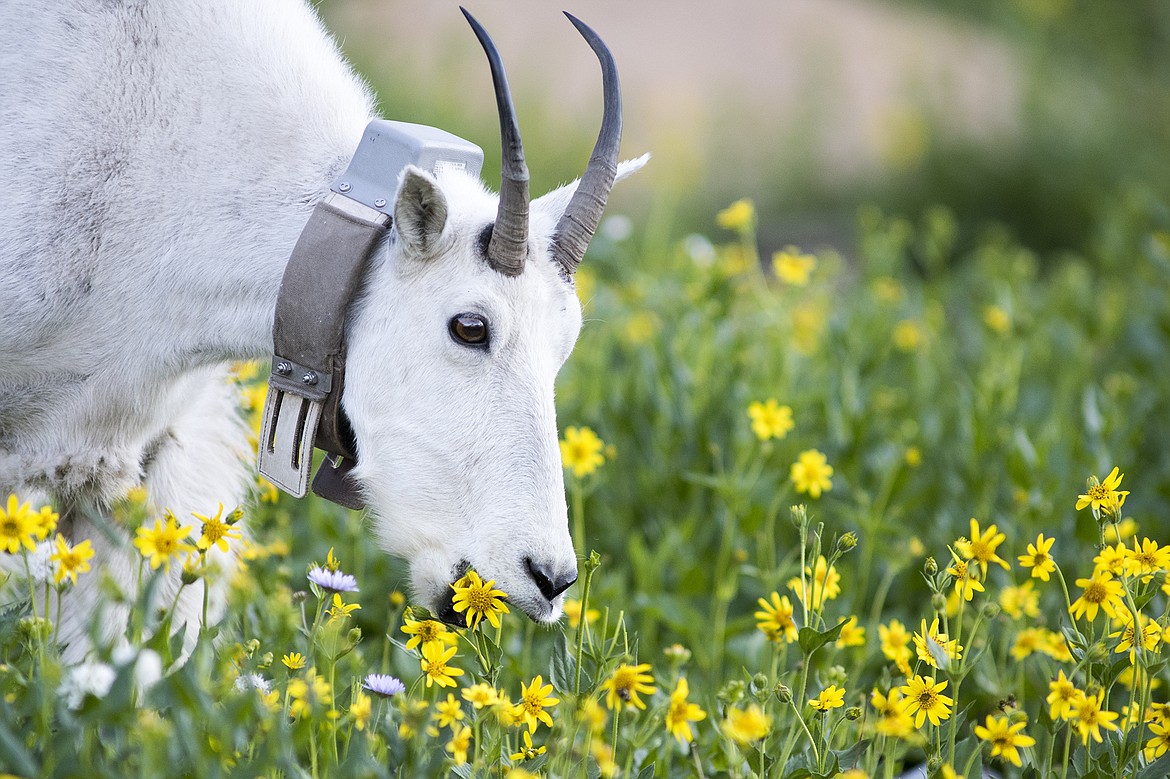
A collared mountain goat nanny at Logan Pass last summer.
Chris Peterson is the editor of the Hungry Horse News. He covers Columbia Falls, the Canyon, Glacier National Park and the Bob Marshall Wilderness. All told, about 4 million acres of the best parts of the planet. He can be reached at [email protected] or 406-892-2151. | December 5, 2016 7:22 AM
A three-year study of mountain goats at Logan Pass wrapped up this fall and Glacier National Park hopes to do a park-wide study of the iconic creatures starting in a couple of years.
The latest study focused on 24 goats living in the Logan Pass region that were radio collared and tracked by University of Montana graduate student Wesley Sarmento.
The goats proved to be quite resilient. Of the 24, only two died. A third lost its collar after it apparently got caught on another goat and it tore off, said Mark Biel, supervisory biologist for Glacier.
Sarmento found that the Logan Pass goats, like most high country ungulates, are salt deficient. In a normal setting without human influences, the goats would travel to natural salt licks near Many Glacier.
But the Logan Pass goats were keying in on urine and sweat from visitors as well as salt and antifreeze leaking off cars at the Logan Pass parking lot.
With as many as 1,300 people a day hiking the Hidden Lake Trail in the summer months, at least some would urinate in the bushes, and the goats would lick up the urine for its salt.
This resulted in goats getting too close to people and to vehicles. Bighorn sheep have also proven to be problematic at Logan Pass for the same reason.
This summer, Biel used a specially trained collie named Gracie to shoo goats and sheep out of the Logan Pass parking lot. The dog proved to be an effective deterrent, though Biel was only able to make it up to the Pass with Gracie a couple of times a week.
In the coming months, Park leadership will decide what actions to take based on Sarmento’s study. One possible idea is to put a pit toilet at the Hidden Lake overlook, to cut down on the public urination problem. Another might be a public information campaign to tell visitors about urine and the goat’s attraction to it, Biel noted.
The problem with a pit toilet is the overlook sits on bedrock. Pit toilets are also fairly unattractive and the overlook is one of the prettiest places on Earth.
Glacier isn’t the only area with goat-salt problems. The Jewel Basin has goats that can get aggressive because of urine and managers of the Scotchman Peaks Wilderness in the Cabinet Mountains also urge people to not urinate on trails because of goats. In some cases, the Peaks goats in particular have been very aggressive near people and trails have been closed because of them.
The Glacier goats dropped their radio collars later than expected, Biel noted.
The collars were supposed to fall off automatically in July — they didn’t fall off until later in the fall.
“They came off much later than anticipated,” Biel noted.
If funding comes through, Glacier wants to do another study of goats on a park-wide basis. The high mountain creatures are susceptible to climate change, as the treeline increases in Glacier, covering up the high mountain meadows where they feed. The loss of glaciers and snowfields also dries up water sources. Goats are also extremely adapted to snow — their long white coats are a perfect camouflage against predators and excellent insulation against the cold.
The Logan Pass goats appear to be very healthy so far. While they do eat antifreeze, it doesn’t seem to have any ill-effects. Some of the collared female goats had multiple kids during the study.
Gracie the dog has been pulling duty around Park headquarters this fall. Biel said he’s been using her to shoo whitetail deer out of the residential area at Park headquarters.
The deer attract mountain lions and lions have killed deer close to homes in the past and there have been incidents where pet dogs and lions have had fights.
The hope is to keep the deer out of the residential areas by using the dog as a deterrent, Biel noted.
ARTICLES BY CHRIS PETERSON
Columbia Falls concerned sewer system could be bottleneck for growth
The City of Columbia Falls could see a significant bottleneck in future growth due to its sewage treatment plant, depending how the city and the state calculate the sewage treatment plant’s maximum treatment capacity without a major upgrade.
Columbia Falls City Council tables e-bike law
The Columbia Falls City Council last week voted to table a city ordinance that would restrict e-bikes and e-motorcycles along with other electrically powered vehicles on its sidewalks and city parks.
Oh, Christmas tree!
I usually talk to my mother on the phone once a week or so. She lives alone in Florida and works for a church doing funerals part-time.