
New MRI machine delivered
CHERYL SCHWEIZER | Hagadone News Network | UPDATED 10 years, 1 month AGO
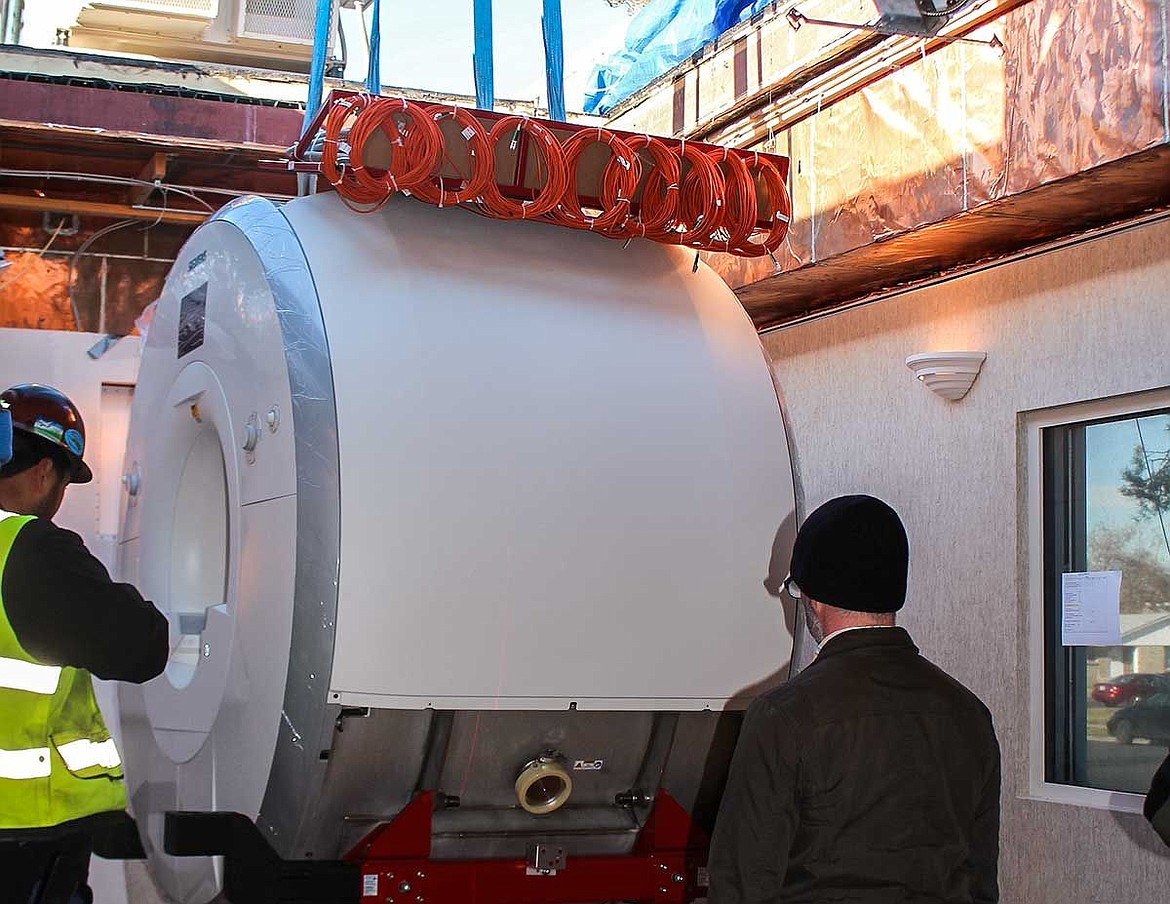
A $1.6 million MRI machine was delivered to its new home at Moses Lake Clinic through a hole in the roof Monday.
Senior Reporter Cheryl Schweizer is a journalist with more than 30 years of experience serving small communities in the Pacific Northwest. She began her post-high-school education at Treasure Valley Community College and enerned her journalism degree at Oregon State University. After working for multiple publications, she has settled down at the Columbia Basin Herald and has been a staple of the newsroom for more than a decade. Schweizer’s dedication to her communities and profession has earned her the nickname “The Baroness of Bylines.” She covers a variety of beats including health, business and various municipalities. | February 4, 2016 5:00 AM
MOSES LAKE — Gregg Fletcher made sure to take a selfie with the new arrival – after all, it’s not every day the director of Moses Lake Clinic gets to take a picture with a million-dollar MRI (magnetic resonance imaging) machine being lowered through the roof.
Actually, the machine by itself was $1.2 million, Fletcher said. “That was actually a bargain price,” said clinic radiologist Dr. Gregory Bear. Total cost, when all the expenses were added up, was $1.6 million. Original estimates were more than $2 million, Bear said.
The new MRI is the “top of the line in the whole Confluence system,” Fletcher said. It replaces an MRI setup that was about a decade old, he said. And it means patients will be less likely to have to leave town to receive MRI services. “There’s not a more advanced magnet in Tri-Cities or Spokane,” said radiology manager Ray Ownby.
“It’s kind of like getting a new car,” Bear said. “Every 10 years is a whole new generation of car.” The space for the patient is wider, and “image quality and detail will be improved,” he said. Image quality will be better for patients with replacement joints,
The new machine will be able to see more detail, and will be more sensitive to abnormalities, Bear said. “Subtle things that might’ve been missed in the past, we’ll have a better chance of seeing them.”
And there’s another advantage. “This scanner is super-quiet,” Bear said. The machine it’s replacing was “pretty much like being in an artillery range.” It’s also easier for radiology technicians to use, Fletcher said.
The MRI unit was delivered Monday morning, and the trick once it got to the clinic parking lot was getting it into the building. Maintenance and operation requirements mean the MRI unit is housed in its own building, and it's in a separate room inside the building. Getting it in either required some wide doors or a hole in the roof, and the designers of the building opted for the latter.
Off came the roof, or at least a section of the roof, and up went the unit – the $1.2 million MRI unit, dangling from straps. Fletcher admitted to a little nervousness as the unit was lifted over the building and lowered into place.
Patients should be able to start using the machine about Feb. 22, Fletcher said.
ARTICLES BY CHERYL SCHWEIZER
REC Silicon reports operating loss in 2025
MOSES LAKE — REC Silicon operating revenue dropped substantially in 2025 when compared with 2024, according to the company’s annual report released March 25. The company reported $78.2 million in operating revenue in 2025, compared with $140.8 million in 2024.
Open house for Moses Lake comprehensive plan Monday
MOSES LAKE — Moses Lake residents are being invited to learn more about and give their opinions on proposed updates to sections of the city’s comprehensive plan at an open house Monday at the Moses Lake Civic Center, 411 S. Balsam St.
Samaritan posts operating loss for first two months of 2026
MOSES LAKE — Samaritan Healthcare posted net revenue losses in January and February, and while hospital officials anticipated some red ink, the losses were larger than the budget projections. Samaritan posted an operating loss of about $1.4 million in February and about $486,500 in January.