
COLUMN: Legion ball a labor of love
Andy Viano | Hagadone News Network | UPDATED 9 years, 8 months AGO
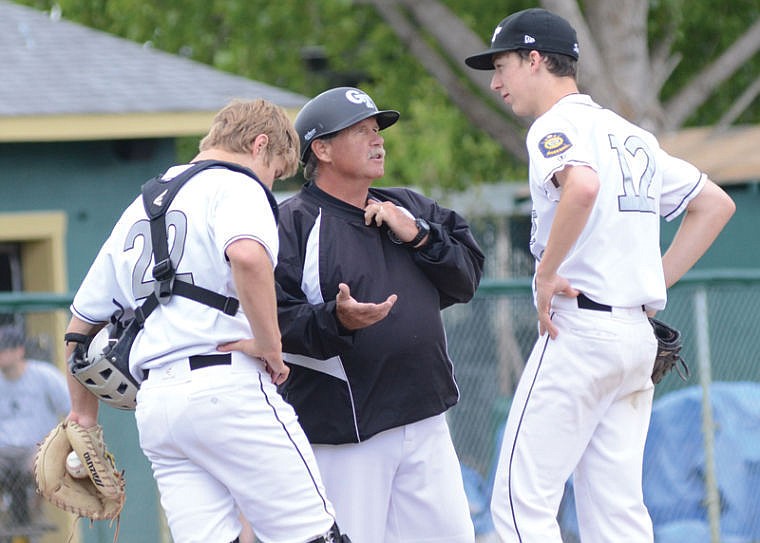
<p>Glacier Twins A head coach Bob Rupp instructs a pair of players in this file photo. (Matt Baldwin/Whitefish Pilot)</p>
When the wildly successful 2014 Glacier Twins season ended following a trip to the American Legion regional tournament in Alaska, head coach Bob Rupp and the rest of the program’s board of directors took a look at the bottom line and saw a major problem.
They were $25,000 in the hole.
So he and assistant coaches Kevin Slaybaugh and Scott Murray, who had just finished a grueling summer shepherding dozens of teenagers through endless bus rides, hours-long practices, games, tarp pulls and everything else that goes into running a baseball team, made a decision: they politely declined to be paid.
At all.
For the whole season.
“When we went to regionals (in 2014) we did not budget for that,” Rupp said. “So when the season ended we didn’t take (our salary). We’re lucky to be retired or have other jobs so we can do that.”
Modest as their salaries already are, the sacrifices made by Rupp and his coaches represent just a tiny portion of those made by countless coaches, players, their families and other volunteers to make American Legion baseball a reality in the Flathead Valley.
The Montana High School Association does not support baseball as a prep sport, so players interested in taking a crack at the game throughout the state play for teams that are almost exclusively volunteer run. Both the Kalispell Lakers and Glacier Twins are run by unpaid boards of directors and rely people donating their time — including the players and coaches themselves — to do literally everything necessary to pull off a show for fans, a level playing field for the competitors and even a meal for the guests, too.
Today both teams will stretch even thinner, with each hosting weekend-long baseball galas on their home turf — the John R. Harp tournament in Kalispell and the Sapa-Johnsrud tournament in Whitefish.
“It’s a long day and a long weekend for the boys,” Rupp said. “We have a couple parents that help out and they all get here, they drag the field, they chalk it, they drag it out, they clean the bleachers, they take the garbage out.
“In some cases they’re doing the scorebook and the announcing and the scoreboard itself and then between games they’re down here lining and doing the field prep.
“These guys love baseball,” he continued. “They like being down here. They never ever complain, they come and do their job and do what needs to get done.”
Sometimes, their job includes even more than the routine duties, too.
The Twins’ website (www.glaciertwinsbaseball.org) features a photo gallery of volunteers installing upgrades to the bleachers at Memorial Park. And each year Twins players both put up and take down the temporary fencing that makes up the outfield wall during baseball season and forms the Whitefish High School football stadium’s northern boundary in the fall.
Rupp, for his part, demurred about his own volunteerism and instead pointed to other board members, specifically Bob and Connie Lockman, a pair of retirees who by Rupp’s account are “the workhorses behind the Twins.”
Things run much the same in Kalispell, where the Lakers’ coaches collect meager salaries for their time and are supported by a board headed by president Marc Liechti, who estimates he’s been involved with the program for around 20 years.
“I love the organization,” Liechti said when asked why he continues to be so heavily involved, especially since his son hasn’t played for the Lakers since last decade.
“I think it’s great for the kids. It’s a huge commitment for a kid that plays Legion baseball particular because it’s a big part of their summer after school is over. A lot of kids love to go (do outdoor activities) or have vacation, but they commit themselves.
“We believe this is an educational thing for the kids to see the hard work that it takes to operate a program like this. Life’s not easy.”
Aside from man hours, Legion teams also need to make ends meet, especially if they hope to keep their stadiums operational, fields safe to play on, uniforms clean, equipment up to date and, most years at least, their coaches paid. Liechti estimated it costs the Lakers around $100,000 annually to field their AA and A teams, while Rupp said the Twins’ budget was at least $125,000 combined for the A and B squads.
Both teams sell corporate sponsorships to local businesses, hold fundraisers, generate money from ticket and concessions sales, and collect fees from players and their families — although players have a chance to work those off through volunteering, selling tickets or other means — to pay those operational costs.
It’s a big price to pay for communities, for players, for their families, for the volunteers, for the coaches and for everyone else involved. It is so many people, making so many sacrifices, to allow a sport to continue to be viable across Montana. It makes you wonder, is it all worth it?
“We know that to make this program run you’ve got to spend the hours,” Rupp said.
“As far as I’m concerned, baseball’s worth it.”
Andy Viano is a sports reporter, columnist and trumpeter of America’s pastime. He can be reached at 758-4446 or [email protected].
ARTICLES BY ANDY VIANO
BOYS BASKETBALL: Bigfork in familiar position entering state tournament
Vikings set sights on second state title in three years
BUTTE — The Bigfork Vikings won a state championship just two years ago.
GIRLS BASKETBALL: Bigfork draws mighty Malta to open state tournament
Vals to take on defending state champs this morning
BUTTE — The Bigfork coaching staff had a chance to watch the Malta-Fairfield Northern B divisional championship game last week, and they came back with a clear message for their girls.
