
Quincy students show their computer skills
CHERYL SCHWEIZER | Hagadone News Network | UPDATED 10 years, 4 months AGO
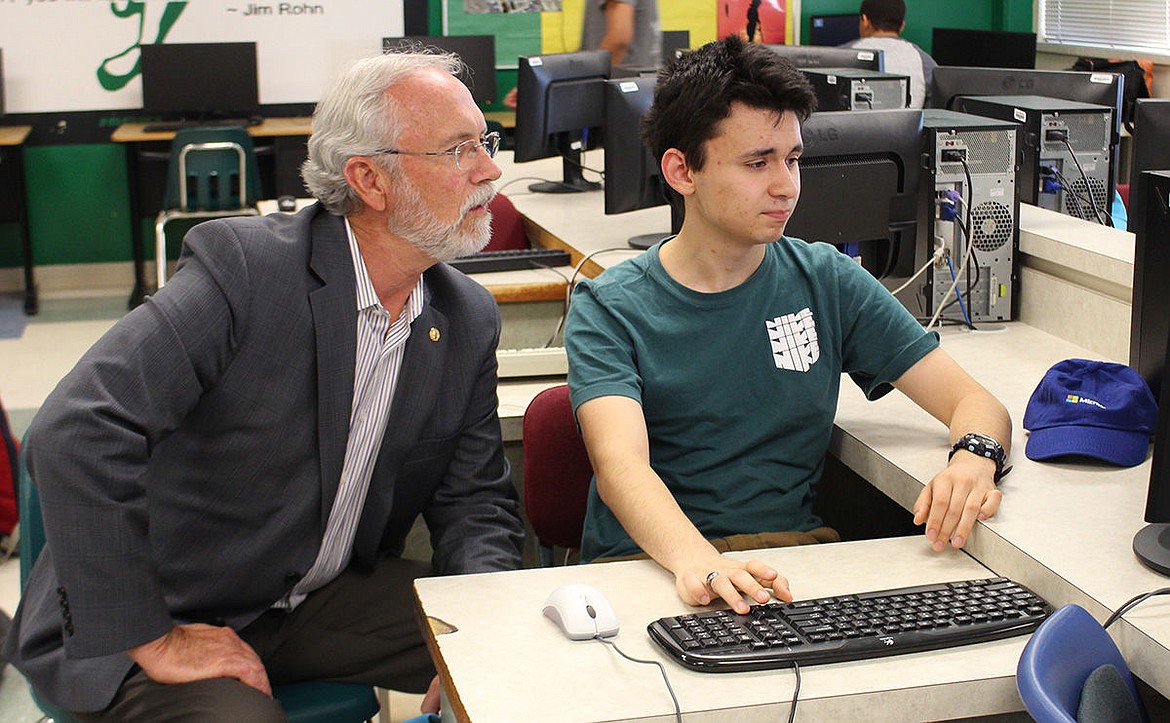
Congressman Dan Newhouse takes a tour of a video game with designer (and Quincy High School student) Octavio Bustos. Newhouse visited QHS and the computer class Monday.
Senior Reporter Cheryl Schweizer is a journalist with more than 30 years of experience serving small communities in the Pacific Northwest. She began her post-high-school education at Treasure Valley Community College and enerned her journalism degree at Oregon State University. After working for multiple publications, she has settled down at the Columbia Basin Herald and has been a staple of the newsroom for more than a decade. Schweizer’s dedication to her communities and profession has earned her the nickname “The Baroness of Bylines.” She covers a variety of beats including health, business and various municipalities. | June 7, 2016 1:45 PM
QUINCY — Juan Zetina, a senior at Quincy High School, called it a roadblock. But to be honest it was more like his project ran into a ditch.
Juan was explaining his project to Dan Newhouse, representative for the Fourth District in the U.S. Congress, Monday morning during Newhouse’s visit to school. Quincy is part of the TEALS program, where computer science professionals work with high school students, and part of the program requirement is a culminating project.
Juan had to write a computer program, and he chose to work with Bitcoin, an alternative way to pay for goods and services. Juan and class partner Angel Bermudez figured out how to link Bitcoin with a smaller computing system called Raspberry Pie. So far so good.
But instructor Ross Kondo thought they could go further. He suggested they link Bitcoin with a network of Raspberry Pies. And that was where they ran into trouble.
“We needed extra hardware,” Angel said, and QHS didn’t have it. They were stuck, and the project deadline was looming.
But Juan didn’t panic. Well, “we can say there was a little panic in there,” he said.
Juan and Angel aren’t alone. “It’s one of those problems we run into writing real code,” said Matt McKee, a program manager with Microsoft in Redmond. McKee is a volunteer at QHS, working with the students every week via videoconference.
Every kid in the TEALS class built a computer program for their culminating class project. Octavio Bustos chose to make a video game, which he demonstrated for Newhouse.
Octavio built a maze, with five levels for the player to master. “It was kind of easy,” he said, not requiring as much code as some other projects.
Angel also chose a video game, a variation on that classic test of spelling and word recognition called Hangman. He also demonstrated his game for Newhouse.
“They get credit for doing this, right? Playing computer games,” Newhouse joked.
“Only if they can write them first,” McKee said.
The TEALS program partners computer science professionals with students in 56 high schools around the state, McKee said. It’s the kind of training that will help students if they’re looking at a career in computer science, he added. He got help from professionals volunteering at his school, but it was after school and extracurricular. “I didn’t have an opportunity to learn this in class.”
Juan, faced with a deadline and no project, turned to the computer. “We just went on the net and looked up projects,” Angel said. They found a “user-friendly calculator,” which Juan used in his demonstration.
The calculator program can add, subtract, divide and multiply; it asks questions of the user, helping them through the process.
Coding, Juan explained, is the foundation of any computer program. “You’re pretty much telling the computer what to do,” he said in answer to question from Newhouse.
Newhouse asked what happens if there’s a mistake. “You’re going to have to go look for it,” Juan said.
The TEALS program is designed to encourage kids to consider careers in computer science, and at QHS it’s piqued interest. Juan has applied to the computer science program at Eastern Washington University, and Octavio has applied to Western Washington. As computers become a bigger and bigger part of industry, knowing the basics of computer science will be useful no matter what career students pursue, McKee said.
ARTICLES BY CHERYL SCHWEIZER

Warden man injured in tractor-trailer collision with train
BRUCE — A Warden man was transported to an out-of-area hospital after the tractor-trailer he was driving was hit by a train near Bruce at about noon Tuesday. "The extent of the driver's injuries is not known at this time," wrote Adams County Sheriff Dale Wagner in a media release. "Preliminary information indicates the semi-truck was traveling above the speed limit and failed to obey posted requiring traffic to yield at the railroad crossing. The train was traveling at a slow speed," Wagner said. "He was moving. He wasn't stuck on the tracks," he said in an earlier interview.

Othello man arrested for Moses Lake attempted burglary
MOSES LAKE — An Othello man jumped into Moses Lake in an unsuccessful attempt to avoid Moses Lake Police Department officers last Friday. An MLPD media release issued Wednesday said Fernando Lira, 36, was booked into the Grant County Jail on suspicion of second-degree burglary in connection with the incident. Lira allegedly attempted to burglarize a business in the 600 block of East Broadway Friday morning. The business owner discovered him and chased him off the property, the release said.
Higher revenues, expenses projected in preliminary Moses Lake city budget
MOSES LAKE — While Moses Lake city officials have reduced expenses and revenues are projected to increase by about 7.9% in the city's preliminary budget, proposed expenditures are projected to go up by about 9.5%. Assistant City Manager James Richmond emphasized the preliminary budget presented earlier this month is not cast in stone. "The projected figures are not finalized. They are requests from departments based on projected 2027 operational costs. Largely, the figures are based on guidance from the city council during the financial sustainability plan analysis," Richmond wrote in answer to questions from the Columbia Basin Herald.