
Quincy students show off skills for Newhouse
CHERYL SCHWEIZER | Hagadone News Network | UPDATED 9 years, 9 months AGO
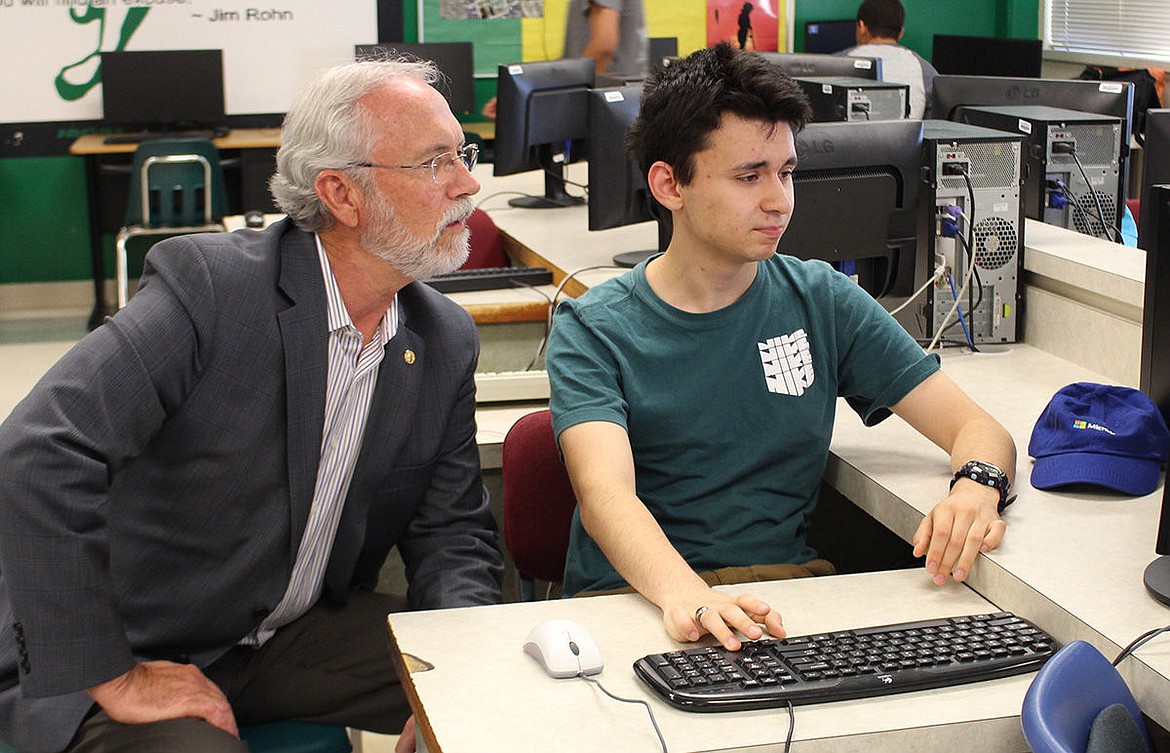
Congressman Dan Newhouse takes a tour of a video game with designer (and Quincy High School student) Octavio Bustos. Newhouse visited QHS and the computer class.
Senior Reporter Cheryl Schweizer is a journalist with more than 30 years of experience serving small communities in the Pacific Northwest. She began her post-high-school education at Treasure Valley Community College and enerned her journalism degree at Oregon State University. After working for multiple publications, she has settled down at the Columbia Basin Herald and has been a staple of the newsroom for more than a decade. Schweizer’s dedication to her communities and profession has earned her the nickname “The Baroness of Bylines.” She covers a variety of beats including health, business and various municipalities. | June 19, 2016 6:00 AM
QUINCY — Juan Zetina, a senior at Quincy High School, called it a roadblock. But to be honest it was more like his project ran into a ditch.
Juan was explaining his project to Dan Newhouse, representative for the Fourth District in the U.S. Congress, during Newhouse’s visit to school. Quincy is part of the TEALS program, in which computer science professionals work with high school students, and part of the program requirement is a culminating project.
Juan had to write a computer program, and he chose to work with Bitcoin, an alternative way to pay for goods and services. Juan and class partner Angel Bermudez figured out how to link Bitcoin with a smaller computing system called Raspberry Pie. So far so good.
But instructor Ross Kondo thought they could go further. He suggested they link Bitcoin with a network of Raspberry Pies. And that was where they ran into trouble.
“We needed extra hardware,” Angel said, and QHS didn’t have it. They were stuck, and the project deadline was looming.
But Juan didn’t panic. Well, “we can say there was a little panic in there,” he said.
Juan and Angel aren’t alone. “It’s one of those problems we run into writing real code,” said Matt McKee, a program manager with Microsoft in Redmond. McKee is a volunteer at QHS, working with the students every week via video conference.
Every kid in the TEALS class built a computer program for their culminating class project. Octavio Bustos chose to make a video game, which he demonstrated for Newhouse.
Octavio built a maze, with five levels for the player to master. “It was kind of easy,” he said, not requiring as much code as some other projects.
Angel also chose a video game, a variation on that classic test of spelling and word recognition called Hangman. He also demonstrated his game for Newhouse.
“They get credit for doing this, right? Playing computer games,” Newhouse joked.
“Only if they can write them first,” McKee said.
The TEALS program partners computer science professionals with students in 56 high schools around the state, McKee said. It’s the kind of training that will help students if they’re looking at a career in computer science, he added. He got help from professionals volunteering at his school, but it was after school and extracurricular. “I didn’t have an opportunity to learn this in class.”
Juan, faced with a deadline and no project, turned to the computer. “We just went on the net and looked up projects,” Angel said. They found a “user-friendly calculator,” which Juan used in his demonstration.
The calculator program can add, subtract, divide and multiply; it asks questions of the user, helping them through the process.
Coding, Juan explained, is the foundation of any computer program. “You’re pretty much telling the computer what to do,” he said in answer to question from Newhouse.
The TEALS program is designed to encourage kids to consider careers in computer science, and at QHS it’s piqued interest.
Juan has applied to the computer science program at Eastern Washington University, and Octavio has applied to Western Washington. As computers become a bigger and bigger part of industry, knowing the basics of computer science will be useful no matter what career students pursue, McKee said.
ARTICLES BY CHERYL SCHWEIZER
REC Silicon reports operating loss in 2025
MOSES LAKE — REC Silicon operating revenue dropped substantially in 2025 when compared with 2024, according to the company’s annual report released March 25. The company reported $78.2 million in operating revenue in 2025, compared with $140.8 million in 2024.

Open house for Moses Lake comprehensive plan Monday
MOSES LAKE — Moses Lake residents are being invited to learn more about and give their opinions on proposed updates to sections of the city’s comprehensive plan at an open house Monday at the Moses Lake Civic Center, 411 S. Balsam St.

Samaritan posts operating loss for first two months of 2026
MOSES LAKE — Samaritan Healthcare posted net revenue losses in January and February, and while hospital officials anticipated some red ink, the losses were larger than the budget projections. Samaritan posted an operating loss of about $1.4 million in February and about $486,500 in January.