
Doug Sly ends 31-year Big Bend CC career
CHERYL SCHWEIZER | Hagadone News Network | UPDATED 10 years, 3 months AGO
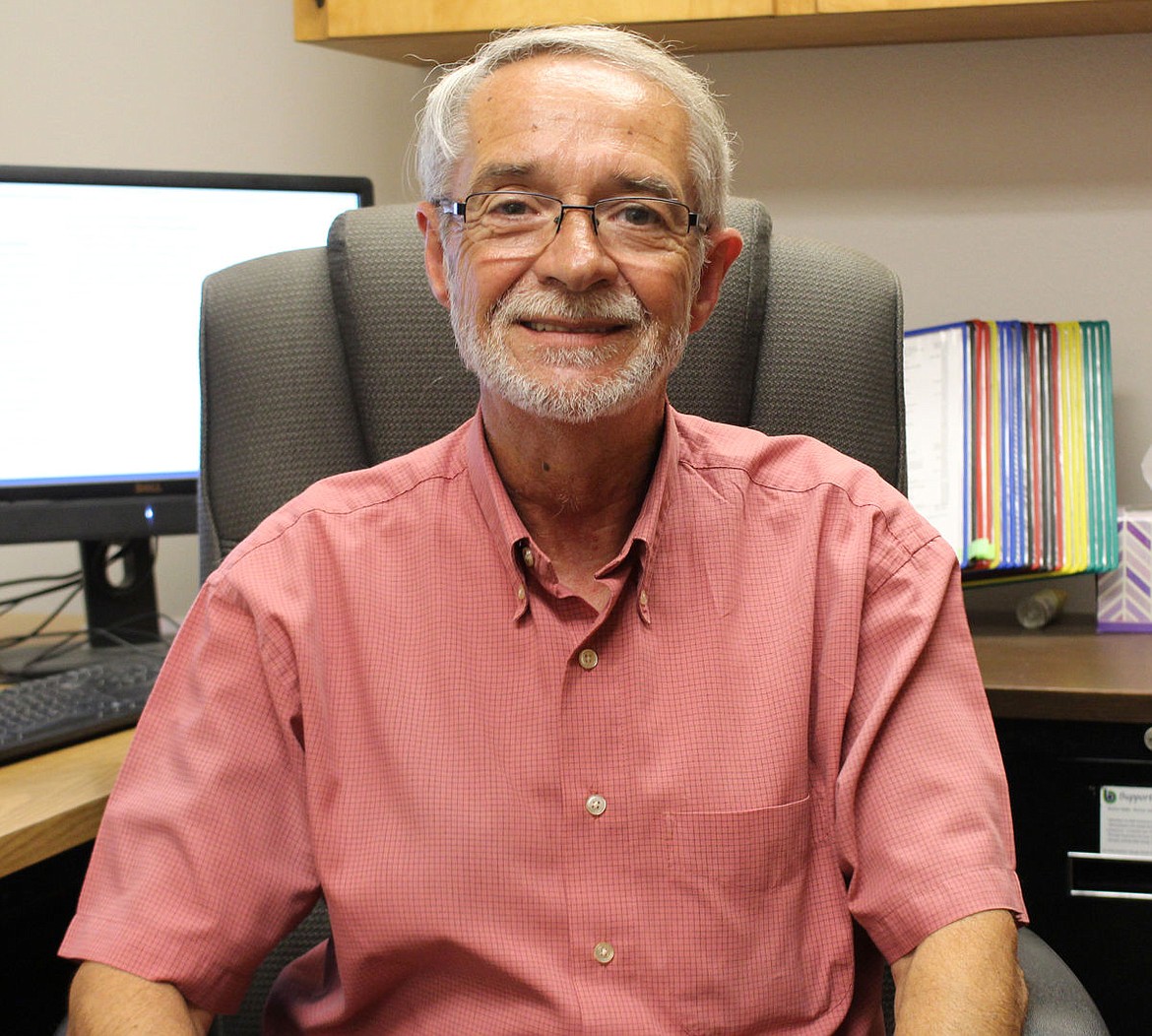
Doug Sly closes out a 31-year career at Big Bend Community College at the end of June.
Senior Reporter Cheryl Schweizer is a journalist with more than 30 years of experience serving small communities in the Pacific Northwest. She began her post-high-school education at Treasure Valley Community College and enerned her journalism degree at Oregon State University. After working for multiple publications, she has settled down at the Columbia Basin Herald and has been a staple of the newsroom for more than a decade. Schweizer’s dedication to her communities and profession has earned her the nickname “The Baroness of Bylines.” She covers a variety of beats including health, business and various municipalities. | June 25, 2016 6:00 AM
MOSES LAKE — Doug Sly said he liked his job as public information officer at Big Bend Community College, and the reason was the students.
“I was kind of inspired by the students, I think. It’s hard not to be,” he said. “To see folks overcome a lot and do very well – it’s very gratifying.” The college staff – the employees in the financial office, tutors, professors – have the potential to change someone’s life every day, he said.
Sly will retire June 30 after 31 years at BBCC. The college’s board of trustees awarded him emeritus status.
Sly said he taught classes as well as working to promote the college during the first dozen years or so. He replaced “a guy named Dave Johnson, who was the publisher of the Grant County Journal (in Ephrata),” Sly said. Along with teaching news writing and communication classes, “I was advisor to the Tumbleweed Times,” the college newspaper at the time.
A lot has changed in communications, but writing well is still a valuable skill, Sly said. “That’s what can get (students) a lot of different jobs, is knowing how to write.” Its usefulness was apparent even before his students graduated. “I told them, ‘use this in your English class, but don’t tell them that’s what you’re doing. You’ll get an A.’”
In 31 years he’s worked for four college presidents and one interim president, he said, and was director of the BBCC Foundation from 1999 to 2011. “Sometimes I was called ‘assistant to the president.’ What that means is you have a new president that needs to be introduced into the community.”
But he started out in the newspaper business, working at the Columbia Basin Herald back in the day. Way back in the day, in technological terms. “I started at the Herald with a manual typewriter,” he said. “It had a bumper sticker on it.”
The change in technology can be illustrated by the construction of the ATEC building, Sly said. College officials were raising money to build it, but the project was in doubt due to an apparently insoluble hitch in the business plan. The cost of providing internet access was going to be astronomical.
Then, at a meeting to discuss the future of technology, college officials heard about a new project under consideration by the Grant County PUD, among others. The college was part of the PUD's pilot project for fiber, "and the cost of it was almost nominal." Access to high-speed fiber made the difference. “It was an ‘ah-hah’ moment, when we went to that conference and tried to understand fiber.”
Big Bend is unusual among community colleges, because many of its buildings were built without a lot of state funding, Sly said. For many years the college administered a program to provide continuing education to U.S. Army soldiers overseas; “we had 110 sites. I think we were even in the Sinai,” he said. The money from that helped build the college’s activity center (gym), the liberal arts-business building and the quad behind the administration building. The money also paid for extensive remodeling. The current library in the ATEC building was built with state funds; the rest of ATEC was built with funds raised locally, he said.
Currently the college is in the beginning stages of building a new professional-technical center, with site selection and design process underway. It’s the biggest capital project in the college’s history, Sly said.
Enrollment has increased, with the equivalent of about 1,600 full-time students during 2016 winter quarter, the latest for which records are available. “Running Start has been interesting to watch.” Running Start allows high school students to attend community college. It started about 1992 with about 35 students, and “it’s 10 times more than that now.”
There have been some downs as well as ups. Sly said the hardest time during his career at the college was in the immediate aftermath of the 2008 recession. The college lost 27 positions through attrition between 2008 and 2010, “and I don’t think the college has fully recovered.”
Sly lived near Spokane as a child, graduated from high school in Oklahoma. “My dad’s career was in nuclear safety,” he said. One brother followed Dad into nuclear engineering; two others are chemists, Sly said. “And I’m the black sheep,” he added with a chuckle.
Cheryl Schweizer can be reached via email at [email protected].
ARTICLES BY CHERYL SCHWEIZER

Warden man injured in tractor-trailer collision with train
BRUCE — A Warden man was transported to an out-of-area hospital after the tractor-trailer he was driving was hit by a train near Bruce at about noon Tuesday. "The extent of the driver's injuries is not known at this time," wrote Adams County Sheriff Dale Wagner in a media release. "Preliminary information indicates the semi-truck was traveling above the speed limit and failed to obey posted requiring traffic to yield at the railroad crossing. The train was traveling at a slow speed," Wagner said. "He was moving. He wasn't stuck on the tracks," he said in an earlier interview.

Othello man arrested for Moses Lake attempted burglary
MOSES LAKE — An Othello man jumped into Moses Lake in an unsuccessful attempt to avoid Moses Lake Police Department officers last Friday. An MLPD media release issued Wednesday said Fernando Lira, 36, was booked into the Grant County Jail on suspicion of second-degree burglary in connection with the incident. Lira allegedly attempted to burglarize a business in the 600 block of East Broadway Friday morning. The business owner discovered him and chased him off the property, the release said.
Higher revenues, expenses projected in preliminary Moses Lake city budget
MOSES LAKE — While Moses Lake city officials have reduced expenses and revenues are projected to increase by about 7.9% in the city's preliminary budget, proposed expenditures are projected to go up by about 9.5%. Assistant City Manager James Richmond emphasized the preliminary budget presented earlier this month is not cast in stone. "The projected figures are not finalized. They are requests from departments based on projected 2027 operational costs. Largely, the figures are based on guidance from the city council during the financial sustainability plan analysis," Richmond wrote in answer to questions from the Columbia Basin Herald.