
Draft motorboat restrictions get initial OK
Sam Wilson | Hagadone News Network | UPDATED 9 years, 10 months AGO
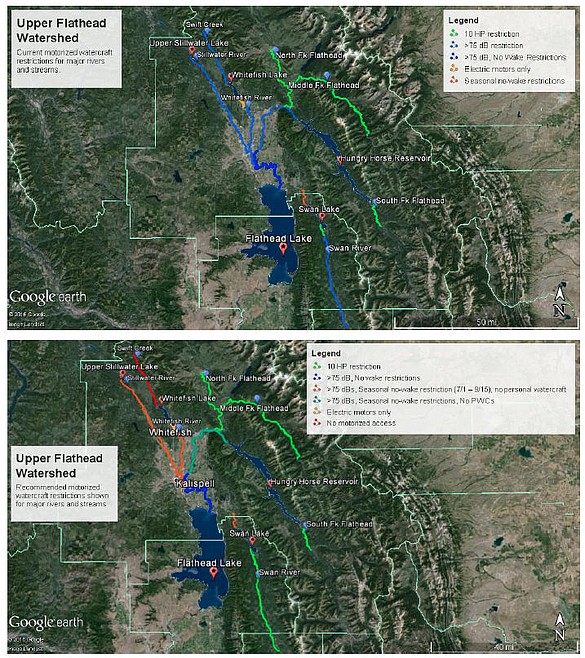
<p><strong>As currently</strong> proposed, the Quiet Waters Initiative would increase motorized watercraft restrictions on much of the Flathead River’s main stem and South Fork, as well as the Swan and Stillwater rivers. (Maps courtesy of Montana Backcountry Hunters and Anglers)</p>
Rivers and streams across Montana could have increased restrictions for motorized watercraft under an initiative given preliminary approval by the Montana Fish and Wildlife Commission on Thursday.
The Quiet Waters Initiative, submitted by Montana Backcountry Hunters and Anglers, aims to prevent conflicts with wildlife and water recreationists caused by the increasing presence of motorized watercraft on rivers and streams in Montana — including many in the Flathead River Basin.
The commission voted unanimously to initiate the rule-making process to adopt the restrictions after more than a dozen Montana residents and representatives from outdoors and conservation organizations spoke in favor of the proposal.
In Northwest Montana, the initiative proposes to add a no-wake season June 1 to Oct. 15 to the Flathead River from the Montana 35 bridge to the confluence of the South and Middle forks and up the South Fork to Hungry Horse Dam.
The proposed rules would also tighten the noise restrictions on those river stretches, setting them at 75 decibels from the shore.
While Region One Warden Capt. Lee Anderson said in an interview after the commission’s meeting that the initiative misstates current noise restrictions in Flathead and Lake counties, the proposed noise limits are slightly stricter than the current statewide limits of 86 decibels at 50 feet and 90 decibels at the muffler when a boat is idle.
According to the California Department of Transportation’s website, 75 decibels is approximately the equivalent of a vacuum cleaner heard from a distance of 10 feet or a gas-powered lawnmower at 100 feet.
The current no-wake restriction on the Swan River would be extended from the current boundary, Spotted Bear Ridge, upstream to the Swan’s headwaters.
Seasonal no-wake restrictions would apply to the Stillwater and Whitefish rivers from July 1 through Sept. 15, and all motorized watercraft use would be prohibited on Swift Creek and tributaries to Whitefish Lake.
“This is the beginning of a process, this is the beginning of a conversation with everybody,” commission chairman Dan Vermillion said before the vote. “This doesn’t mean that we’ll end up with all these restrictions in place or all these new management decisions in place, but I as a commissioner think it’s at least time to have this conversation.”
Proponents contend that conflicts between motorized and nonmotorized users are a threat to public safety and that motorized boating has negative impacts on wildlife.
Speaking via teleconference from the wildlife agency’s regional headquarters in Kalispell, Ben Long, co-chairman of the board of directors of Backcountry Hunters and Anglers, characterized the initiative as a “proactive” measure.
“You want to talk about drastic change, there’s been a change in both the number of watercraft on the water and the kinds of boats they’re using,” Long said. “This is about being proactive and protecting our natural resources that belong to everybody and heading off problems not only before they become dangerous, but before they become unsolvable.”
Tom Flowers, the chief of law enforcement for Montana Fish, Wildlife and Parks, said a department review found that no significant comments or concerns requesting such restrictions had been received by any of the five regions.
The department had recommended the commission deny the proposal.
“Even though we realize the potential is there for issues, we don’t see that they’re happening yet,” Flowers told the commission. “Our general stance would be recommending that this is unwarranted at this time.”
Once the new river recreation rules are drafted, the commission will hold public hearings and comment periods on the proposals before making any final decision.
Anderson said in an interview following the commission meeting that the rulemaking process would likely extend beyond this summer’s boating season.
“On the Whitefish River, the first commission meeting on that started in June and that didn’t get adopted until November,” Anderson said, referring to similar restrictions enacted two years ago.
“And that was just a little stretch of river,” he added.
After the rules are drafted, they must be filed with the Secretary of State’s office, initiating the public review process. At least a 30-day public comment period will follow, and Anderson said that will likely include public hearings on the rules throughout Montana.
After Fish, Wildlife and Parks gathers public comment, the agency will submit final rules to the commission, which can then vote to finalize them.
If substantial changes or amendments are made to the proposed rules as part of the public review, the department also could opt to extend the process for another round of comments.
No date for publication of the rules was announced during the commission’s consideration of the initiative.
The initiative is available online at mtquietwatersinitiative.wordpress.com.
Reporter Sam Wilson can be reached at 758-4407 or by email at [email protected].
ARTICLES BY SAM WILSON
Filmmakers fined $5,950 for bull trout violations
The owners of a Missoula-based film company were recently issued 38 state and 11 federal citations for violating bull trout regulations and filming illegally in the Bob Marshall Wilderness.
Hatchery objects to Creston bottling plant
In a formal objection filed earlier this month, the U.S. Fish and Wildlife Service challenged the Montana Department of Natural Resources’ determination that a proposed water bottling plant in Creston would not adversely affect the nearby fish hatchery.
Panel opposes shooting-range plan
At a packed hearing Thursday night to consider a proposed shooting range near Echo Lake, the Bigfork Land Use Advisory Committee voted unanimously in opposition to the proposal after local residents criticized its potential safety, noise and environmental impacts.