
A survivor, not a victim
Bethany Blitz | Hagadone News Network | UPDATED 9 years, 10 months AGO
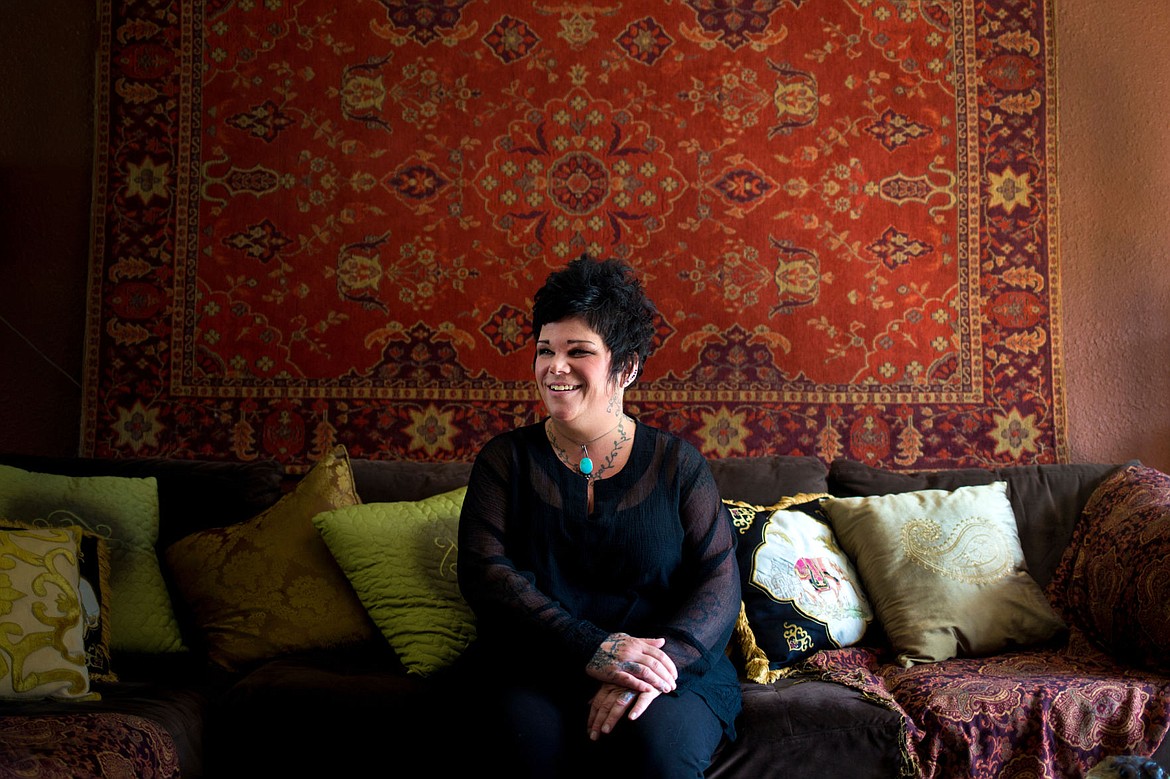
<p>Michaelle Dierich was abducted, then raped and tortured for seven days by brothers Paul Jackson and Vance Roberts in 1988 in Portland, Ore. As of Tuesday, both brothers are serving prison sentences. Dierich's mission in life is to help other victims of abuse. She is photographed here on Thursday in her Coeur d'Alene home.</p>
Michaelle Dierich sat 10 feet from one of her rapists. She held her head high and proud while he bowed his head as low as it would go.
After 25 years on the run, Paul Jackson pleaded guilty Tuesday in a Washington County court in Portland, Ore., to all counts against him in two different cases: eight counts of first-degree kidnapping, six counts of first-degree sodomy, six counts of first-degree rape, three counts of first-degree sex abuse and two counts of unlawful sexual penetration. Jackson was sentenced to 18 years in prison.
“I guess mission accomplished in a small way, in that he is off the streets for 18 years,” Dierich said of what she thinks is a very light sentence. “Was it a blow to my heart? Yes.”
Twenty-eight years ago, Jackson and his brother, Vance Roberts, kidnapped Dierich and held her hostage for a week while raping and torturing her. The men were arrested two years later in 1990 when another of their victims escaped.
Both men jumped bail and disappeared. Roberts turned himself in in 2006 and was convicted in 2008. He is now in prison serving a 108-year sentence.
Jackson fled to Mexico and was arrested in September last year by Mexican immigration authorities working with the U.S. Marshals Service. He had started his life over. His alias was Pablo Bennet Hamilton. He was married and had two daughters.
It didn’t scare Dierich to be so close to Jackson again in the courthouse. Nor did it scare her to stand up and tell her story.
“Well, he sure didn’t seem intimidating in shackles and an orange jumper,” she said. “On a personal and emotional and spiritual level, sure I was taken aback. I was shook up. But was it physically awkward? Not really, because he’s just a pathetic human being.”
When Dierich took the stand, she said it was easy to be strong. She has transformed and grown as a person from her experiences and was ready for closure.
“I really wanted to speak on the behalf of the victims that didn’t come forward,” she said. “Once I got back to my seat next to my husband I fell apart, but when I was in the moment, it felt good to be strong. It felt good to have that control over someone who had total control and dominated me. It felt good for me to have that moment, to have that control — I just used it in a good way.”
Jackson took a plea bargain for his 18-year sentence. Part of what prompted the court to give the plea deal, according to Dierich, was a letter written by Jackson’s family and friends in Mexico attesting to his character.
Dierich also said Jackson testified he was threatened by his brother to help kidnap the women, that he wasn’t in charge of the operation and he wasn’t present all the time. Dierich thinks these facts all played into the plea bargain. There was also no evidence that, in his 25 years gone, Jackson repeated the offense.
“I don’t believe it,” Dierich said. “It’s been clinically proven, and proven on all levels, that rape turns to torture and torture turns to murder. My huge concern right now is should we be looking for bodies?”
At the end of the sentencing, Presiding Judge Charles Bailey “ripped into Jackson,” Dierich said.
She was glad he told the truth. She was glad to hear the judge say Jackson was the most evil person he has ever faced.
Dierich feels bad for the family Jackson left in Mexico. Her father died when she was 8 and she knows the struggle of growing up without one.
“My heart aches for the little ones, I don’t know their ages, but my heart breaks for them,” she said. “I know what it’s like to not have a dad, and I watched my mom be a young widow. I imagine that his wife is going through the same thing, not in death, but it might as well be.”
Dierich has tried to reach out to Jackson’s wife and kids to see if they needed any help through this process. Her phone calls to the local English-speaking newspaper in Guadalajara fell through and her emails went unanswered.
She stopped trying to make contact with them so she could focus on preparing for Jackson’s trial. Now that it’s over, she is considering trying again.
Dierich didn’t know where Jackson and Roberts were keeping her. She only saw the two bedrooms and bathroom that they let her in.
When they weren’t using her, the men locked her in an unfinished closet. She was chained to the floor by her wrists, sometimes they shackled her waist and ankles, too.
“I’m pretty savvy, I could tell I wasn’t their first victim. They were really prepared for this and they were really comfortable doing this. They worked as a team and didn’t have to speak a lot to each other,” Dierich said. “I was concerned about my fate because these guys didn’t just take a chance, they knew what they were doing. They were well-rehearsed and ready for me.”
At the time, Dierich didn’t know how long she was held by the men. She was later told they had her for seven days and six nights. She also found out Jackson wasn’t there the whole time. Investigators told her that after four days, Jackson flew back to Arizona where he lived.
It was Roberts who eventually dumped Dierich in the neighborhood where her mom lived. She ran to her mother’s place where they called the police and then proceeded to the hospital. She was 20 at the time.
It wasn’t until Andrea Hood was captured and escaped that the police found the house and identified Jackson and Roberts.
“Really she’s my hero,” Dierich said of Hood. “She was thinner and younger than me at the time. She got out of the handcuffs and jumped through a pane glass window. That brought the neighbor’s attention, to see a bloody, naked girl yelling and running up the street.”
Dierich is now on a personal mission to help as many rape and human trafficking survivors as she can.
There was evidence at the brothers’ house in Portland that at least 10 other women had been held captive there, Dierich said. But no one has been able to find them. No one has left any anonymous calls or come forward.
Part of why she was eager to catch and testify against Jackson was so she could speak for the women who this happened to.
Dierich understands why women would not want to come out about something like this, especially when it happened about 25 years ago.
Dierich had a long road to recovery after her abduction. What got her through, she said, was love. Her mother was there for her in the very beginning. As she slowly built back her confidence, she held two jobs to keep her busy and her mind off things.
She got married and moved to Coeur d’Alene. She wasn’t nearly as confident in court when Roberts turned himself in. But since then, she has a new husband and that has opened her eyes to what unconditional love looks like. That helped her heal and find the courage to stand up for everyone else in her situation.
Dierich has a few pieces of advice for rape survivors. The first is that they need to know they are survivors, not victims. Also, she said it was essential to not blame herself for what happened to her. And most importantly, Dierich said, not to justify what happened.
“You don’t have to justify your rape to anybody. I can’t tell you how many times other people try to justify it,” she said. “I’ve heard victims say ‘Yeah he got in through my window, my window was open,’ I’m like, you don’t have to justify a predator’s behavior. You don’t have to find a way to try to blame yourself or justify if somebody else is a predator.”
Dierich wants to help people who have gone through the same thing she did. She sometimes posts ads online for people who need to talk anonymously to call her or if they need a shoulder to cry on, to meet her somewhere.
She is happy how far society has come in dealing with rape survivors. There are police stations and hospitals that have rape advocates to be there to help calm and sympathize with survivors. She is happy that rape is a discussion now and people are less afraid to talk about it.
Dierich has an email address where people can reach her if they need help: [email protected]. Safe Passage, a Coeur d’Alene-based nonprofit that provides services and shelter for victims of sexual and domestic violence, has a 24-hour hotline: (208)-664-9303.
ARTICLES BY BETHANY BLITZ
Never forgotten
The events of Sept. 11, 2001 made their mark on the U.S. with unforgettable force.
Protect the victims
Groups push to address issue of human trafficking in the region
According to Jessica Tschida, founder of the Coeur d’Alene chapter of the Coalition to Abolish Human Trafficking in the Inland Northwest, human trafficking is the fastest growing criminal industry in the world.

Windermere lends Children's Village a hand for cleanup
When Janet Davis told the kids at Children’s Village the volleyball court there would be repaired and usable again, the youngsters jumped up and down and screamed in excitement.