
Creating joy through music at life's end
Katheryn Houghton | Hagadone News Network | UPDATED 9 years, 10 months AGO
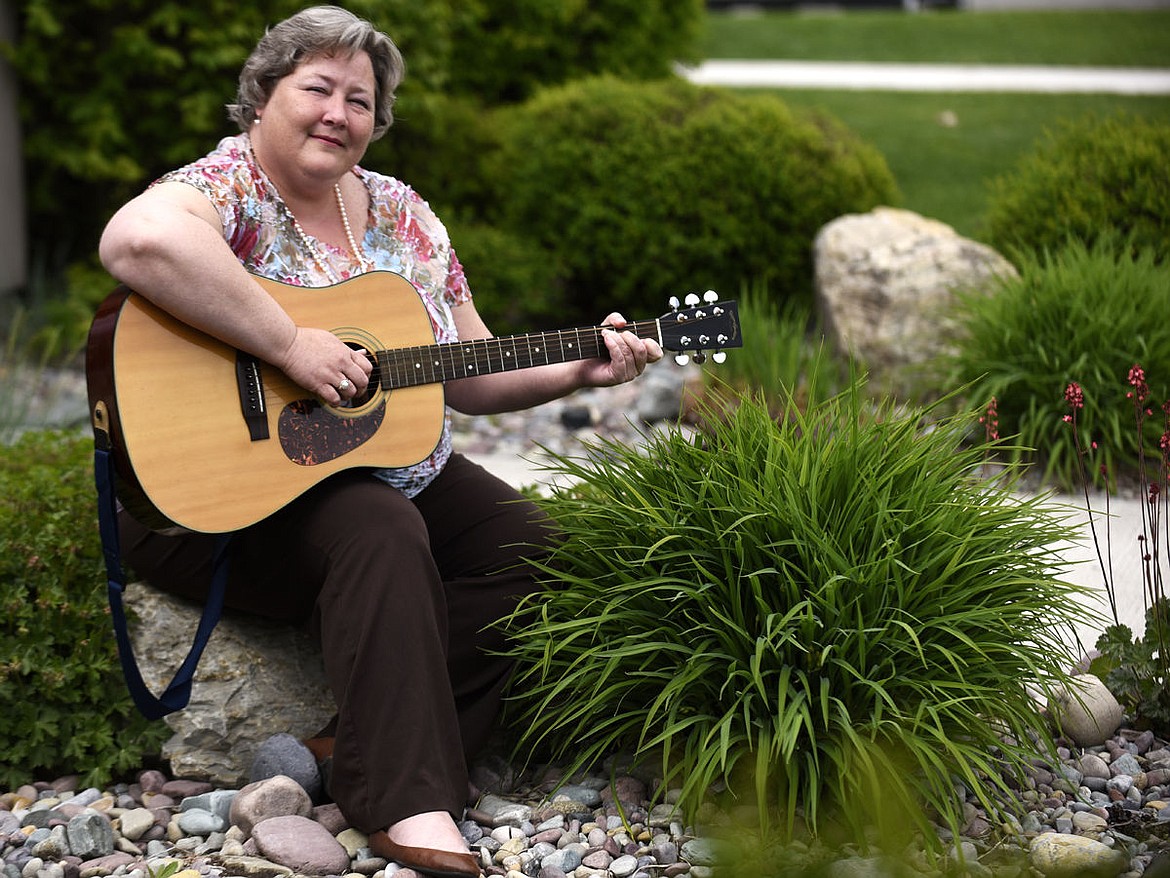
<p>Jenna Justice, the branch director of Frontier Hospice, uses music for therapy with her clients.</p>
Jenna Justice thinks about death a lot in her role as a hospice music therapist.
Justice tried to estimate how many people she has watched die throughout her 16 years working for Hospice organizations. She landed on “hundreds.”
“Our chaplain often says that the dying are our teachers,” Justice said. “If I have any zen about me, as it relates to this work, it’s because the dying have been my teachers.”
Purple maracas sat in the windowsill of her Kalispell office at Frontier Hospice. A guitar leaned against her bookshelf. Her purple sweater, pink lipstick and blue eyes matched the room’s colors.
For five years, she has worked as Frontier’s branch director.
“I really had to sell that music therapy would be a valuable position in this environment as long as we had the nurse leadership throughout, that music would add something that was missing,” Justice said.
Music therapy is the clinical and evidence-based use of music interventions to treat mental and physical health concerns, according to the American Music Therapy Association. The part of a human brain that captures music is the medial pre-frontal cortex, which shares storage space with emotions. It’s also the last part of the brain affected by dementia.
“With the brain holding on to music longer and us being emotionally attached to it, the design of our bodies illustrates really well why music is such a powerful tool,” Justice said.
Music reaches the brain’s reward center by releasing a chemical associated with pleasure called dopamine. For dementia patients, music can tap into memories. For people with autism, it strengthens their ability to the identify and express emotions.
According to the American Music Therapy Association, in 2013 there were roughly 5,000 board-certified music therapists in the nation. Today, that number is almost 6,800, according to the Certification Board for Music Therapists.
Justice said while the field is expanding, that trend hasn’t reached Montana. According to the board, Justice is one of two certified music therapists in the Flathead Valley. There are 11 throughout the state.
Justice said Montana lags behind because the West lacks music therapy programs. But she said that could also change. In 2010, there were 59 accredited music therapy schools in the country. Justice said she has heard that number is now 72.
Justice found her passion the first time she played at someone’s deathbed. She was in graduate school studying music therapy. She intended to have a career working with children — volunteering with hospice was just a step along the way.
“A hospital bed sat in the middle of the room and the family asked for songs they knew their loved one wanted. The music and that time was what everyone in the room needed, and that death became a beautiful moment,” she said.
For 11 years, the Wyoming native let her career steer her. She studied and worked in Virginia before being recruited to work in Florida offices, then Chicago. In 2009, she realized while she spent the majority of her life improving people’s quality of life, she had forgotten to evaluate hers.
“I quite my job in the middle of the recession, got in my little Corolla with my four-pound chihuahua, Pepsi, and we drove around the country for four months,” she said.
Three months in, she started looking for a home that would last back West. Justice said her patients taught her to look for joy, and living in a place that creates a sturdy structure for that joy is vital. She picked the Flathead Valley, where she said she intends to live the rest of her life.
During the day, Justice oversees a staff that serves people facing illness. In evening, she creates music for herself or takes her kayak out on one of the lakes surrounding her Bigfork home.
“I have always poured myself into the work as I’m doing it, but when the day is done I have to remember that the folks whose lives I’ve been invited into, I have to close the door and open the door into my own life,” she said.
Though she tries not to carry sorrow home, Justice said she doesn’t avoid talking about death. She has written out what type of care she wants when she’s dying, how she wants people to treat her and what she wants her loved ones to know. More importantly, she knows what her family members want when they die.
She said living in a death-denial culture makes a very natural moment in life turn into a crisis.
“I’ve learned life and death aren’t as big of a deal as we make them to be. It’s all the stuff in between that should be a big deal,” she said. “I’ve been taught that if you’re putting value in those things, joy, community, relationships, that’s what’s going the what’s most important to you when you’re dying.”
Reporter Katherine Houghton may be reached at 758-4436 or by email at [email protected].
ARTICLES BY KATHERYN HOUGHTON
Bigfork works to create map of town's defibrillators
The Bigfork Fire Department has paired with the Chamber of Commerce to create a map of defibrillators throughout town.
Bigfork ministry searches for more volunteers
As a Bigfork ministry grows, its leaders are looking to fill the gaps in mentors reaching out to support teens throughout the Flathead Valley.
Helicopter crashes near Yellow Bay
No one was injured in a helicopter crash near the Yellow Bay area over the weekend, according to the Lake County Sheriff’s Office.