
Don Fry reflects on his baseball coaching days
Katheryn Houghton | Hagadone News Network | UPDATED 9 years, 10 months AGO
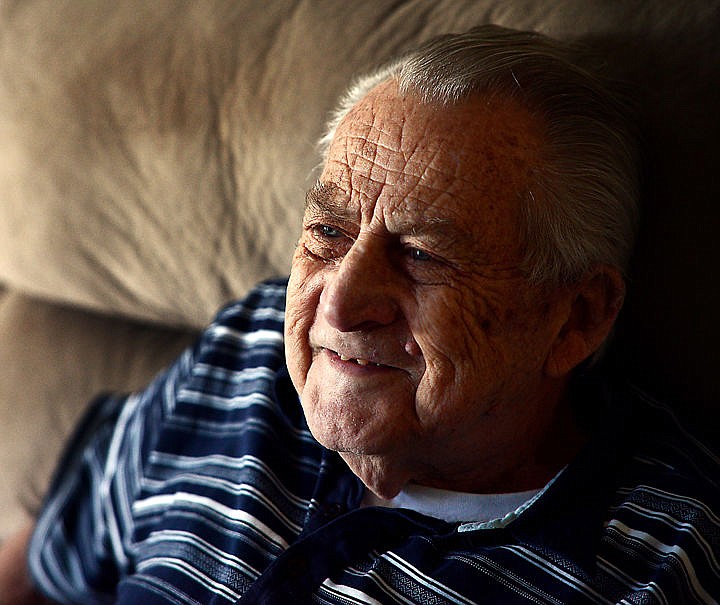
<p>Don Fry in his home at Prestige Assisted Living in Kalispell on Monday, May 2. Fry was a local Pee Wee baseball coach for 43 years.</p>
Don Fry taught two generations and hundreds of kids how to play baseball, even though he never had the opportunity to play on a team.
“When I was a kid, baseball was reserved for men, adults,” Fry, 88, said. “The game didn’t make its way to kids until after WWII. And they needed coaches, so I coached.”
Fry joined his father in the effort to bring organized baseball to children during a time that baseball fields were empty lots in neighborhoods and bases were drawn in the ground.
Today, one of five Pee Wee baseball fields in Kalispell carries the Fry name, in honor of the family’s effort that propelled Kidsports in the Flathead.
Though Fry ended his 43 years of coaching Pee Wee baseball in 1995, his home has scattered remnants of a ball park.
A jar of peanuts sat on his kitchen counter. A baseball with signatures across its leather was in a case outside his living room door. One of the thousands of trophies his teams won sat next to the ball.
As Fry talked, he picked up a baseball that sat next to his recliner.
“It feels best to hold it with your fingers on its stitching,” Fry said, rotating the ball in his hand and going back into coaching mode. “You can get a good curve this way.”
His generation learned the rules of the game by watching their dads play on a team — something that disappeared when the war began.
“I think when the guys came back, it was a good time to have baseball,” Fry said. “The war made a different kind of world. But it also brought baseball back for kids, many who didn’t have a lot of other things.”
In the late 1940s, Fry’s father heard Pee Wee teams were forming across the nation. He waited for the trend to hit Montana. When it never did, he began creating his own teams with kids from throughout the city’s neighborhoods. Fry, 25 at the time, joined his dad’s efforts.
It began with a few families down the street and grew into teams representing neighborhoods from around the valley.
The game created a place for kids to play when money was tight. A bat, ball and shared glove was all they needed, Fry said.
“It gave kids a chance to travel when that hadn’t been an option,” Fry said. “The community pulled together gas rationing cards when it was hard to come by so that we could take kids to games in places like Canada and Washington.”
Fry didn’t love baseball. But it taught kids how to work as a team and how to interact with each other, he said. Brothers played together after school and neighborhood kids began forming communities.
“There wasn’t a whole lot to the game unless you were playing it,” he said. “ But like all sports, baseball teaches kids how to get along, and how to improve and keeps them out of trouble.”
Most of all, it was fun for the kids, he said.
At 10 years old, Rob Sloan walked from his house across the street to the baseball field his uncles had created. Under Fry’s watch, Sloan was ready to try out for a team. He was matched with other neighborhood kids and stayed with the Pee Wee team until he was old enough for little league.
“Thanks to this guy,” Sloan said nodding toward Fry, “I really got to watch baseball unfold in the valley. He taught me the game along with hundreds of others.”
By the time Sloan was old enough to pick up a bat and join a team, there were six Pee Wee teams, he said. A field with lights had been installed, making the kids feel like professionals.
Sloan said learning the game from his uncle was easy-going but very organized.
Fry taught Sloan the basics. Sloan said he remembered looking to his uncle from the outfield for signals for what to do next — a tug of the ear meant stay on base. From the pitcher’s mound, if Sloan saw Fry tug on his belt buckle, he knew to throw a curveball.
“If he signaled to steal, that’s what you did,” he said.
Sloan said baseball has remained a part of his life. When Sloan had kids, he joined the family tradition and began teaching Pee Wee baseball for this children and their friends. When his kids had kids, he helped teach grandchildren how to play.
“Baseball is just one other thing that the greatest generation taught us,” Sloan said. “Thankfully, it’s become a part of our family and this town.”
Reporter Katheryn Houghton may be reached at 758-4436 or by email at [email protected].
ARTICLES BY KATHERYN HOUGHTON
Bigfork works to create map of town's defibrillators
The Bigfork Fire Department has paired with the Chamber of Commerce to create a map of defibrillators throughout town.
Bigfork ministry searches for more volunteers
As a Bigfork ministry grows, its leaders are looking to fill the gaps in mentors reaching out to support teens throughout the Flathead Valley.
Helicopter crashes near Yellow Bay
No one was injured in a helicopter crash near the Yellow Bay area over the weekend, according to the Lake County Sheriff’s Office.