
Glacier trout study comes with alarms, pleasant surprises
CHRIS PETERSON | Hagadone News Network | UPDATED 9 years, 2 months AGO
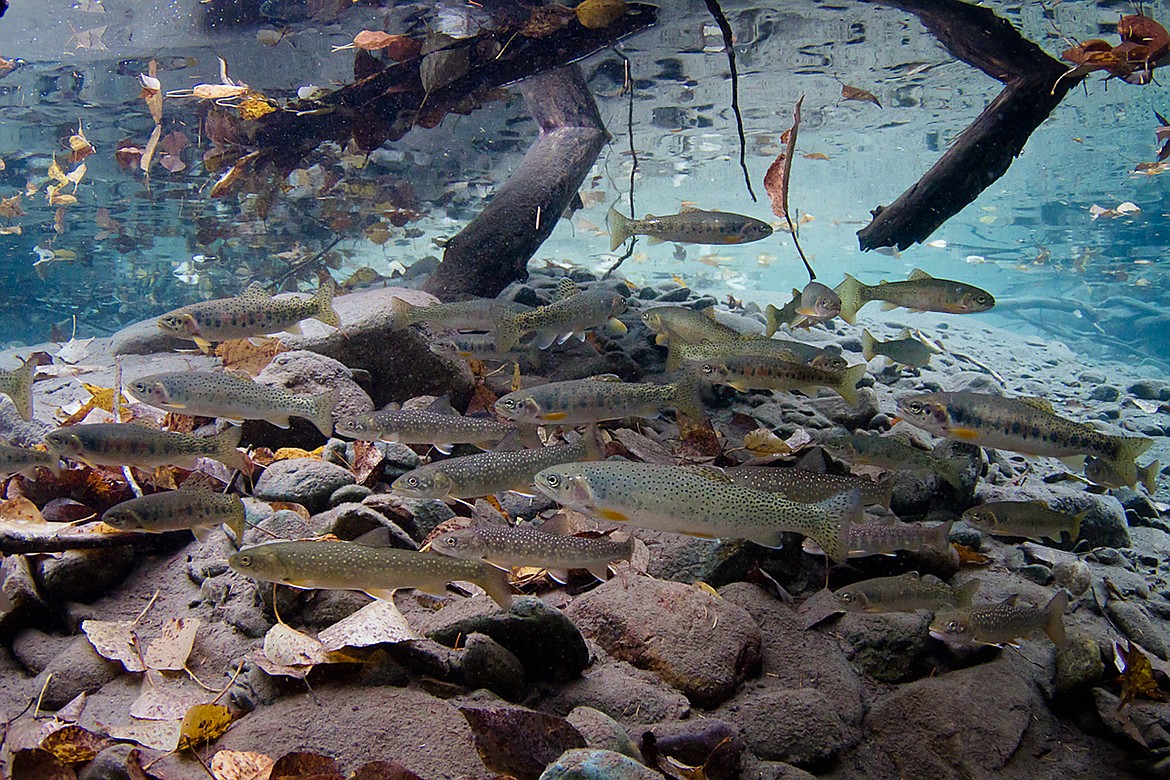
Westslope cutthroat trout swim in a gin-clear Glacier Park stream. A bull trout is at the bottom of the school.
Chris Peterson is the editor of the Hungry Horse News. He covers Columbia Falls, the Canyon, Glacier National Park and the Bob Marshall Wilderness. All told, about 4 million acres of the best parts of the planet. He can be reached at [email protected] or 406-892-2151. | October 6, 2016 8:04 AM
U.S. Geological Survey scientists Vin D’Angelo and Clint Muhlfeld were wading up Valentine Creek in Glacier National Park when they came upon a pool close to where two forks of the stream came together. Valentine Creek is no picnic to get to — it’s not close to any road and is notoriously brushy, draining the east side of Jefferson Pass.
But in that pool, even above barrier falls, they found fish — non-native fish — Yellowstone cutthroat trout, stocked decades ago.
From 2010 to 2012 D’Angelo, Muhlfeld and a team of young biologists surveyed the entire park in the most comprehensive study of native westslope cutthroat in Glacier that’s ever been done.
The study was designed to get a baseline of the westslope’s health in Glacier. Westslope cutthroat, the native trout of western Montana, faces a myriad of threats, from climate change, to hybridization to competition from non-native species.
In Glacier, the greatest threat is from inbreeding with non-native species like rainbow trout and Yellowstone cutthroats.
Muhlfeld notes that for decades, millions of fish — most of them non-native — were stocked in the Glacier intentionally. The Creston Hatchery on the west side was once the hatchery for the Park.
“They planted everything under the sun,” he noted.
Over time, fisheries management philosophies evolved and today in Glacier, the emphasis is on preserving and protecting native species like the westslope cutthroat trout. But biologists a few years ago, didn’t know how well westslopes were actually doing after the stocking era. Former biologist Leo Marnell years ago had studied the Park’s lakes, but many of the streams hadn’t been thoroughly surveyed, Muhlfeld noted.
So the U.S.G.S., with help from a Park Service grant, embarked on a complete survey of the Park, most of which was done by good old fashioned hook and line — dry fly fishing, to be exact. Westslope cutthroat like sunny, warm days D’Angelo noted and are relatively easy to catch. So biologists waded hundreds of miles of streams, catching fish in set intervals. Ideally, they looked to catch about 30 fish in each one-kilometer section they fished to ensure a good genetic sampling. But on average, they caught about 20, D’Angelo noted.
While westslopes are prone to hybridization, it’s often impossible to tell a crossbred fish just by looking at it. Biologists took a sample of tissue from each fish’s fin, and they were released.
The results of the study were published earlier this year.
What they found was both surprising and alarming. The surprise, Muhlfed noted, was that despite the decades of stocking, on the west side of the Park, in the Middle and North Fork of the Flathead drainages, there were still robust populations of native westslope cutthroat trout. One noted population is in Upper McDonald and Mineral creeks, which are separated from the threat of hybridization with rainbow trout by impassable waterfalls.
There are also several lakes on the west side of the Park that have pure strains of westslope cutthroat and a few streams in Canada that flow into the North Fork that have pure strains as well.
Other streams and lakes, such as Akokala, have pure strains of westslopes, but are at high risk of hybridization because non-native rainbows exist in the North Fork.
Once hybridization starts, it’s impossible to reverse, Muhlfeld notes. Hybrids aren’t as robust of a fish because they don’t carry the genes that have made westslopes so adaptable over thousands of years. The hybridization takes off in low water years, Muhlfeld notes. His theory is that rainbows are adapted to spawning as spring water flow rise, while westslopes are adapted to spawning as spring water flows drop.
In a normal year, rainbow spawning beds get washed out by high water. In a low water year, however, they don’t, which sets the stage for cross-breeding with cutthroats, diluting the gene pool.
Rainbows have so thoroughly infiltrated east side waters, that westslopes could cease to exist in a pure form.
“Cutthroat trout populations in the Missouri and South Saskatchewan River drainages appear to be at imminent risk of genomic extinction, as only a few populations remain in spatially limited stream habitats and those populations are generally at risk of invasive hybridization,” the study found.
Two of those streams are Railroad and Midvale creeks. In Railroad Creek, the westslopes are threatened by non-native brook trout; in Midvale, by invading rainbow trout that can get into the creek through a diversion dam.
Managing these trout populations into the future is a delicate business. There is no blanket method for conservation. In the South Fork of the Flathead — another westslope cutthroat stronghold, Montana Fish Wildlife and Parks has used fish poisons to kill some lakes and streams with hybrids. The purged lakes are then re-stocked with native fish.
That method could be used in Glacier. Other methods include artificial fish barriers, that stop the migration of non-native species. Glacier has already used those methods in Akokala and Quartz lakes to conserve trout.
A third method is to simply move fish to suitable habitat. Glacier is currently experimenting in Grace Lake with that — they’ve moved bull trout — another native species in trouble — into Grace in an attempt to start a population there.
The Park is working on a comprehensive fisheries management plan. It emphasizes conservation of native fish and it will utilize the data in this study in prioritizing future westslope conservation efforts, noted Park fisheries biologist Chris Downs.
ARTICLES BY CHRIS PETERSON
Columbia Falls concerned sewer system could be bottleneck for growth
The City of Columbia Falls could see a significant bottleneck in future growth due to its sewage treatment plant, depending how the city and the state calculate the sewage treatment plant’s maximum treatment capacity without a major upgrade.
Columbia Falls City Council tables e-bike law
The Columbia Falls City Council last week voted to table a city ordinance that would restrict e-bikes and e-motorcycles along with other electrically powered vehicles on its sidewalks and city parks.
Oh, Christmas tree!
I usually talk to my mother on the phone once a week or so. She lives alone in Florida and works for a church doing funerals part-time.