
Lakeland staff learns about trauma's victims
Bethany Blitz Staff Writer | Hagadone News Network | UPDATED 9 years, 2 months AGO
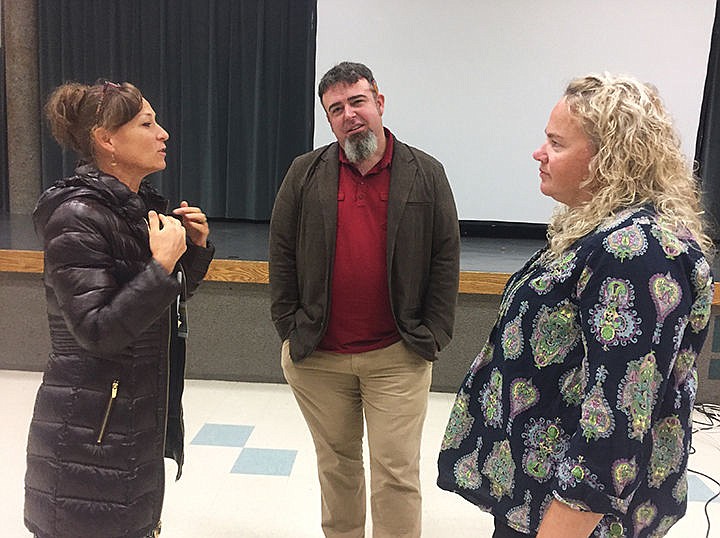
<p>Lakeland School District Superintendent Becky Meyer, left, talks with Erik Gordon, middle, and Genie Huntemann after the trauma and resilience training Friday. The presentation showed Lakeland staff how a trauma-sensitive approach to teaching can benefit the school.</p>
Trauma in a child’s life can take many forms; abuse, poverty, sick relatives, a house fire, having to move frequently.
When students lash out, according to Tracey Sutton, a clinical supervisor at Heritage Health, the outburst often has more to do with what’s going on in that student’s environment than it does the other person.
Last Friday, more than 600 Lakeland School District staff learned about what kids with trauma-filled lives need to succeed in school. Heritage Health, which has a mobile care unit that works with the district, helped plan the training.
“More than anything, I hope the staff were able to take away that when kids experience emotional difficulty, their ability to learn and take in information at that time becomes compromised,” Sutton said. “Kids can be triggered by well-meaning adults, and adults personalize it and think they’re being disrespected.”
During the training, Lakeland staff watched the documentary “Paper Tigers,” which follows the lives of a few students from Lincoln Alternative High School in Walla Walla, Wash., while a trauma-sensitive program was being implemented. The film showed the severity of some of the kids’ situations and how their teachers developed relationships with them, giving them support when no one else would.
After the film, Erik Gordon and Genie Huntemann, both teachers at Lincoln Alternative High School, gave a presentation about how their school has built a safe and supportive environment for its students.
“A kid’s behavior in the classroom might not be a choice,” Huntemann said. “And discipline may not be the best option.”
Gordon, a science teacher, presented information about how the brain develops, especially when under constant stress. He said the part of the brain that recognizes danger is the emotional part of the brain. In times of stress, it shuts down the front of the brain, which is where reasoning happens.
When a child is under chronic stress, when their fight or flight senses are activated constantly and unpredictably, the front part of the brain is constantly blocked. Something very small and seemingly insignificant can easily trigger that child, Gordon said.
Throughout the presentation, Gordon and Huntemann shared stories about how they worked with different students. A big part of their message was to develop meaningful relationships.
“The importance of building a relationship with these kids is more important to me than my job,” Gordon said. He wants his students to be able to approach him with their problems and be able to focus on school.
Gordon and Huntemann said the number of suspensions, fights and police-involved incidents has decreased dramatically since their school implemented the trauma-sensitive program.
Lisa Sexton, Lakeland School District’s assistant superintendent, said she wanted staff to go to this training because it could help educators, and anyone else in the district, reach out to students in need.
“Schools are a mirror of society and it’s the responsibility of schools to address social issues,” she said. “There are more mental health issues nowadays and adult drug abuse...There are populations of kids that come to us in poverty, whose parents are incarcerated, who have been sexually or physically abused and there’s a need for schools to respond.”
During the presentation, Timberlake High School English teacher Jenn Jenson couldn’t help but be proud of where she works. She said staff members at her school strive to be intentional with their actions.
“They spoke about intensity of relationships like an out-of-the-box idea, and I’m proud we do it here naturally,” she said. “I’m looking for ways I can consistently be slowing myself down so I can see where the kids are at and what they need from me at that moment.”
Krista Bullard teaches at Mountain View Alternative High School and had already seen “Paper Tigers.” She said she’s happy the rest of the district is now on board with how to help at-risk students. She’s especially excited that Friday’s lesson could be incorporated into the elementary schools as well.
“It’s never just a bad kid,” she said. “Everyone learns better when they know they’re cared for.”
ARTICLES BY BETHANY BLITZ STAFF WRITER
Lethal flu season hits Idaho hard
Flu kills, and this year in Idaho, it’s particularly deadly.
Project inspires bright futures
Idaho schools now have some extra help providing students access to opportunities.
Training for heavy jobs
Idahoans could get a major boost in their industry credentials with the Heavy Equipment Operator School this summer.