Journalists sky high on refueling mission
Sholeh Patrick Staff Writer | Hagadone News Network | UPDATED 9 years, 2 months AGO
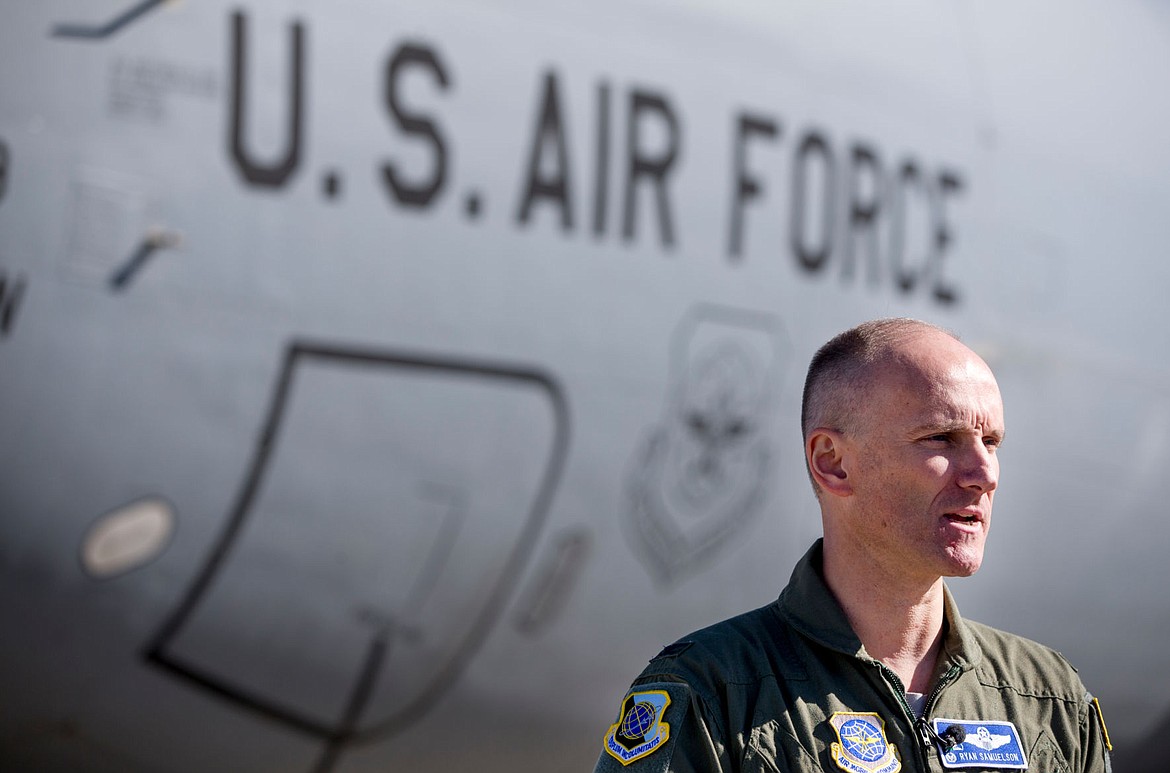
<p>Air Force Col. Ryan Samuelson, 92nd Air Refueling Wing commander, talks with the media on Fairchild Air Force Base after an aerial refueling training mission on Tuesday. Samuelson took command of the 92nd Air Refueling Wing in July.</p>
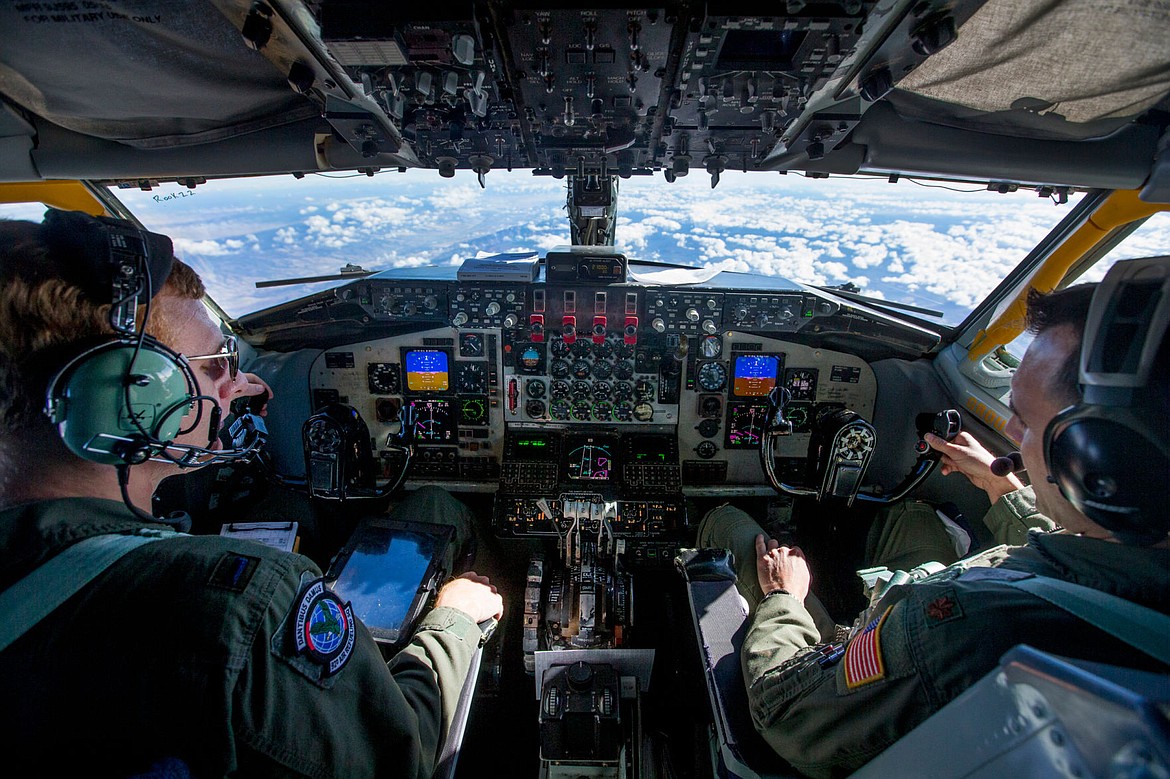
<p>Air Force Pilots Lt. Adam Less, left, and Maj. Denique Asion fly the 92nd Air Refueling Wing's KC-135 Stratotanker above Central Oregon during an aerial refueling training mission on Tuesday.</p>
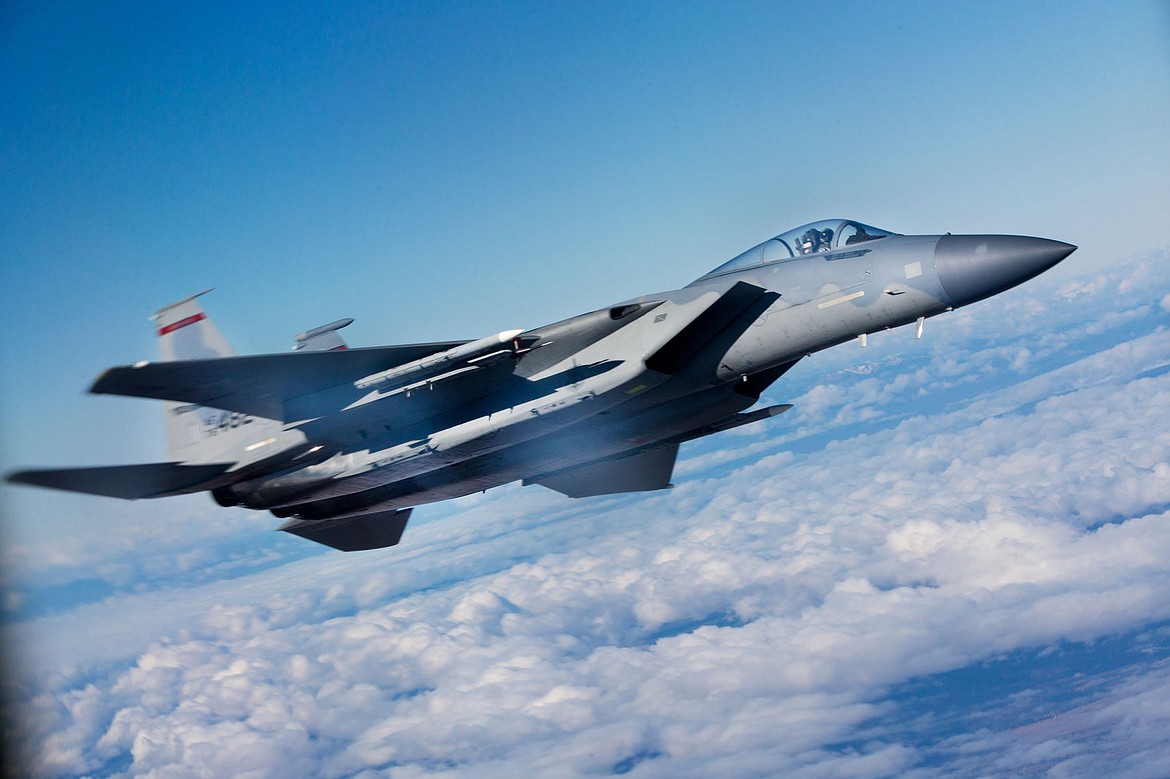
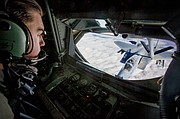
<p>Seen out the window of the KC-135 Stratotanker, an F-15C Eagle fighter jet flies in formation as another F-15C is refueled during an aerial refueling training mission on Tuesday.</p>
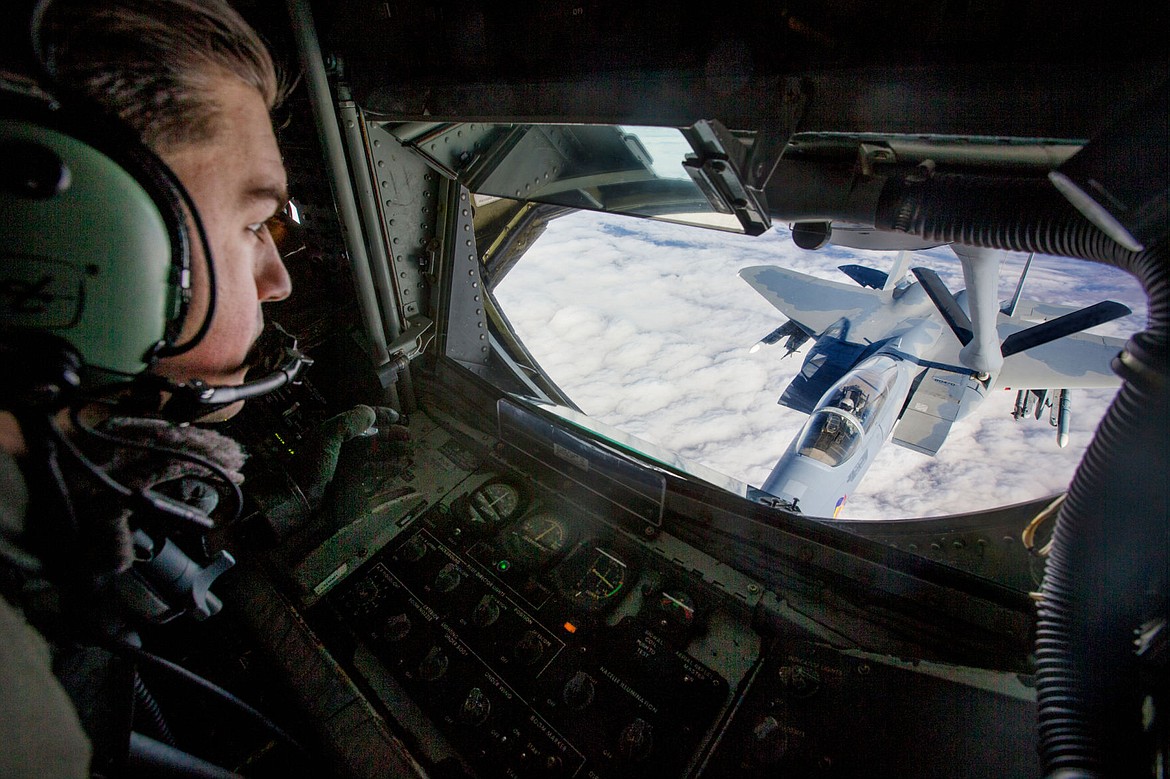
<p>Air Force Senior Airman Tim Weber operates the refueling boom as it refuels a F-15C fighter jet at an altitude of about 24,000 feet during a training mission on Tuesday. Weber and the pilot of the aircraft being refueled communicate via lights, hand signals and vocal commands as they complete the refueling process while the two aircraft match their speeds of about 500 miles-per-hour.</p>
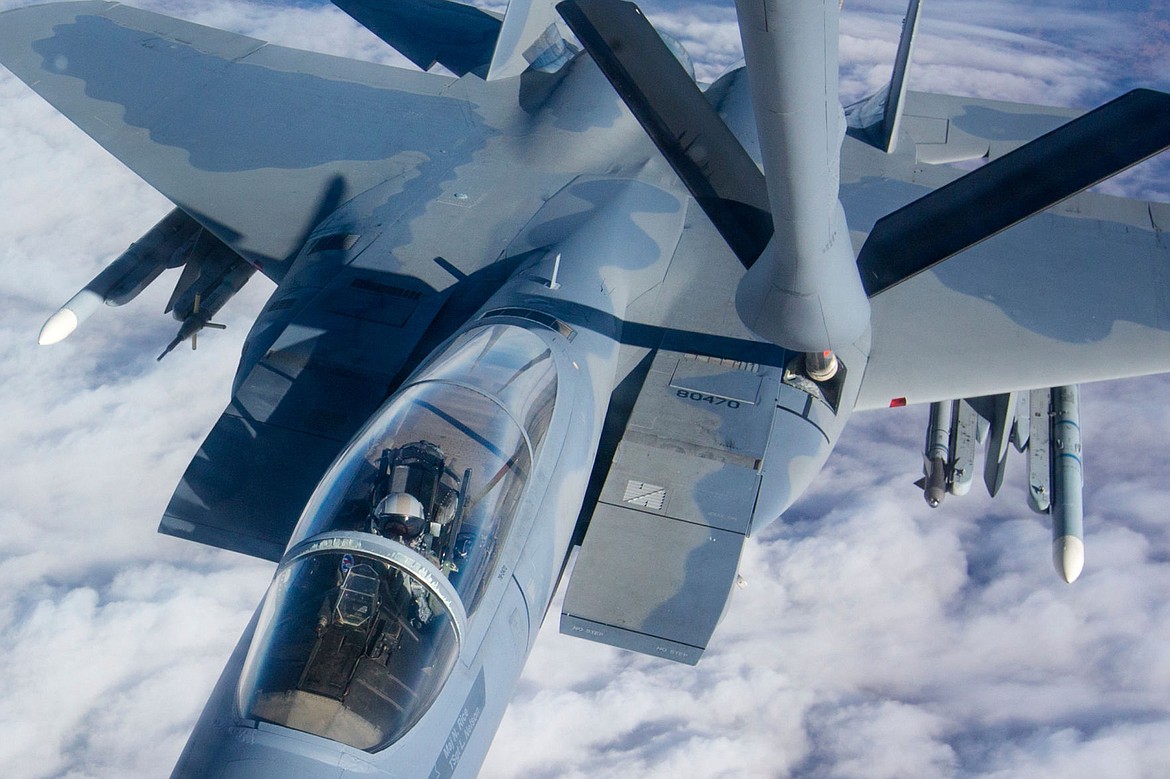
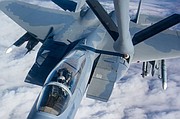
<p>The refueling boom from the KC-135 Stratotanker, operated by the 92nd Air Refueling Wing of Fairchild Air Force Base, is docked securely into a F-15C Eagle fighter jet during a training mission on Tuesday. The boom, located in the rear of the Stratotanker, can pump up to 6,500 pounds of fuel a minute to a docked aircraft.</p>

<p>A KC-135 Stratotanker, operated by the 92nd Air Refueling Wing at Fairchild Air Force Base, is prepped for a refueling training mission on Tuesday. First used by the Air Force in 1965, KC-135 Stratotankers provide aerial refueling, aeromedical evacuations, crew transportation and other forms of assistance worldwide.</p>

SPOKANE — Maybe there was a ghost in the mission, if not the machine.
Like a bunch of eager schoolkids on a field trip, a handful of journalists arrived well before 0600 Tuesday at Fairchild Air Force Base, ready to witness the refueling of F-15 Eagles from the back end of a tanker at 28,000 feet over Washington and Oregon. Smooth sailing? It shouldn’t have been, and yet, it was.
Roll call: Check. Safety briefing: Check. Crew: Ready. De-icer: Check. Ninety-minute preflight... Uncheck. Moments before we were to board the KC-135 Stratotanker, the pilot pulled Wing Commander Col. Ryan Samuelson aside. Malfunctioning instruments.
“The aircraft is broken,” announced Staff Sergeant Shawna Sims, a 26-year-old boom operator (the boom is a stick-like apparatus extending up to 47 feet to fuel receiving aircraft). “It’ll take two hours to fix, but it’s OK; we’ve got another aircraft ready for you.”
That aircraft wasn’t the famous Spook 50, much to my chagrin. More on that later.
Plan B had us aboard — within minutes of the reported problem — another KC-135 originally slated to fly with us in formation. That changed flight plans for both aircraft, which was no problem for the 92nd Air Refueling Wing of the United States Air Force. We departed on schedule, flush with extra crew, although the KC-135 needs only three to operate its missions.
That was just the first hitch solved in a flash.
“That flexibility and adaptability is what’s so unique about the U.S. Air Force,” said Col. Samuelson, who has served worldwide and observed how other military forces operate. “It’s what makes us different; we can make things happen quickly by empowering junior officers to make these decisions.”
Hitch two happened midflight. But first, a little about the boomer.
This mission’s two boom operators were Senior Airmen Tim Weber and Chris Shelton — both with more than 1,000 hours and 120 combat missions to their credit, and both flying their very last mission for the 92nd. Airman Shelton and his wife, Samantha, also in training as a boom operator, have been reassigned to Mildenhall, a base in the United Kingdom. This move will unite the pair, who’ve been living apart while stationed in different cities.
Airman Weber is separating to study sustainable architecture at Columbia University.
“It’s been so much fun.” said Weber, lauding the military for giving him a strong work ethic and mature approach toward his education. “But I’m not a huge fan of war; seeing that has made me want to live a lifestyle that betters humanity.”
Picture a Boeing 707 (that’s what the Stratotanker design is based on), gutted, with a mini stairwell leading under the floor at the back end. Underneath is a crawlspace with a couple of stretcher pads, a mini instrument panel, and a clear view of sky inches away. The boomer lies flat on his or her stomach, head up, like an emerging swimmer. Alongside to the right is a joystick-style lever which controls the direction of the boom — both rudder and elevator control, a.k.a. the ruddervator. Left hand goes on the actuator, another control which extends the boom. In front are gauges indicating the position within the “receiving envelope” — the space within which the receiving aircraft can be refueled within 10 to 40 minutes, depending upon needs. The Stratotanker has been tested at a capacity of seven days in flight and 36 refuelings.
That’s a long way from history’s first air refueling in 1921, when a man climbed off the seat of an airborne biplane with a five-gallon gas can strapped to his back, wingwalked, and dropped it to the waiting aircraft.
Speaking of winging it, on to hitch number two. After the KC-135’s fourth F-15 refueling (“F” for fighter, “K” for tanker, and “C” for cargo), we had a “delayed disconnect” — the boom operator clicked the disconnect switch, but it didn’t work. The F15 pilot tried it from his end; then there was an abrupt snap when it came off improperly. The rules say that’s it for boom operations, so no more refuelings for us.
Flight aborted? No way. Remember that “broken” aircraft? All fixed. In the air and on its way, soon flying in formation, demonstrating a refueling right alongside us. This time instead of a rear view, we got a bird’s-eye. Yeah, cool. Again, minutes between hitch and solution, no stress.
So what’s midair refueling like? As low-key as our crew’s demeanor; so smooth you hardly feel it. None of those jerky position changes you feel in civilian planes. If not for the boom operators walking to and fro, it was hard to know it was happening. Plus the F15s were close enough to see the pilot’s skin tone. Little hint.
“For refueling you need smoother transitions while continually communicating with receivers (in the fueled aircraft),” said Lieutenant Adam Less, our KC-135 pilot who landed nice and easy (landings aren’t easy, as pilots in training quickly discover). “The goal is to be as stable as possible, such as with airspeed changes.”
The world’s best pilots the USAF may have, but to be fair, the airplane deserves a little credit.
Few look this good at 60, but don’t let age fool you. The KC-135 may be twice the age of her typical crew, but that original airframe gleamed as shiny as her state-of-the-art avionics. (So did the floor; we could practically see our reflections in it.) Her beauty’s backed up by substance; we felt nary a ripple as two CFM-56 turbofan engines cut the clear air.
This isn’t your grandfather’s tanker.
Your grandson’s, maybe. Wing Commander Samuelson is a third generation military man, following the footsteps of his grandfather and uncle. His father was a pilot who worked for jet manufacturer Lear, and his mother sold avionics.
“I literally grew up at the airport,” said Col. Samuelson, who made his USAF career choice at age 6. He didn’t dally; after growing up in Petersburg, Ill., he did ROTC at Purdue University. Immediately after earning his engineering degree he began his military service, which has taken him across the world, including more than 2,000 flying hours in eight types of aircraft, and earned him six medals.
Some of those hours likely included Spook 50, a KC-135 at the 92nd named for the last three digits — 050 — of the “N” number sported on the tail. She sat unobtrusively on the tarmac, holding her place in line among the others. You can’t tell to look at her, but — seriously — she’s haunted.
The story is pretty straightforward: a navigator killed in the days before GPS and fancy equipment; the glass covering his chart shattered. They say he never left the aircraft, haunting Spook 50 ever since. Stories of footsteps and mysterious sounds and shadows abound ever since, but there is a more tangible element today — electrical quirks. Switches flipping without being touched, lights flickering, weird stuff the other planes don’t seem to do, or not as often. Sgt. Sims told us the story of one officer she knows who swore he saw the ghost walking by. But she takes it in stride.
“People want to talk trash about her, but she’s a good jet.”
•••
Sholeh Patrick is a Press columnist, a pilot and a member of the Coeur d’Alene Airport Advisory Board.
ARTICLES BY SHOLEH PATRICK STAFF WRITER