
Tester meets with niche producers, farmers
HEIDI DESCH | Hagadone News Network | UPDATED 9 years, 12 months AGO
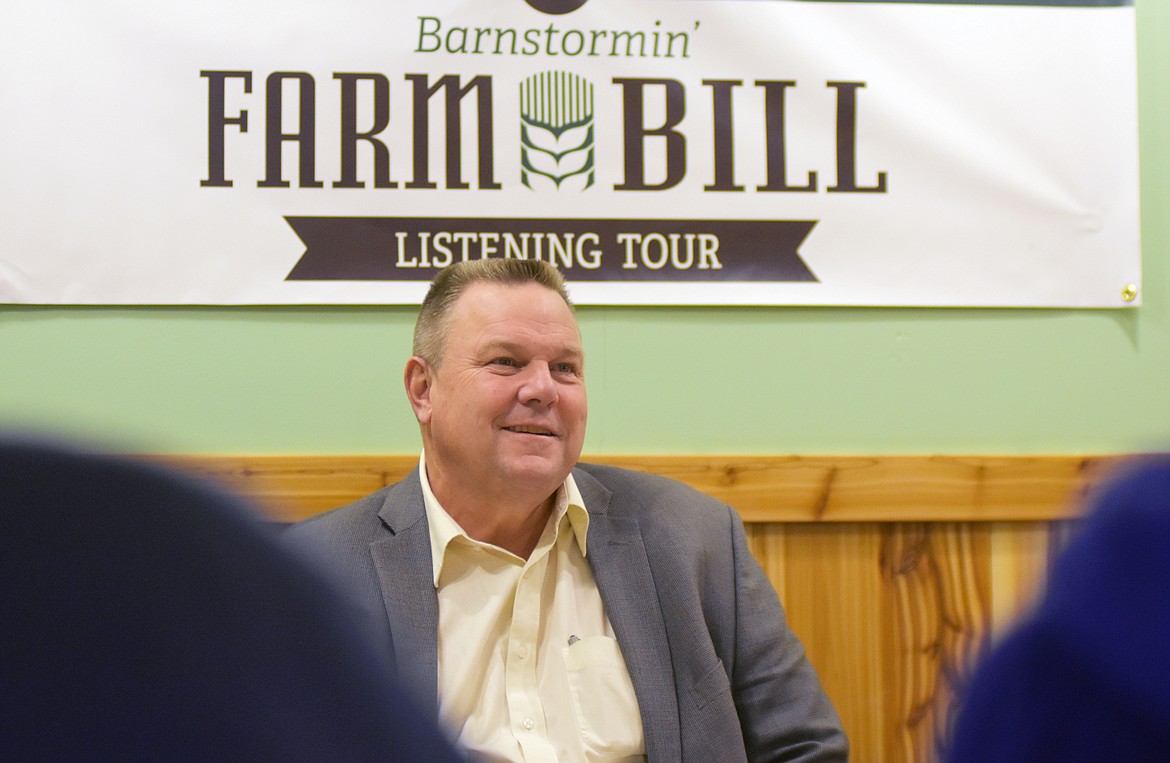
U.S. Sen. Jon Tester listens to a comment Thursday during a listening session on the Farm Bill at Glacier Hops Ranch south of Whitefish.
DEPUTY EDITOR, FEATURES Heidi Desch is the Deputy Editor at the Daily Inter Lake, overseeing coverage of arts, culture, lifestyle, community, and business. Desch leads reporters in developing stories that highlight the people, traditions, and events shaping Northwest Montana, guiding content across print and digital platforms. With more than 20 years of journalism experience, including serving as managing editor of the Whitefish Pilot, Desch is a graduate of the University of Montana School of Journalism. She has received multiple Montana Newspaper Association awards, including part of the team leading the Daily Inter Lake to Best Daily Newspaper in Montana Award and the General Excellence Award in 2024 and 2025. IMPACT: Heidi’s work connects readers with stories that deepen the understanding of the community beyond daily news. | October 26, 2016 8:38 AM
Montana farmers and producers face increasing pressure from international competition and navigating the bureaucracy that comes with the federal grants that could assist them is a challenge.
That was the message a group of specialty crop producers and farmers told U.S. Democratic Sen. Jon Tester Thursday during a listening session at Glacier Hops Ranch south of Whitefish.
Mike Jopek, owner of Purple Frog Gardens, said there needs to be more focus on helping small farms. Large producers want access to bigger markets, but for his farm that doesn’t make sense, he noted.
“Some of us don’t have an international market,” he said. “For some of us our market is Whitefish. We can’t compete with international vegetables. When country of origin labeling left the beef industry that was an issue. I hope we don’t lose that for the vegetable labels.”
Andy Sponseller, owner of Ten Spoon Winery in Missoula, said he doesn’t want the wine he produces in larger markets because he says that model is not sustainable, but he is facing increased pressure from international wines flooding the marketplace.
“The small businesses are the fabric our of state and we have to have a different priority,” he said. “Anything we can do to encourage the use of Montana made, grown and raised products. How do we get the guy down the street to eat the vegetables grown here, drink the beer with the hops grown here and the wines that are made here?”
Tester’s stop in Whitefish was part of a statewide listening tour on the Farm Bill. Specialty crop producers who joined the discussion raise hops, grapes and fruits that traditionally have not been a part of Montana’s production agriculture landscape.
Congress passed the last Farm Bill in 2014 and beginning next year Congress will hold hearings on a new bill. The last Farm Bill was nearly $1 trillion and with agriculture contributing as much as $2 billion annually to Montana’s economy the bill could have a big impact on the state.
“The Farm Bill ends in 2018 and that seems like a long time, but it’s not,” Tester told the roughly two dozen people gathered for the session. “I think the conversation is going to start early that’s why I wanted to get around the state and visit about what works and what doesn’t.”
“We’ll try to make a difference,” he added. “We need to have a thoughtful discussion about where we want to go rather than being reactive.”
A common frustration amongst the farmers and producers who gathered inside a small farm building at the hops farm was issues revolving around grants that could benefit their operations. Concerns included the timing of deadlines for grants that often hit during peak production season, unfair administrative costs associated with the grants and a lack of grant money for those creating value-added products or producing niche crops.
Kathy Hadley, executive director of the Butte-based National Center for Appropriate Technology that promotes sustainable solutions, said one of the biggest complaints she hears is from producers applying for grants that the deadlines fall in summer when they are the busiest. The grants aren’t going to small farmers either, she added.
“They expect the grantee to have zero administrative costs [spent from the grant],” she said. “That’s why 75 percent of the grants go to the university system because they can handle the administrative costs.”
Tester said grant money needs to be spent the way it’s intended, but “we need to make sure that money gets to the ground.”
Sue Snow owns Tabletree Juice, a juicing facility in Bigfork, that plans to assist Flathead cherry growers by turning culled cherries into juice. She said the business faces a challenge in that most grants are designed to assist the producer rather than the businesses looking to assist those farmers through creating value-added products.
“Farmers lose a lot of money from the fruit and vegetables they have to cull, but they’re still viable and can be used,” she said.
Tom Britz, owner of Glacier Hops Ranch where the event was held, said alternative products like his own face challenges and he has witnessed those in getting his operation up and going. Britz’s property has been part of a state Department of Agriculture grant to experiment with different processes for hop growth. He said flexible grant programs would assist small producers so they could better react to the market opportunities for their crops.
There isn’t a shortage of demand for hops, he said, but growing and harvesting the hopes can present problems.
“There’s one new brewery opening [in the country] every nine and a half hours,” he said.
“You got to love it,” Tester interrupted.
“Craft breweries use 10 times more hops than corporate beers, so we can sell whatever we can produce,” Britz continued. “There is building markets for these crops, but the difficulty is that a niche crop can take $18,000 per acre to establish.”
Following the more than hour-long session, Tester called the meeting productive.
“I took four pages of notes,” he said. “There’s some things we can to do to influence the laws being written. That’s why we’re here rather than at the 11th hour.”
ARTICLES BY HEIDI DESCH

Whitefish wildfire protection plan up for City Council review
Fourteen areas of concern that are primed for mitigating wildlife risk are at the center of a draft Whitefish Community Wildfire Protection Plan.

Kalispell resident advocates for more women in the trades after being crowned Mrs. America
Standing on the stage in Las Vegas, wearing a white formal gown accented with feathers on one shoulder, Qadra Evans gripped hands with a fellow competitor.

Whitefish mulls updates to community growth plan
Whitefish City Council on Monday will consider updates to its community plan including language that looks to protect the historic character of its downtown amid state requirements allowing buildings up to 60 feet in height in certain zoning districts.